- Sun, 25 October 2026

What if the most credible thing about you is not what you have built, but what you have rebuilt?
Most leaders arrive at this question sideways. A project fails in a way that is publicly visible. A leadership decision, made with absolute conviction, produces consequences nobody wanted. A health event interrupts a career at a moment when interruption feels most inadmissible. A professional relationship ends badly enough to leave a mark on more than a calendar.
What follows these moments is, in most organisations and most professional cultures, a form of intensive invisible repair. Both the narrative and the composure are being adjusted so that the next meeting is entered with the fracture carefully managed so that it will not interfere with the competence the environment expects.
The repair itself is not wrong and, often, it is the sensible response. What it costs, however, rarely shows up anywhere it can be measured: the effort of keeping the fracture out of view, and the slow widening between the self being presented and the person doing the work.
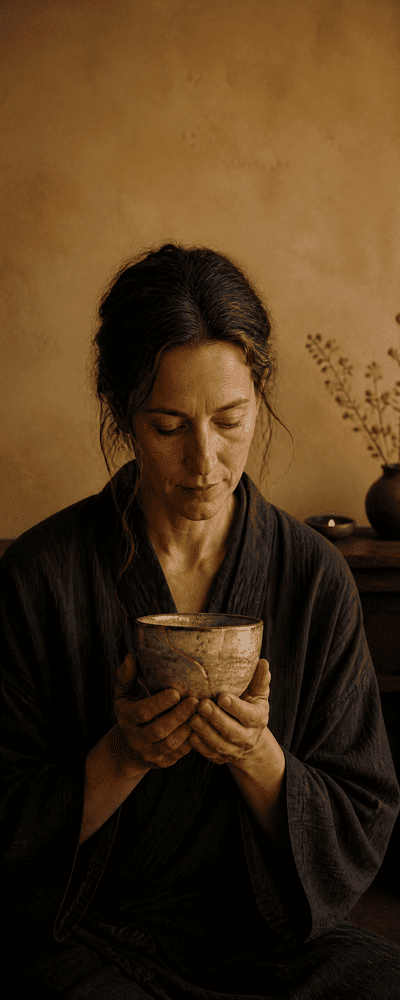
The tiredness that follows a period of genuine difficulty is to be expected and is manageable. The tiredness that follows a sustained effort to ensure that legitimate difficulty leaves no visible trace is something more corrosive.
Many of the leaders sitting with this pattern are not in acute crisis. They have, in fact, navigated their difficulty competently. The project was recovered, the decision was reviewed, the health event was managed, the professional relationship was replaced. From the outside, the sequence reads as resilience. Internally, it often reads as something more like suppression – the experience of having moved through something real without having fully moved through it, because the demands of professional life did not allow for genuine integration.
Several converging pressures have intensified this dynamic considerably in recent years. Digital environments have made professional identity more visible and, consequently, more carefully managed. Leaders are now observable across more moments than previous generations navigated – on video calls, on internal platforms, on professional networks. The result is a kind of ambient curation: an ongoing, largely unconscious effort to ensure that the self being seen is the right version of the self.
Performance cultures add further weight. Burnout is now widely acknowledged in most organisations, and accordingly, wellness initiatives and psychological safety frameworks are common. However, many of the cultures in which leaders actually operate send contradictory signals: vulnerability is endorsed in principle and penalised in practice. Consequently, many experienced professionals have become skilled at performing vulnerability in acceptable doses, while keeping the real fractures private.
Generational shifts complicate this further. Younger colleagues entering leadership contexts are often more attuned to the gap between what leaders project and what they are actually experiencing. They are, generally, less persuaded by the polished version of struggle. They tend to notice the gap between what leaders project and what they are actually carrying, and they tend to trust the ones who carry it more honestly.
Furthermore, midlife sharpens all of this. Research on identity development in mid-career consistently identifies a period – often in the mid-forties, sometimes earlier, sometimes later – in which accumulated fractures that were individually managed begin to create a collective weight. Not because of their quantity, but because they were absorbed rather than integrated or survived rather than moved through.
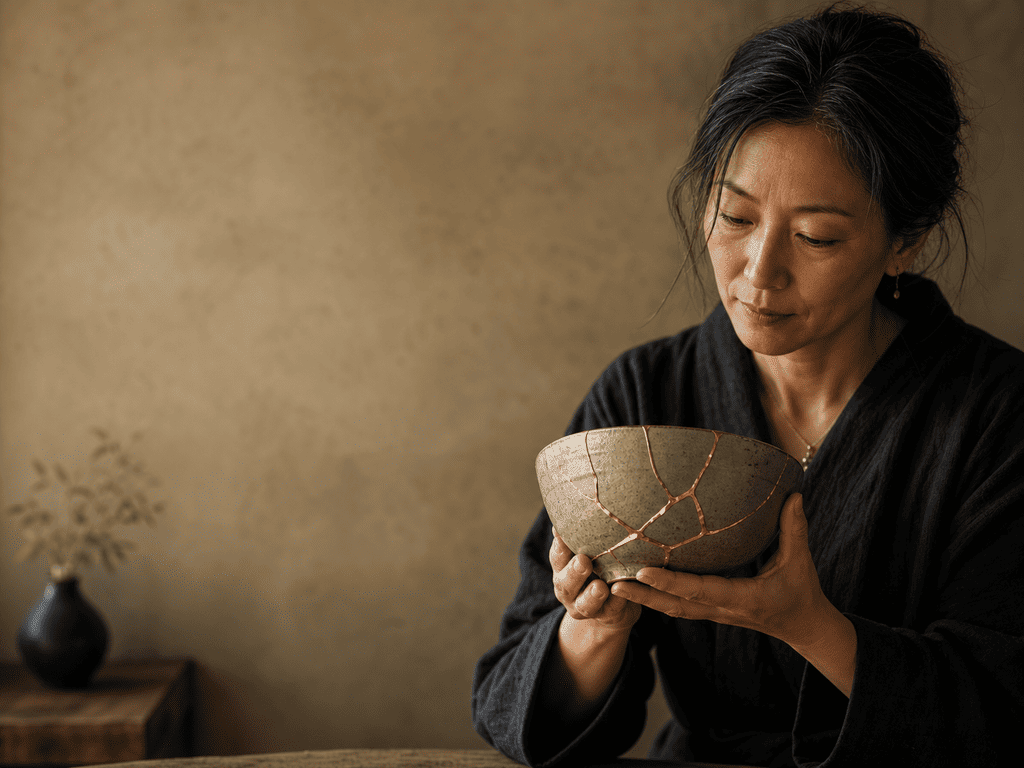
A specific Japanese craft practice has become, in recent years, a widely circulated metaphor in coaching, psychology, and leadership development: Kintsugi. The practice involves repairing broken ceramics with lacquer mixed with gold, silver, or platinum powder. The result is an object whose cracks are not concealed but traced, made visible and beautiful. The object carries its full history in its form.
The philosophical weight behind the practice is significant. The broken bowl could be discarded. It could be repaired in a way that hides the damage. Kintsugi does neither. The repair is deliberate, careful, and visibly honest. Consequently, the object that results is not restored to its original state; it arrives at a new state, one that carries both the original form and the evidence of having been broken and tended.
In its popular iteration, Kintsugi has been somewhat flattened into a motivational framework: your cracks are beautiful, failure is a path to growth, what broke you made you stronger. These ideas are warmly intended. But they also tend to compress a demanding, non-linear process into an optimistic narrative arc, which, for anyone in difficulty, can feel like a performance note delivered at the wrong moment.
Taken seriously, Kintsugi makes no claim about the beauty of breaking. The breaking is simply what happened. What Kintsugi addresses is what comes after – specifically, whether the repair is done with care, and whether the evidence of the repair is honoured or erased. The gold does not pretend the crack did not occur. It rather traces it and that trace is both an aesthetic and an ethical act.

There is a difference worth naming here. Some leaders have learned to talk about past difficulty in ways that are polished and purposeful – the keynote story, the curated lesson, the setback that became a strategy. Others simply lead differently afterward – more careful, a little more honest about what they do not yet know, maybe more understanding of the complexity they might once have dismissed. The first is a performance of having been through something. The second is what Kintsugi actually looks like in a professional life.
Research in narrative psychology supports this distinction. People who integrate difficulty honestly into an account of who they have become – rather than packaging it retrospectively or suppressing it altogether – demonstrate measurably greater psychological coherence and more durable resilience over time. Post-traumatic growth research extends this further: genuine growth following adversity does not arise from the difficulty itself, but from the quality of engagement with it afterward. Specifically, from the willingness to sit with what happened long enough for it to actually change something.
That willingness requires conditions, time, and some degree of safety, and the sense that the difficulty does not need to resolve into something impressive before it can be acknowledged. Most professional environments do not offer these conditions automatically. They tend, instead, to create performance-pressure precisely at the moment when integration most needs space.

For coaches, a Kintsugi orientation means something specific: resisting the pull toward premature resolution. Staying with a fracture long enough to understand what it is actually made of, before beginning to think about what comes next.
A client who has moved through significant professional difficulty – a failure, a health disruption, a forced transition, an identity loss – is often, in the early stages of coaching, still in the concealment phase: managing the narrative, presenting the recovery rather than inhabiting it. The most useful thing in that moment is not to help them construct a better story, but to create enough space for the actual experience to be named; to simply acknowledge that something genuinely hard happened, and that they have been carrying it for longer than was sustainable.
Sometimes the most honest and useful thing a coach can offer is to slow the whole process down, and to stay with what is actually there rather than moving toward what could be made of it.
Some questions that tend to open this territory:
And now, again… What if the most credible thing about you is not what you have built, but what you have rebuilt?
The bowl repaired with gold is not more beautiful despite the crack. It is more specific and more particular because of it. It holds more honesty about what it has been through. And consequently, to the eye willing to look, more trustworthy – because it is no longer pretending to be something that has not been tested.
The same is true of people. The leader who has moved through difficulty and integrated it honestly – not performed it, not packaged it, but carried it in how they actually show up – holds something that competence alone does not produce: a quality of presence that has been earned rather than constructed.
That is simply what becomes possible when the repair is done honestly, and the gold is allowed to show.


Sign up our newsletter to get update information, news and free insight.