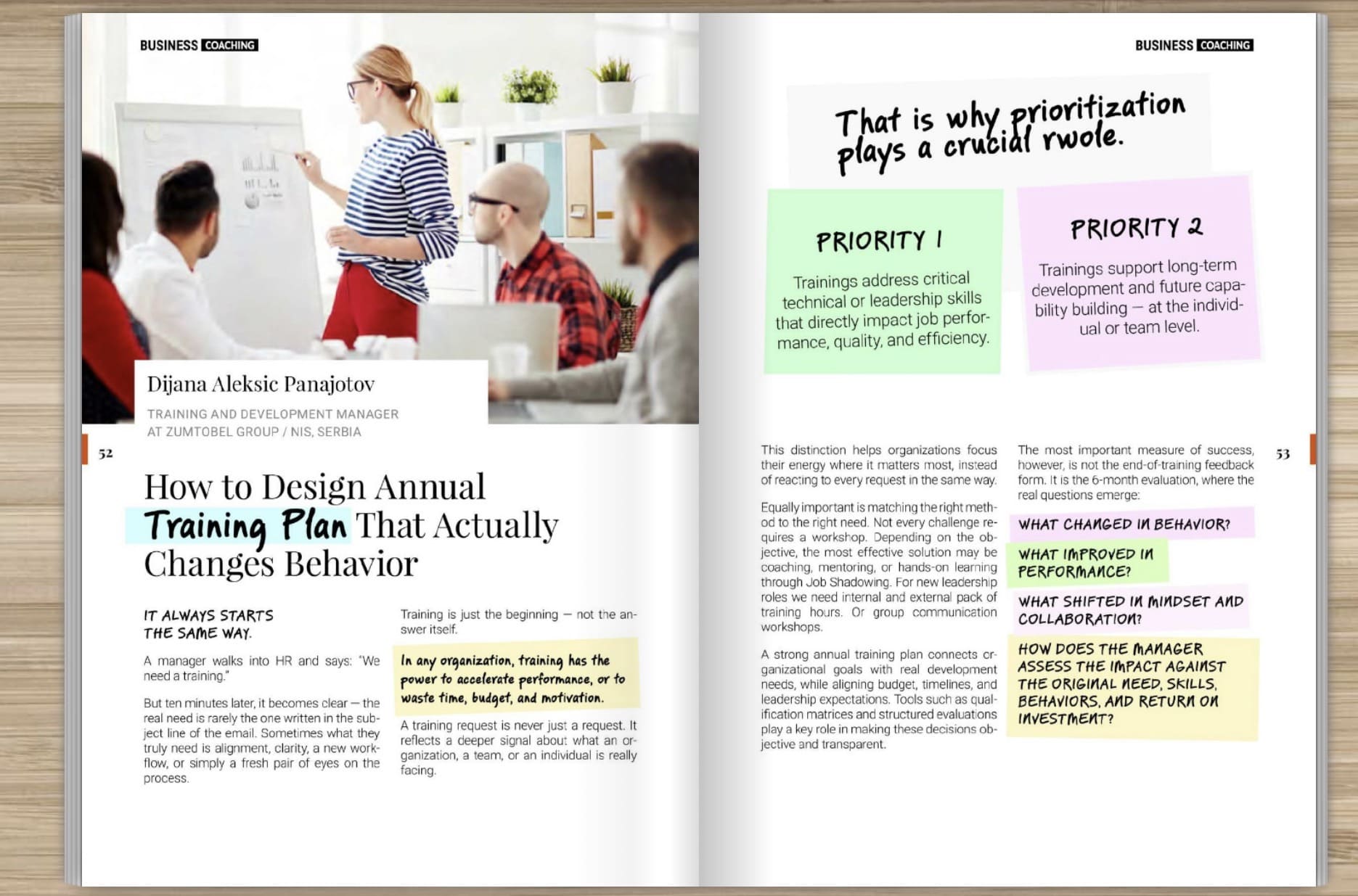


It always starts the same way.
A manager walks into HR and says: “We need a training.”
But ten minutes later, it becomes clear — the real need is rarely the one written in the subject line of the email. Sometimes what they truly need is alignment, clarity, a new workflow, or simply a fresh pair of eyes on the process.
Training is just the beginning — not the answer itself.
In any organization, training has the power to accelerate performance, or to waste time, budget, and motivation.
A training request is never just a request. It reflects a deeper signal about what an organization, a team, or an individual is really facing.
That is why prioritization plays a crucial role.
Priority 1 trainings address critical technical or leadership skills that directly impact job performance, quality, and efficiency.
Priority 2 trainings support long‑term development and future capability building — at the individual or team level.
This distinction helps organizations focus their energy where it matters most, instead of reacting to every request in the same way.
Equally important is matching the right method to the right need. Not every challenge requires a workshop. Depending on the objective, the most effective solution may be coaching, mentoring, or hands‑on learning through Job Shadowing. For new leadership roles we need internal and external pack of training hours. Or group communication workshops.
A strong annual training plan connects organizational goals with real development needs, while aligning budget, timelines, and leadership expectations. Tools such as qualification matrices and structured evaluations play a key role in making these decisions objective and transparent.

The most important measure of success, however, is not the end‑of‑training feedback form. It is the 6‑month evaluation, where the real questions emerge:
- What changed in behavior?
- What improved in performance?
- What shifted in mindset and collaboration?
- How does the manager assess the impact against the original need, skills, behaviors, and return on investment?
Ultimately, training that truly changes behavior is intentional, strategic, and continuous.
One of the most surprising moments in my practice came during a Job Shadowing initiative.
A team lead spent time observing a process in another department, and after that experience, the “training need” he had originally reported simply disappeared.
He didn’t need a workshop.
He needed perspective.
What made the difference was not formal learning, but the type of Job Shadowing itself. Job Shadowing can take different formats: observational, targeted, or hands‑on, depending on the objective. Sometimes it is enough to observe. Sometimes it requires focused exposure to a specific part of the process. And sometimes true understanding only comes through doing.
The benefits go far beyond individual learning. Job Shadowing helps retain knowledge within the organization, strengthens relationships between teams, improves communication, and often resolves long‑standing process dependencies between departments. It creates shared understanding where documentation and traditional training programs often fall short.
Sometimes the fastest behavioral change comes not from learning something new, but from finally seeing what has been there all along.