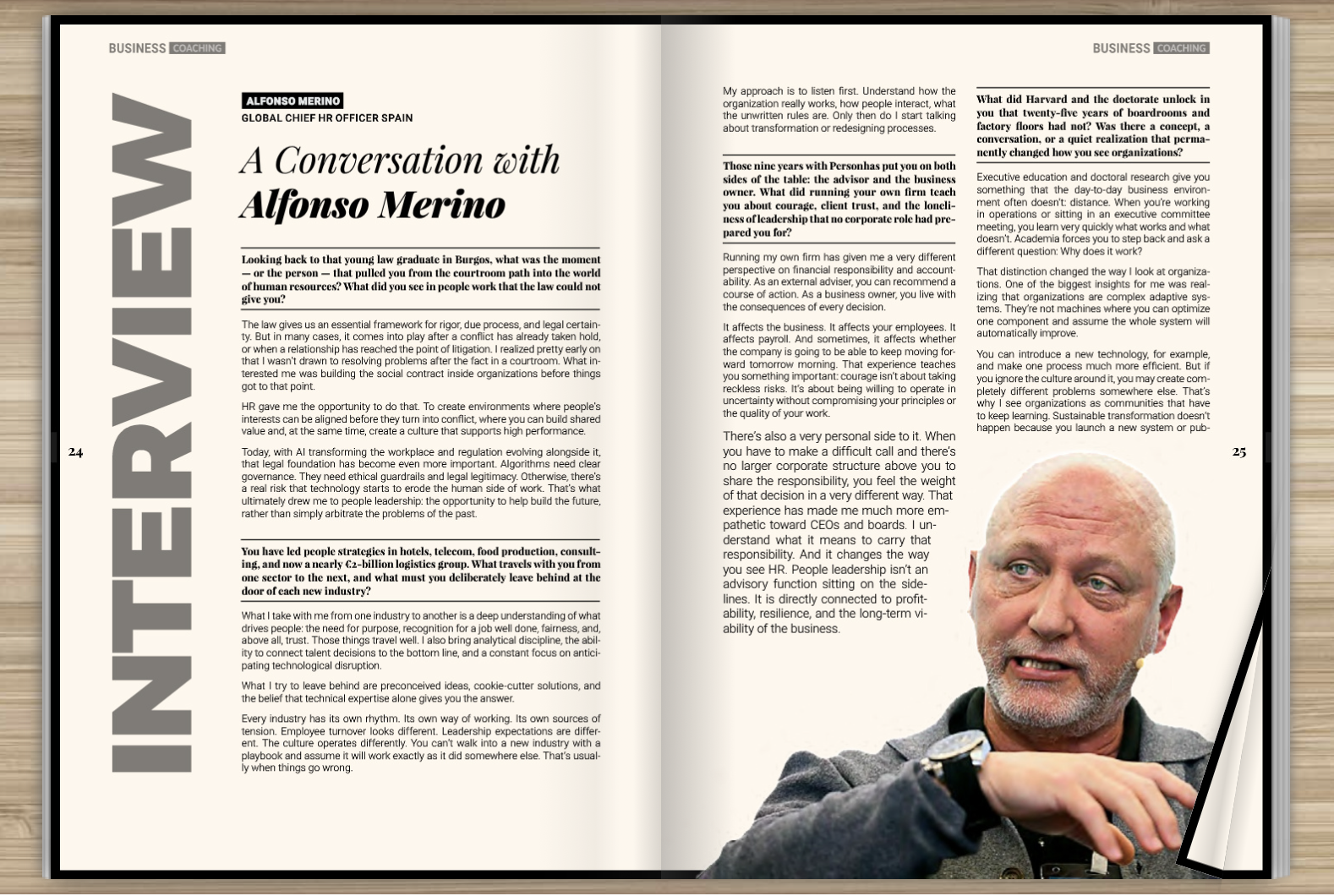

Looking back to that young law graduate in Burgos, what was the moment — or the person — that pulled you from the courtroom path into the world of human resources? What did you see in people work that the law could not give you?
The law gives us an essential framework for rigor, due process, and legal certainty. But in many cases, it comes into play after a conflict has already taken hold, or when a relationship has reached the point of litigation.
I realized pretty early on that I wasn’t drawn to resolving problems after the fact in a courtroom. What interested me was building the social contract inside organizations before things got to that point.
HR gave me the opportunity to do that. To create environments where people’s interests can be aligned before they turn into conflict, where you can build shared value and, at the same time, create a culture that supports high performance.
Today, with AI transforming the workplace and regulation evolving alongside it, that legal foundation has become even more important. Algorithms need clear governance. They need ethical guardrails and legal legitimacy. Otherwise, there’s a real risk that technology starts to erode the human side of work. That’s what ultimately drew me to people leadership: the opportunity to help build the future, rather than simply arbitrate the problems of the past.
You have led people strategies in hotels, telecom, food production, consulting, and now a nearly €2-billion logistics group. What travels with you from one sector to the next, and what must you deliberately leave behind at the door of each new industry?
What I take with me from one industry to another is a deep understanding of what drives people: the need for purpose, recognition for a job well done, fairness, and, above all, trust.
Those things travel well.
I also bring analytical discipline, the ability to connect talent decisions to the bottom line, and a constant focus on anticipating technological disruption.
What I try to leave behind are preconceived ideas, cookie-cutter solutions, and the belief that technical expertise alone gives you the answer.
Every industry has its own rhythm. Its own way of working. Its own sources of tension.
Employee turnover looks different. Leadership expectations are different. The culture operates differently. You can’t walk into a new industry with a playbook and assume it will work exactly as it did somewhere else. That’s usually when things go wrong.
My approach is to listen first. Understand how the organization really works, how people interact, what the unwritten rules are. Only then do I start talking about transformation or redesigning processes.
Those nine years with Personhas put you on both sides of the table: the advisor and the business owner. What did running your own firm teach you about courage, client trust, and the loneliness of leadership that no corporate role had prepared you for?
Running my own firm has given me a very different perspective on financial responsibility and accountability.As an external adviser, you can recommend a course of action. As a business owner, you live with the consequences of every decision.
It affects the business. It affects your employees. It affects payroll. And sometimes, it affects whether the company is going to be able to keep moving forward tomorrow morning.
That experience teaches you something important: courage isn’t about taking reckless risks.
It’s about being willing to operate in uncertainty without compromising your principles or the quality of your work.
There’s also a very personal side to it. When you have to make a difficult call and there’s no larger corporate structure above you to share the responsibility, you feel the weight of that decision in a very different way. That experience has made me much more empathetic toward CEOs and boards. I understand what it means to carry that responsibility. And it changes the way you see HR. People leadership isn’t an advisory function sitting on the sidelines. It is directly connected to profitability, resilience, and the long-term viability of the business.
What did Harvard and the doctorate unlock in you that twenty-five years of boardrooms and factory floors had not? Was there a concept, a conversation, or a quiet realization that permanently changed how you see organizations?
Executive education and doctoral research give you something that the day-to-day business environment often doesn’t: distance.
When you’re working in operations or sitting in an executive committee meeting, you learn very quickly what works and what doesn’t. Academia forces you to step back and ask a different question: Why does it work?
That distinction changed the way I look at organizations.
One of the biggest insights for me was realizing that organizations are complex adaptive systems. They’re not machines where you can optimize one component and assume the whole system will automatically improve.
You can introduce a new technology, for example, and make one process much more efficient. But if you ignore the culture around it, you may create completely different problems somewhere else. That’s why I see organizations as communities that have to keep learning. Sustainable transformation doesn’t happen because you launch a new system or publish a new policy. It happens when people understand the change, learn from it, and eventually make it part of the way they work.
And perhaps ironically, at a time when AI is pushing us toward ever more data and measurement, higher education has reinforced my belief that some of the most durable competitive advantages are still human: ethical maturity, sound judgment, and the ability to think deeply.
How do you hold the double life of practitioner and professor? What does the classroom give back to the executive, and what does the executive refuse to let the classroom forget?
Maintaining both an executive and an academic perspective takes discipline, but I wouldn’t give up either side.
They keep each other honest.
The classroom forces me to stay curious. It exposes me to new research, new ideas, and younger generations who often look at work and corporate commitment in ways that are very different from previous generations.
But the executive world is an equally important reality check.
I don’t want an academic discussion to lose sight of what happens in a real collective bargaining negotiation, what it feels like when the P&L is under pressure, or how difficult it can be to keep people engaged during a major restructuring.
Academia gives me rigor, methodology, and a longer-term perspective.
The business world gives me realism. It teaches you where the limits are, what can actually be implemented, and what happens when theory meets pressure.
I need both.
That constant exchange is what allows me to develop and work with leaders who are grounded in reality but still capable of looking beyond the immediate horizon.
Tell us about an ‘invisible employee’ who shaped a culture you led — someone whose name never topped a performance ranking, yet without whom the place would have felt hollow. How do you design systems that honor people like that?
Over the years, I’ve met a lot of people whose contribution never shows up properly on a spreadsheet.
There’s the operator who takes the new hire under their wing. The administrator who quietly defuses tension between colleagues. The person who stays calm when everyone else is under pressure and somehow keeps the team together.
Those people matter.
They’re the connective tissue of an organization. They carry institutional memory. They build trust. And very often, they have far more influence over the culture than their job title would suggest.
Historically, our management systems have tended to reward the people who are most visible and the results that are easiest to measure.
That’s changing.
With ethical People Analytics and Organizational Network Analysis, we can start identifying the real networks of collaboration and trust inside an organization. We can see who peopleactually go to for advice, who connects different groups, and who has influence without necessarily having formal authority.
The challenge is then to recognize that contribution appropriately.
We need broader recognition and reward systems that value cultural contribution, generosity, collaboration, and the ability to strengthen the organization — not just individual output.
When you talk about human–AI co-intelligence, you protect a space that algorithms cannot enter. Can you walk us through a real decision where abductive reasoning — that human leap — changed the outcome in a way no model would have recommended?
AI and predictive models are incredibly good at identifying patterns in historical data. That’s one of their strengths.
But they don’t have context in the human sense. They don’t have intuition. And they struggle when something doesn’t fit the pattern.
I’ve seen this matter in restructuring and complex integration situations.
A model looking strictly at cost and performance might recommend letting go of someone whose productivity has temporarily declined.
There have been situations where I’ve made the opposite call.
I’ve protected or redeployed people because I believed their cultural credibility, relationships, and moral authority were more valuable to the organization at that particular moment than their short-term productivity numbers suggested.
They were, in a sense, holding the organization together.
A predictive model wouldn’t necessarily see that. It can’t put a reliable number on loyalty, reputation, or someone’s ability to help a team recover from a difficult period.
That’s where human judgment still matters.
AI should inform the decision. It shouldn’t own the decision.
There has to be room for human judgment to step in, challenge the model, and ask whether the numbers are telling the whole story.
If compensation could listen to a person’s life in real time — a new child, an aging parent, a sabbatical dream — what would a truly genomic benefits model look like inside a company the size of Grupo Alonso? Where does fairness meet radical personalization?
I think of a “genomic,” or highly personalized, compensation model as a way of using data to better understand what employees actually value at different stages of their lives.The same salary and benefits package doesn’t necessarily have the same value to a twenty- five-year-old employee as it does to someone raising children, caring for an aging parent, or investing heavily in further education.
That creates an interesting leadership challenge.
How do you give people more flexibility without compromising internal equity?
For me, fairness doesn’t necessarily mean giving everyone exactly the same thing. It means having a transparent compensation framework where different choices can still have comparable economic value and where the rules are clear and free from hidden bias.
The risk, of course, is that personalization can become arbitrary. Or worse, that algorithms make decisions that unintentionally discriminate.
That’s why governance matters so much.
Technology should give employees more options, not quietly make decisions for them.
People should retain control over their choices, while the organization maintains a clear framework that protects fairness and cohesion.
Describe the moment in a hiring process when the algorithm should step back and the human conversation must take over. What do you listen for in that room that no scorecard can capture?
AI agents and automated assessment tools can be extremely useful at the front end of recruitment.
They can improve speed, reduce administrative friction, and help screen candidates against basic technical requirements.
But there’s a point where I want the technology to step back.
When we start talking about intention, vulnerability, character, and ethical judgment, I want a human being in the room.
In a deep interview, I’m not particularly interested in the perfectly rehearsed answer or the beautifully polished résumé.
I pay attention to the pauses.
How does someone talk about a mistake they made? Can they admit they were wrong? Can they apologize? How do they talk about former colleagues when those people aren’t there to defend themselves?
Those moments tell you a lot.
I’m looking for authenticity, intellectual curiosity, comfort with ambiguity, and the ability to reflect on experience. Those are difficult things to reduce to a standardized score.We’re entering a world where candidates will increasingly have access to AI-generated answers. That makes the human conversation even more valuable.
At some point, you have to look someone in the eye and have a real conversation.
We live in a culture that confuses speed of reply with quality of leadership. How do you coach executives to reclaim the slow, hard conversations — the ones that actually change people — without feeling they are falling behind?
Digital immediacy has changed leadership, and not always for the better. Too often, leaders have become professional responders — answering messages, clearing notifications, moving from one urgent issue to the next.
The problem is that leadership isn’t just about response time.
Part of my work is helping leaders create enough space to think, especially when the issue in front of them is fundamentally human.
A difficult conversation about disengagement, ethical concerns, or someone questioning their career path cannot be handled like an email.
It requires time. Silence. Listening.
I often remind executive teams that what looks like thirty minutes of “unproductive” conversation today can save months of conflict later — not to mention the emotional cost and the financial cost of unwanted turnover.
Leadership maturity isn’t measured by how quickly you answer.
It’s measured by the quality of the conversations you’re willing to have, especially the ones that are uncomfortable.
When an organization is mid-transformation and fatigue sets in, what is the story you tell people — and what is the story you refuse to tell — to keep trust intact while the ground is still moving?
When change fatigue sets in, leaders need to change the conversation.
You can’t keep talking about targets, milestones, and KPIs as if people were machines that simply need to accelerate.
At that point, people need honesty.
I talk about the transformation as something we are building together. I explain why the change is necessary for the long-term sustainability of the business and, importantly, how each part of the organization contributes to that future.
But I won’t sell people a fantasy.I’m not going to tell them that the journey will be easy, painless, or over in a few months if I don’t believe that’s true.
That destroys trust.
People can handle difficult news. What they struggle with is being treated as if they can’t handle the truth.
So I’d rather show them the map, explain what we know and what we don’t know, and acknowledge that leadership is navigating some of the same uncertainty.
That creates credibility.
What does it actually take to build a coaching culture inside a large corporation — not a program with a logo, but a daily habit of curiosity between managers and teams? Where have you seen it take root, and where has it quietly died?
You don’t create a coaching culture by putting the word “coaching” into a corporate strategy document or sending managers to a two-day training course.
It starts with everyday behavior.
The real shift happens when a leader stops feeling that they always have to provide the answer and starts asking questions that help people think for themselves.
I’ve seen this work particularly well when senior executives model the behavior themselves — when they listen, admit that they don’t have all the answers, and recognize people who take constructive initiative rather than simply rewarding those who follow instructions.
I’ve also seen coaching cultures disappear.
It happens in organizations where people are afraid to make mistakes, managers micromanage everything, and dashboards focus almost entirely on short-term productivity.
You can’t ask people to learn, experiment, and take ownership while simultaneously punishing every mistake.
Curiosity requires psychological safety.
And psychological safety requires leaders to behave consistently with what they say.
Leading people across countries and cultures, when have you misread a room — and what did that misfire teach you about humility as a global HR leader? How do you stay a learner when you are expected to be the expert?
Global leadership teaches you a fairly simple lesson: people don’t communicate the same way everywhere.Early in my international leadership experience, I learned that a direct, confrontational management style that might work perfectly well in one culture can completely shut down collaboration in another.
In some cultures, consensus matters more. In others, hierarchy and formality carry much more weight.
If you ignore those differences, you can end up mistaking a cultural difference for a performance problem.
That experience also taught me something about expertise.
Experience is extremely valuable, but it can become a blind spot if you start assuming that what worked before must work again.
For me, real global leadership is about staying curious.
Ask before telling.
Listen to local leaders. Test your assumptions. Make sure your diagnosis actually reflects what is happening on the ground.
You can still provide strong technical leadership without pretending you already understand everything.
In cross-cultural environments, humility isn’t a weakness. It’s a leadership skill.
Most succession plans look impressive on a slide and collapse under the first real departure. What makes a talent pipeline alive rather than decorative — and how do you know, years before a vacancy, that someone is truly ready?
One of the biggest problems with traditional succession planning is that it often becomes a box-checking exercise.
You put names on an organizational chart, identify a few “high potentials,” and assume you have a succession plan.
You don’t.
A real talent pipeline is built through experience.
If someone is expected to take over a complex leadership role, they need to have faced complex situations beforehand. Give them cross-functional projects. Put them in unfamiliar environments. Let them deal with ambiguity, difficult stakeholders, and situations where there is no obvious answer.
Do it before the vacancy occurs.
Today, predictive analytics and continuous assessment can help us understand how someone is developing without relying entirely on the opinion of one manager.But data is only part of the picture.
Someone is ready for senior leadership when they can bring different people together, navigate organizational politics without losing their integrity, handle pressure, and make difficult or unpopular decisions while keeping the team together.
Technical expertise gets you into the room.
Leadership maturity determines what happens once you’re there.
Take us inside a great coaching conversation. What do you protect in that space — silence, challenge, warmth — and what is the one question you find yourself returning to when a leader is stuck?
In high-impact executive coaching, one of the most valuable things you can give a leader is something that sounds almost trivial: silence.
Real silence.
It gives the executive enough space to put down the defensive armor, stop performing, and look honestly at their own contradictions.
I combine that space with warmth and psychological safety, but I also challenge people.
Coaching isn’t about making someone feel comfortable all the time.
Sometimes you need to challenge the story they’re telling themselves.
When a leader feels stuck or spends most of the session blaming the environment, I often come back to one question:
“To what extent is the way you’re choosing to act — or not act — contributing to the very problem you say you want to solve?”
It’s a powerful shift.
Suddenly, the conversation moves away from everything that is happening to them and toward what they can actually influence.
That’s where self-aw areness starts. And, in my experience, that’s where meaningful change becomes possible.
If you mapped the emotional arc of an employee from offer letter to farewell lunch, where do most organizations break the relationship — and what would it look like to design that entire journey with the same care a great hotel gives a guest?
The emotional connection between an employee and an organization rarely disappears because of one major event.
More often, it erodes slowly. Through small moments of indifference.You see it when a company makes a great impression during recruitment and then gives the new employee a chaotic onboarding experience. You see it when someone goes through an important personal transition and the organization barely notices.
That’s why I believe in designing the employee journey with the same care that great hospitality companies apply to the customer experience.
You identify the moments that really matter: the first week, the recognition someone receives after overcoming a difficult failure, returning from an extended leave, and, perhaps most importantly, the way you handle someone’s departure.
AI will increasingly take over administrative work and much of the analytical follow-up.
That gives us an opportunity.
We can spend less human energy on administration and more on actually being there for people.
And when someone leaves, we should treat that moment with the same care we showed when they joined.
That isn’t just the right thing to do.
It’s also one of the strongest signals an organization can send about who it really is.
In 2026, what is still the biggest misconception leaders hold about HR? And how do you gently — or not so gently — dismantle it when you sit across from a CEO who still sees people strategy as a cost center?
One of the most persistent misconceptions about HR is that it’s primarily an administrative function — a support department that deals with procedures, policies, and problems after they happen.
When I talk to a CEO who sees it that way, I usually start with the numbers.
I connect talent loss, absenteeism, and organizational misalignment directly to operating margin and EBITDA.
I show how productivity per employee, the successful adoption of technology, and the speed of organizational processes are all affected by the quality of the human system underneath them.
You can have great technology and still have a poor business if people aren’t aligned around it.
Today, with AI agents entering the workplace, that connection is becoming even more obvious.
The People function has to lead the transition to hybrid talent models, reskilling, and new ways of working.
That makes HR much more than a cost center.
If you treat talent simply as an expense on the P&L, you’re missing one of the biggest sources of value creation in the modern company.
What is your clearest advice to a CEO who wants people development to become a true competitive advantage — not a slogan on the wall, but something rivals cannot easily copy? Where should they start on Monday morning?
My advice to any CEO is very simple: never lose sight of the fact that businesses move because people move them.
A company can have great technology, sophisticated processes, strong capital, and an excellent strategy. But at the end of the day, people are the ones who make those things work.
One person. Ten people. Ten thousand people.
Each person has a role. Together, they create the processes that make up the value chain and ultimately generate revenue.
No people, no business.
That’s why people need to stay at the center of strategic and tactical decision-making.
It sounds obvious.
But sometimes the most obvious things are the easiest ones to forget.
If you could sit across from your thirty-year-old self — perhaps still in those early hotel or telecom years — what would you tell him to stop worrying about, what would you tell him to start sooner, and what would you simply ask him to trust?
To the thirty-year-old executive I was, I would say: stop trying so hard to control every operational variable.
And stop feeling that you constantly have to prove how technically capable you are.
You don’t need to have every answer.
Real maturity comes from being able to sit with uncertainty without feeling the need to immediately eliminate it.
I would also tell myself to start much earlier in understanding the strategic value of data, impact analytics, and the connections between technology, law, and finance.
Those disciplines increasingly intersect, and leaders who understand how they fit together will have a very different perspective on business.
But above everything else, I would say: trust authenticity and empathy.Stay close to the people doing the actual work. Listen to the person on the production floor.
Negotiate with integrity.
Over the long run, those things will take you much further than tactical cleverness ever will.
A great career isn’t a straight line.
It’s built through the difficult transitions, the lessons you take from them, and the kind of person you become along the way.
Looking ahead — beyond the current role, beyond this decade — what are you building next? What is your vision for the future of people and organizations, and what part of that future do you most want to help write?
My focus now is on helping shape the next generation of workplace governance — particularly the future of hybrid work and the relationship between AI, autonomous agents, and human judgment.
The opportunity is enormous. We can use technology to increase productivity without sacrificing human dignity, trust, or social cohesion.
I want to continue working at the intersection of business, academia, and governance — serving as a bridge between boards, senior executives, and academic institutions, whether through advisory roles, nomination committees, or advanced executive education.
The People function of the near future will look very different from traditional HR.
It won’t simply be the department that manages resources, policies, and processes. It will help design the architecture of organizations that are increasingly augmented by technology while remaining deeply human.
That’s the part of the story I want to help shape: a new social contract around technology and work.
One that proves something I strongly believe: analytical rigor and business performance do not have to come at the expense of human flourishing.
They can reinforce each other.
And, done properly, they should.