
CHRO is one of those professions whose value will grow as organisations lose their power to convince.
“Trust in organisations goes up the stairs and down the lift.”
Every generation of HR directors feels that its time is pivotal in reimagining the organisation and giving work a new meaning. This is perhaps the lifeline, the very means of survival, for a profession that must help organisations function while preserving the reasons why people choose to commit to them.
Yet there is a paradox that neither successive transformations of work nor AI will resolve: we ask organisations to build trust while they also, sometimes by their very structure, create the conditions for distrust. Refusing to believe blindly in organisations does not prevent us from understanding them, transforming them or caring for those who bear the brunt of their shortcomings.
Perhaps this is where the HR profession can find a new definition of its role.
An organisation is a human construct. It rests on rules, procedures, hierarchies, objectives and mechanisms of coordination. But it also produces effects that no one has consciously chosen: silences, resignations, rivalries and feelings of injustice. It can proclaim autonomy while multiplying controls, champion cooperation while organising competition, and talk about trust while penalising the slightest willingness to take risks.
The question, then, is not simply how to improve organisations. It is also why they so often end up contradicting the very intentions that gave rise to them.
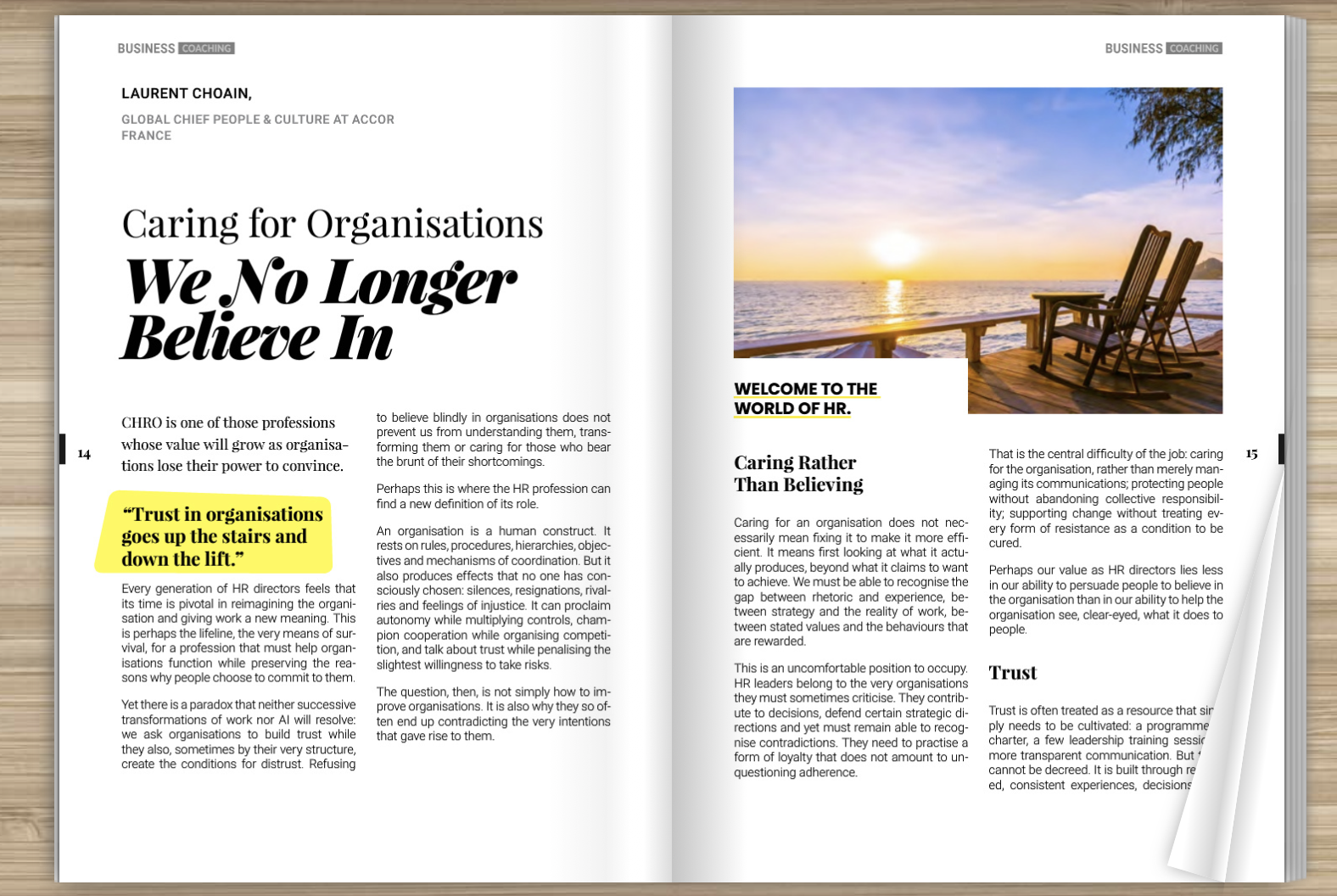
Welcome to the world of HR.
Caring Rather Than Believing
Caring for an organisation does not necessarily mean fixing it to make it more efficient. It means first looking at what it actually produces, beyond what it claims to want to achieve. We must be able to recognise the gap between rhetoric and experience, between strategy and the reality of work, between stated values and the behaviours that are rewarded.
This is an uncomfortable position to occupy. HR leaders belong to the very organisations they must sometimes criticise. They contribute to decisions, defend certain strategic directions and yet must remain able to recognise contradictions. They need to practise a form of loyalty that does not amount to unquestioning adherence.
That is the central difficulty of the job: caring for the organisation, rather than merely managing its communications; protecting people without abandoning collective responsibility; supporting change without treating every form of resistance as a condition to be cured.
Perhaps our value as HR directors lies less in our ability to persuade people to believe in the organisation than in our ability to help the organisation see, clear-eyed, what it does to people.
Trust
Trust is often treated as a resource that simply needs to be cultivated: a programme, a charter, a few leadership training sessions, more transparent communication. But trust cannot be decreed. It is built through repeated, consistent experiences, decisions people can understand and the possibility of challenging those decisions without being discredited.
As an HR leader, a substantial part of my job consists of building relationships of trust, arbitrating difficult situations, giving people a chance and explaining decisions that will not always be understood. But it also means recognising when trust has been damaged, sometimes by a decision that was legitimate in principle but unfair in how it was implemented or harsh in its consequences.
Caring for trust does not mean asking people to believe more strongly in the organisation. It means making the organisation more worthy of their trust.
Preserving Value in Critical Moments
This is precisely where an essential part of the HR leader’s value lies: in those moments when an organisation is confronted with its own contradictions.
A senior executive has close to a hundred critical conversations a year. For them, these may be one episode among many; for the person on the other side, they often represent a career turning point, a lasting wound or a profound challenge to their sense of place within the organisation.
For an HR leader, such situations are even more frequent. Underperformance, conflict, restructuring, a rejected promotion or dismissal are all moments when the relationship between an individual and their organisation reveals just how fragile it can be.
In these situations, the priority is not always to create value. More often, it is to avoid destroying what remains: preserving a person’s dignity, keeping the door open to dialogue, making a decision understandable, allowing disagreement without turning it into an irrevocable rupture. An organisation is judged less by the values it proclaims than by how it treats those who make life difficult for it, those who fail, those who challenge it and those it no longer needs.
These are also the moments when the idea of care takes on its full meaning. It does not mean eliminating conflict or making every decision acceptable. It means not adding unnecessary harm to an already difficult situation, not confusing authority with humiliation, and not turning a professional setback into a judgement on a person’s worth.
This leads to a rule of conduct that is sometimes forgotten in large organisations: HR is a contact sport. You cannot care for an organisation from a distance, through processes, metrics and programmes alone. You have to show up, listen, understand and sometimes be willing to confront what the organisation would rather not hear.
Engagement
This question takes on particular significance in the age of artificial intelligence. How can we ask employees to commit to a transformation that they may anticipate will reduce their autonomy, put their jobs at risk or diminish the value of their contribution?
The discourse around AI adoption often assumes that people will eventually come on board once they understand the benefits of the technology. But this approach overlooks an essential question: what’s in it for them?
If productivity gains are captured exclusively by the organisation while employees bear the costs of adaptation, uncertainty and the disappearance of certain skills, distrust is not a failure of change management. It becomes a rational response to a distribution perceived as unfair.
An essential HR question, then, is how the value created will be shared. How will productivity gains be redistributed? Through pay, more time freed up, better working conditions, training or new career opportunities? What say will employees have in decisions that transform their work?
Without credible answers to these questions, AI risks becoming an accelerator of disengagement. Employees may adopt the tools without buying into the project, follow instructions without contributing to collective improvement, and remain in the organisation while gradually withdrawing from it.
Here we find the dilemma described by Albert Hirschman in Exit, Voice, Loyalty. Most organisations regard people who refrain from speaking up and choose to stay as “loyal”. Yet this behaviour often conceals apathy and disengagement – what we commonly call “quiet quitting” today.
Engagement cannot be decreed any more than trust can. It requires people to recognise something of their own interests, dignity and future in the collective endeavour.
In short, if we were to imagine the role of tomorrow’s HR director through the lens of care, it might be this: not to restore belief in the organisation at all costs, but to make it more liveable, by staying close to people, particularly at critical junctures — those moments when their relationship with the organisation is shaped in concrete terms.
This calls for three simple but demanding attitudes:
Listen without discrediting. Accept criticism, including when it challenges the organisation’s rules, practices or decisions. Do not reduce every form of opposition to resistance to change.
Respond with candour and transparency. Explain what can change, what cannot, and why. Acknowledge contradictions, constraints and uncertainties rather than promising what the organisation will not be able to deliver.
Do not undermine the credibility of speaking up. Make visible the decisions and improvements that result from employees’ feedback, while also explaining why certain requests cannot be met. Nothing erodes trust more than inviting people to speak without ever showing what their words have helped to change.
Ultimately, not believing blindly in organisations does not mean giving up on them. Quite the opposite, perhaps: it means giving ourselves the means to act on them without idealising them.
Is curiosity focused only on the world?
The definition of curiosity at the Global Curiosity Institute is that curiosity is “the will to challenge the status quo.” Its playing ground is the world at large, our relationships and ourselves.
Curiosity about the world is an important dimension of curiosity. It is the drive for children to learn about the world and for scientists like Albert Einstein to explore the laws of the universe. Closer to home, it invites all of us to learn new things and be open to novelty in the world around us. In the workplace, this is the curiosity behind questions like “Why do we do it this way?” and “What can we learn from how another industry solves this?” Teams that practise it systematically challenge their own assumptions before their competitors do. For teams and organisations, this type of curiosity is closely linked to creativity and innovation.
Yet curiosity goes further. It also is a wonderful tool for interpersonal flourishing. Curiosity invites us to be curious about the people around us: people we live and work with, as well as strangers. In practice, it shows up in small acts: asking the second question instead of the first, truly listening instead of rehearsing your reply, wondering why an unusually quiet colleague is unusually quiet. The better we are at this, the more we can put ourselves in the shoes of others and thrive in our relationships. Its absence is just as visible: teams where colleagues assume they know each other, stop asking, and slowly drift into silos and friction.
It does not stop here: curiosity also has the capability to turn inwards and explore our deeper selves. Curiosity guides our self-reflection beyond the stories we like to believe about ourselves. This is perhaps the hardest dimension, because our own stories are the ones we defend most fiercely. It takes real courage to ask: “What if the problem the team keeps facing is partly me?” or “Which of my beliefs about my own abilities is simply out of date?” Self-awareness increases when we allow curiosity to explore our deeper individual and collective beliefs, even our limiting beliefs.
Together, these three playing grounds reinforce each other. Curiosity about the world gives us new perspectives, curiosity about others helps us connect those perspectives to the people around us, and curiosity about ourselves keeps our own lens honest.
In closing
Curiosity, in the end, asks only two things of us: that we keep asking, and that we stay willing to be surprised by the answers. Every innovation, every genuine connection, every moment of growth begins with someone willing to ask.
So before you close this piece, ask yourself one question: where in my life – at home or at work – have I stopped being curious? Then take the shortest route back: measure where you stand with the short diagnostic at https://www.globalcuriosityinstitute.com/individualdiagnostic, and let the answers sharpen your own definition of curiosity and where it could show up more fully in your life