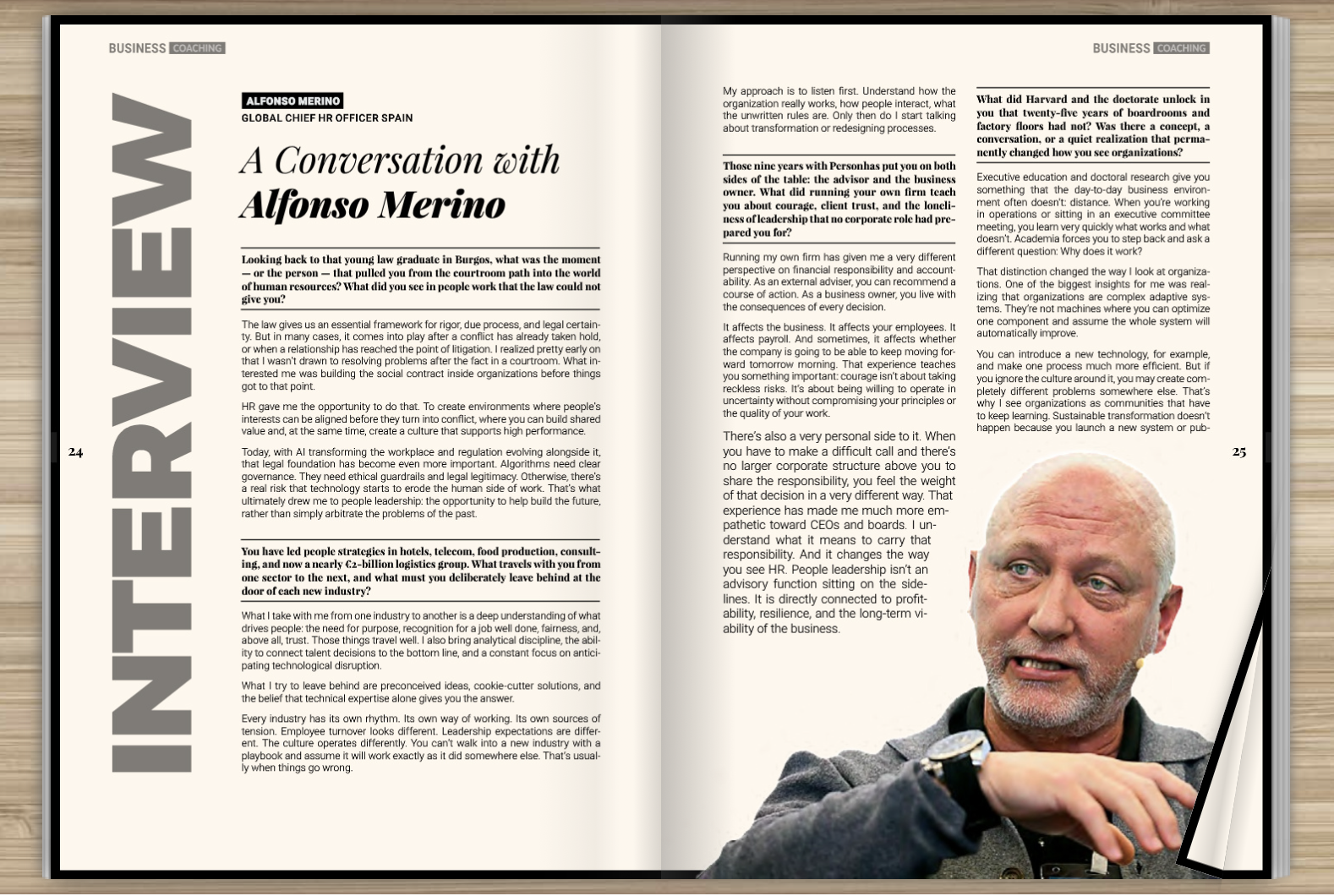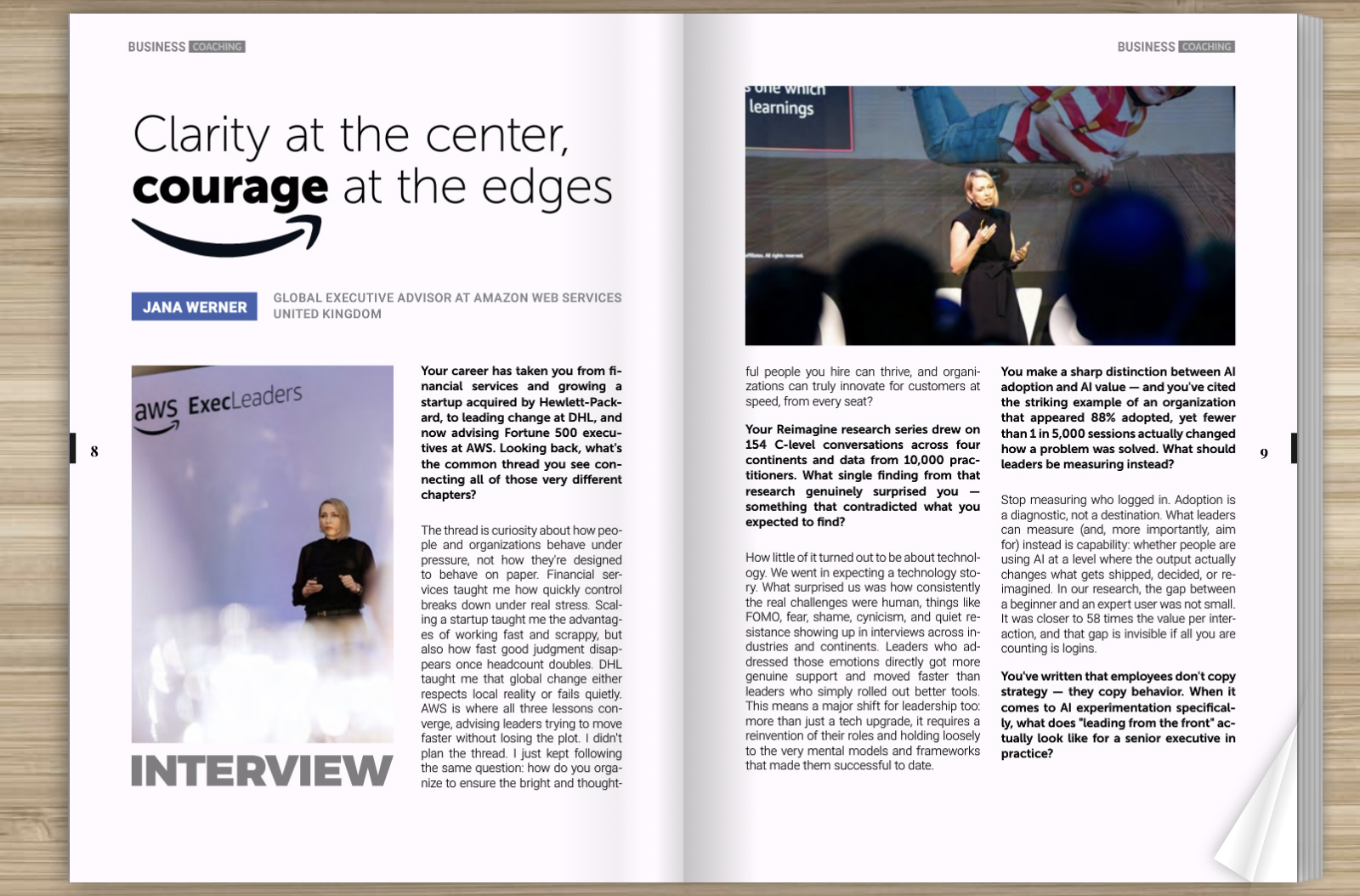

Your career has taken you from financial services and growing a startup acquired by Hewlett-Packard, to leading change at DHL, and now advising Fortune 500 executives at AWS. Looking back, what’s the common thread you see connecting all of those very different chapters?
The thread is curiosity about how people and organizations behave under pressure, not how they’re designed to behave on paper. Financial services taught me how quickly control breaks down under real stress. Scaling a startup taught me the advantages of working fast and scrappy, but also how fast good judgment disappears once headcount doubles. DHL taught me that global change either respects local reality or fails quietly. AWS is where all three lessons converge, advising leaders trying to move faster without losing the plot. I didn’t plan the thread. I just kept following the same question: how do you organize to ensure the bright and thoughtful people you hire can thrive, and organizations can truly innovate for customers at speed, from every seat?
Your Reimagine research series drew on 154 C-level conversations across four continents and data from 10,000 practitioners. What single finding from that research genuinely surprised you — something that contradicted what you expected to find?
How little of it turned out to be about technology. We went in expecting a technology story. What surprised us was how consistently the real challenges were human, things like FOMO, fear, shame, cynicism, and quiet resistance showing up in interviews across industries and continents. Leaders who addressed those emotions directly got more genuine support and moved faster than leaders who simply rolled out better tools. This means a major shift for leadership too: more than just a tech upgrade, it requires a reinvention of their roles and holding loosely to the very mental models and frameworks that made them successful to date.
You make a sharp distinction between AI adoption and AI value — and you’ve cited the striking example of an organization that appeared 88% adopted, yet fewer than 1 in 5,000 sessions actually changed how a problem was solved. What should leaders be measuring instead?
Stop measuring who logged in. Adoption is a diagnostic, not a destination. What leaders can measure (and, more importantly, aim for) instead is capability: whether people are using AI at a level where the output actually changes what gets shipped, decided, or reimagined. In our research, the gap between a beginner and an expert user was not small. It was closer to 58 times the value per interaction, and that gap is invisible if all you are counting is logins.
You’ve written that employees don’t copy strategy — they copy behavior. When it comes to AI experimentation specifically, what does “leading from the front” actually look like for a senior executive in practice?
It means using the tools yourself, visibly and often, rather than delegating experimentation downward while staying a spectator. It requires being publicly uncomfortable with not knowing how to use them, and unlearning what made you successful in the past. Leaders using AI ten or more times a day at more complex levels develop a visceral sense of what is actually possible that cannot be gained any other way. Without that fluency, setting an ambitious target to reimagine your organization with AI is impossible because you simply do not know what ambitious looks like. Equally important is admitting when it is hard. A leader who says “I found this difficult too” does more for genuine adoption than any mandate or training rollout ever will.
One of your recurring themes is the idea of “anchors” — stable ground that lets teams absorb continuous change without burning out. What are the most underrated anchors that leaders tend to overlook?
The most underrated strategy is reminding people what won’t change. People absorb and thrive through enormous change in their private lives, yet at work, we constantly hear leaders say, “Our people resist change.” Teams can absorb and thrive through tremendous shift if they know their anchors: a clear purpose, lived practical values, an honest read on customer needs, goals stated in simple language, metrics used for learning rather than defending targets, and clear guardrails that allow teams to operate at speed. Leaders often assume stability means slowing down. It doesn’t. It means being explicit about the handful of things you have deliberately decided are permanent and can be relied upon, no matter what else is in motion around them.
You’ve been candid about the content pollution problem — organizations using AI simply to accelerate broken processes and flood channels with generic noise. Where are you actually seeing companies get this right?
The companies getting this right treat AI output the way they would treat a junior analyst’s first draft: useful, but never shipped without a human actually reading it, sparring with it, and raising the bar end to end. In our research, we saw what we started calling AI slop: poorly reviewed output that shifts the burden of thinking from the creator to whoever receives it. We remind people why documents and communication exist in the first place, as tools for thinking, to convey meaning, engage, and get to decisions. The organizations avoiding that pitfall had a simple, unglamorous rule: if you used AI to produce something, you are accountable for every sentence in it, the same as if you had written it yourself.
You wrote a post about a COO who told you “my people don’t want ownership,” and thirty minutes later the real story emerged: ownership came with career-limiting consequences and zero clarity. How do you help a leader see past their own blind spots while you’re still in the room with them?
That story stays with me because it is so common. She believed her people did not want ownership. Thirty minutes in, it became clear that ownership came with real career risk and zero clarity on what “ownership” actually meant. I asked her to describe, in detail, why people did not want ownership, and what happened the last time someone on her team made a call above their pay grade or outside the process. I would love for more leaders to be less directive and do more coaching. I believe coaching is listening ten more seconds than you want to, and asking a few more questions than you want to. We all became successful by having answers, but in the coming years, we need more listening and more questions. I am grateful this COO was curious enough to listen and think about this from a different perspective.
The octopus is a genuinely inspired metaphor — extraordinary distributed intelligence, eight arms that can think independently while working in harmony. How did you and Phil land on it? Were there other creatures or models seriously in the running?
Phil suggested a tardigrade, but let’s not go there. Jokes aside, we did not want to name specific companies as models, because no company is ever perfect. Even organizations that seem remarkably octopus-like can regress when key leaders leave or rapid hiring dilutes the culture.
The octopus won because it is not just distributed – it is intelligent at the edge. Two-thirds of an octopus’s neurons live in its arms. Each arm can problem-solve independently while remaining completely coordinated with the whole. That is precisely the organizational model we were describing, and no other creature captures both halves of it.
They are also neophilic. Unlike most animals (and organizations), they do not see something new as a threat; they explore it with curiosity. There are a million other qualities of an octopus that map to how we see organizations. They are insane learning machines, largely because their mother dies when they are born, they only live a few years, and they must learn everything on their own. They can even be taught to play the piano, though that probably won’t help anyone make their organization more adaptive.
The book identifies 36 antipatterns — conditioned habits that keep organizations stuck. If you had to name the three most universal ones, the ones you encounter regardless of industry or company size, what would they be?
Gatekeeping approval, relying on jargon, and seeking perfect decisions: they show up nearly everywhere because they all stem from the same instinct. Control feels safer than trust. Approval gates get added to reduce risk, and instead, they slow everything down. Jargon gets used to sound rigorous, and instead, it hides a lack of clarity. Perfect decisions get pursued to avoid being wrong, and instead, they guarantee being late. All three are solvable. None of them get solved by adding more process on top.
You contrast the “Tin Man” organization — rigid, rusted, designed for a factory age that no longer exists — with the Octopus. Many leaders reading this will quietly recognize themselves in the Tin Man. What’s the first, smallest lever someone can pull on Monday morning?
Pick one decision this week and say, out loud, who actually owns it. Not a committee. One name. And if it is yours, do you really have to make it, or can you delegate it relatively safely? Most organizations do not have a decision-making problem. They have a decision-ownership problem, and it hides behind meetings that feel productive. Naming the owner is uncomfortable the first time. It is also the fastest, cheapest lever available on a Monday morning, requiring no budget, no consultant, and no transformation program to get started.
The book makes a compelling case for “good enough, reversible decisions” over exhaustive, risk-averse data gathering. In highly regulated industries — finance, healthcare, aviation — how do you make that argument land without losing the room?
You do not ask a regulated industry to abandon rigor; you ask them to be precise about where that rigor actually needs to live. We use a simple Amazonian mental model: a one-way door and a two-way door. If a decision can be reversed, and most decisions can be, make it with about 70 percent of the information you wish you had. If part of the decision is truly irreversible, like a regulatory filing or a safety threshold, mitigate the risk of that specific component rather than slowing down the entire decision to protect one element. In finance or healthcare, that reframe tends to land well because it does not ask anyone to lower their standards. It asks them to stop applying irreversible-decision standards to reversible ones, which is where almost all the wasted time actually lives.
Your data shows that 88% of transformations fail. Given that statistic, what keeps organizations coming back to the same model? Is it habit, incentive structures, sunk cost — or something harder to name?
Mostly sunk cost dressed up as diligence. Organizations that have spent two years and significant budget on a transformation model find it easier to add another initiative than admit the model itself is the problem. Incentives reinforce it too: careers get built managing grand superhero programs, not questioning them. Designing a plan also feels quicker and cleaner. Treating an organization like a machine where you can simply replace a part with a new operating model or tech roadmap feels far more controllable than treating it like a living system, even when the evidence in front of you says otherwise.
“Clarity at the center, agency at the edges” is a phrase that runs through much of your thinking. What does genuine clarity actually look like in practice — and how do you diagnose when an organization thinks it has clarity but doesn’t?
Real clarity means a stranger could read your stated purpose or strategy and predict your last three decisions. Most organizations have the opposite: a purpose statement few can recite and nobody can apply. Ask five people on different teams what the company will not do, even if it would be profitable. If you get five different answers, you do not have clarity. You have a slogan hanging on a wall that nobody actually uses to decide anything.
The book has won the Thinkers360 Book of the Year and the International Book Award in the Business General category. Beyond the recognition, what’s the response from a reader — a message, a story, a moment in a workshop — that has meant the most to you personally?
We get a lot of kind feedback that leaders who read our book feel like it’s written for their organisation. It resonates. A reader once told me the book gave them the language to finally explain, to their own board, why a programme that looked disciplined was actually quietly bureaucratic. That’s the response that means the most, not the award. It’s someone using a phrase from the book to win an argument they’d been losing for years. That’s the whole point of writing it, giving people words for something they already sensed but couldn’t quite articulate before.
Ilse Henne, a member of the Executive Board at thyssenkrupp AG, said the following to us: “[The Octopus Organization] reframed how I look at leadership in a world that is anything but predictable … Decisions are best taken very close to the actual expertise and creativity on the ground. This leads to better decisions and increased speed.”
Is curiosity focused only on the world?
The definition of curiosity at the Global Curiosity Institute is that curiosity is “the will to challenge the status quo.” Its playing ground is the world at large, our relationships and ourselves.
Curiosity about the world is an important dimension of curiosity. It is the drive for children to learn about the world and for scientists like Albert Einstein to explore the laws of the universe. Closer to home, it invites all of us to learn new things and be open to novelty in the world around us. In the workplace, this is the curiosity behind questions like “Why do we do it this way?” and “What can we learn from how another industry solves this?” Teams that practise it systematically challenge their own assumptions before their competitors do. For teams and organisations, this type of curiosity is closely linked to creativity and innovation.
Yet curiosity goes further. It also is a wonderful tool for interpersonal flourishing. Curiosity invites us to be curious about the people around us: people we live and work with, as well as strangers. In practice, it shows up in small acts: asking the second question instead of the first, truly listening instead of rehearsing your reply, wondering why an unusually quiet colleague is unusually quiet. The better we are at this, the more we can put ourselves in the shoes of others and thrive in our relationships. Its absence is just as visible: teams where colleagues assume they know each other, stop asking, and slowly drift into silos and friction.
It does not stop here: curiosity also has the capability to turn inwards and explore our deeper selves. Curiosity guides our self-reflection beyond the stories we like to believe about ourselves. This is perhaps the hardest dimension, because our own stories are the ones we defend most fiercely. It takes real courage to ask: “What if the problem the team keeps facing is partly me?” or “Which of my beliefs about my own abilities is simply out of date?” Self-awareness increases when we allow curiosity to explore our deeper individual and collective beliefs, even our limiting beliefs.
Together, these three playing grounds reinforce each other. Curiosity about the world gives us new perspectives, curiosity about others helps us connect those perspectives to the people around us, and curiosity about ourselves keeps our own lens honest.
In closing
Curiosity, in the end, asks only two things of us: that we keep asking, and that we stay willing to be surprised by the answers. Every innovation, every genuine connection, every moment of growth begins with someone willing to ask.
So before you close this piece, ask yourself one question: where in my life – at home or at work – have I stopped being curious? Then take the shortest route back: measure where you stand with the short diagnostic at https://www.globalcuriosityinstitute.com/individualdiagnostic, and let the answers sharpen your own definition of curiosity and where it could show up more fully in your life