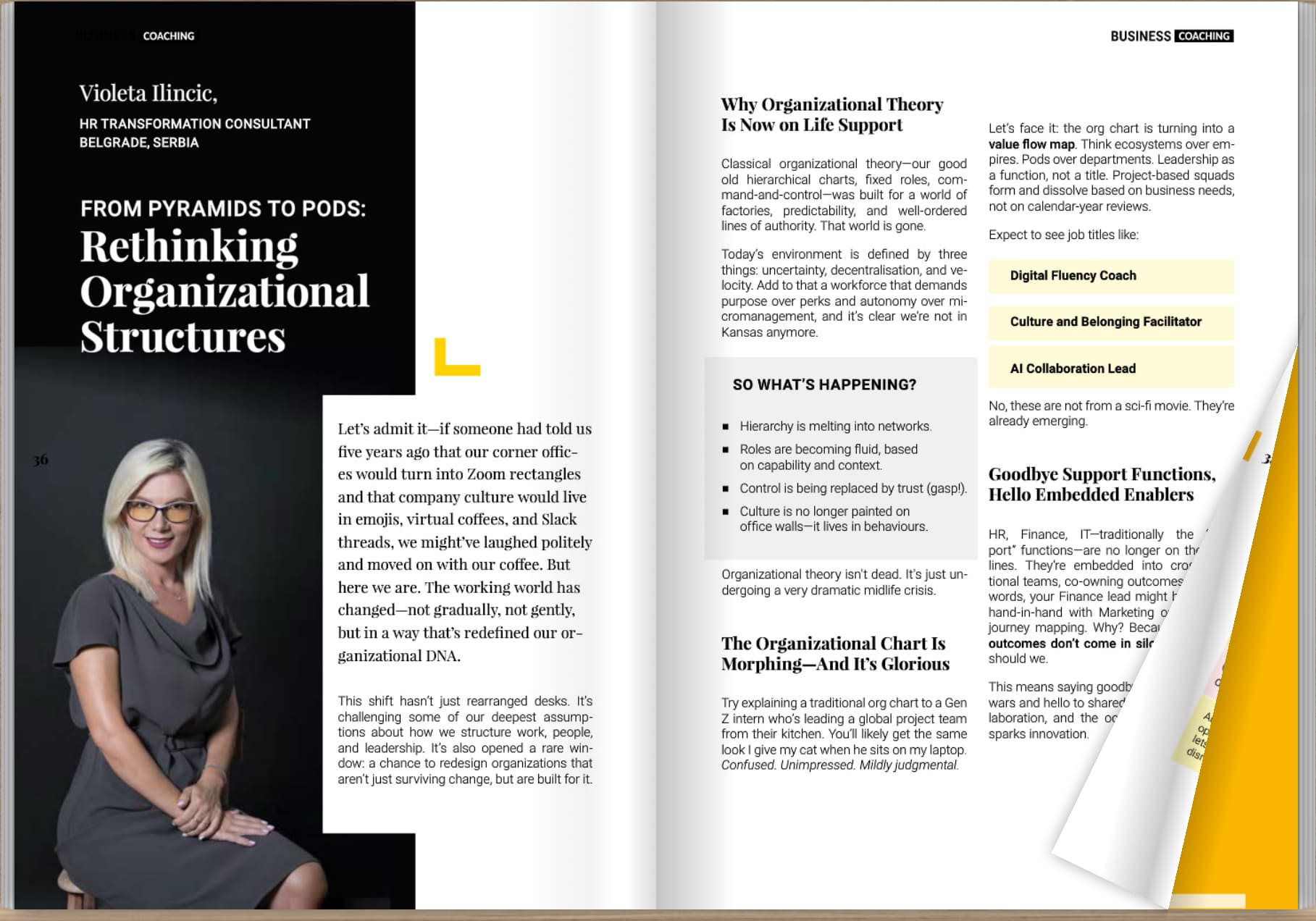
Let’s admit it—if someone had told us five years ago that our corner offices would turn into Zoom rectangles and that company culture would live in emojis, virtual coffees, and Slack threads, we might’ve laughed politely and moved on with our coffee. But here we are. The working world has changed—not gradually, not gently, but in a way that’s redefined our organizational DNA.
This shift hasn’t just rearranged desks. It’s challenging some of our deepest assumptions about how we structure work, people, and leadership. It’s also opened a rare window: a chance to redesign organizations that aren’t just surviving change, but are built for it.
Why Organizational Theory Is Now on Life Support
Classical organizational theory—our good old hierarchical charts, fixed roles, command-and-control—was built for a world of factories, predictability, and well-ordered lines of authority. That world is gone.
Today’s environment is defined by three things: uncertainty, decentralisation, and velocity. Add to that a workforce that demands purpose over perks and autonomy over micromanagement, and it’s clear we’re not in Kansas anymore.
So what’s happening?
- Hierarchy is melting into networks.
- Roles are becoming fluid, based on capability and context.
- Control is being replaced by trust (gasp!).
- Culture is no longer painted on office walls—it lives in behaviours.
Organizational theory isn’t dead. It’s just undergoing a very dramatic midlife crisis.
The Organizational Chart Is Morphing—And It’s Glorious
Try explaining a traditional org chart to a Gen Z intern who’s leading a global project team from their kitchen. You’ll likely get the same look I give my cat when he sits on my laptop. Confused. Unimpressed. Mildly judgmental.
Let’s face it: the org chart is turning into a value flow map. Think ecosystems over empires. Pods over departments. Leadership as a function, not a title. Project-based squads form and dissolve based on business needs, not on calendar-year reviews.
Expect to see job titles like:
- Digital Fluency Coach
- Culture and Belonging Facilitator
- AI Collaboration Lead
No, these are not from a sci-fi movie. They’re already emerging.
Goodbye Support Functions, Hello Embedded Enablers
HR, Finance, IT—traditionally the “support” functions—are no longer on the sidelines. They’re embedded into cross-functional teams, co-owning outcomes. In other words, your Finance lead might be working hand-in-hand with Marketing on customer journey mapping. Why? Because business outcomes don’t come in silos, and neither should we.
This means saying goodbye to outdated turf wars and hello to shared KPIs, real-time collaboration, and the occasional “oops” that sparks innovation.
Leadership: Less Superman, More Orchestra Conductor
The myth of the all-knowing, ever-present leader is finally being retired (and we’re not sending flowers). What we need now are contextual leaders—people who can step in, lead when needed, and step back when someone else has the answer.
Leadership becomes fluid, collective, and yes, a little bit uncomfortable. But also incredibly powerful.
So, What Do We Do in This Messy Middle?
We’re not yet in the future. But we’re definitely not in the past. That means we need a transitional model that’s grounded, flexible, and scalable. Something like what I call the:
“Core & Cloud” Organizational Model
| Core (Stable Backbone) | Cloud (Adaptive Edge) |
| Governance, identity, compliance | Project squads, agile teams, innovation hubs |
| Financial and legal structure | Customer-centric experimentation |
| Culture, talent development | Strategic partnerships, gig experts |
Add a culture integration layer—your company’s operating system—and you’ve got a model that lets you keep your identity while dancing with disruption.
Looking Ahead: The Rise of Liquid Organizations
Let’s be brave for a moment and look a bit further. The destination isn’t a flatter version of what we had—it’s something entirely new.

We’re heading toward liquid organizations. These are entities that:
- Scale without losing humanity
- Shift without losing coherence
- Embrace technology without becoming robotic
- Are data-smart, but deeply human-first
And they’re not built by accident. They’re built by design—through thoughtful decisions, courage to let go of control, and a commitment to co-create with your people, not at them.
Final Thought: Ready to Unlearn?
Here’s the real challenge: it’s not about learning new tools. It’s about unlearning old beliefs. That control equals safety. That presence equals productivity. That titles equal authority.
The new world of work is not asking us to have all the answers—it’s asking us to ask better questions. To build organizations where people can do meaningful work, in meaningful ways, supported by structures that breathe.
If we can do that—well, that’s not just good business. That’s good humanity.