- Tue, 13 October 2026


Your calendar is stacked with meetings. Your inbox looks like a battlefield. And somewhere between a performance review and a budget update, someone told you that you should “invest in your skills”. This is the leadership development challenge every busy manager knows.
Yes, sure. With which spare hour, exactly?
That’s the reality for most managers today. AI is quietly taking over the busywork: reports, scheduling, even part of the decision support. But instead of easing the pressure, it often raises the bar: you’re expected to be more empathetic, more strategic, more intentional… and still deliver.
The paradox: expectations go up but time does not.
The good news? You don’t need a week-long offsite to grow as a leader. You need small and regular moves you can plug into the flow of your work. Here are five ways to do exactly that.

Traditional leadership training assumes you can step out of your job, sit in a room, absorb theory, come back enlightened, and magically change how you lead.
You know how that story ends: slides are forgotten, the backlog is still there, and nothing really changes.
Flip the script. Look for tools you can try this week with your team.
That’s the whole idea behind Management 3.0 or M3K: simple practices you can drop straight into real work. Moving Motivators to talk about motivation. Kudo Cards to make appreciation visible. These are not “chapters” you study. In fact, they’re experiments you run in your next meeting.
Before you sign up for anything, ask yourself:
“Will this give me something I can try with my team in the next 7 days?”
If not, it’s probably bad timing or the wrong format.
It’s easy to feel productive by binge-listening leadership podcasts. You’re “on top of things”. In reality, most of it evaporates before you can use it.
Remember:
“1 idea applied is more valuable than 10 ideas vaguely remembered.”
Pick one concept for the month. For example:
“I want to get better at giving feedback”
“I want to understand what really motivates my team”
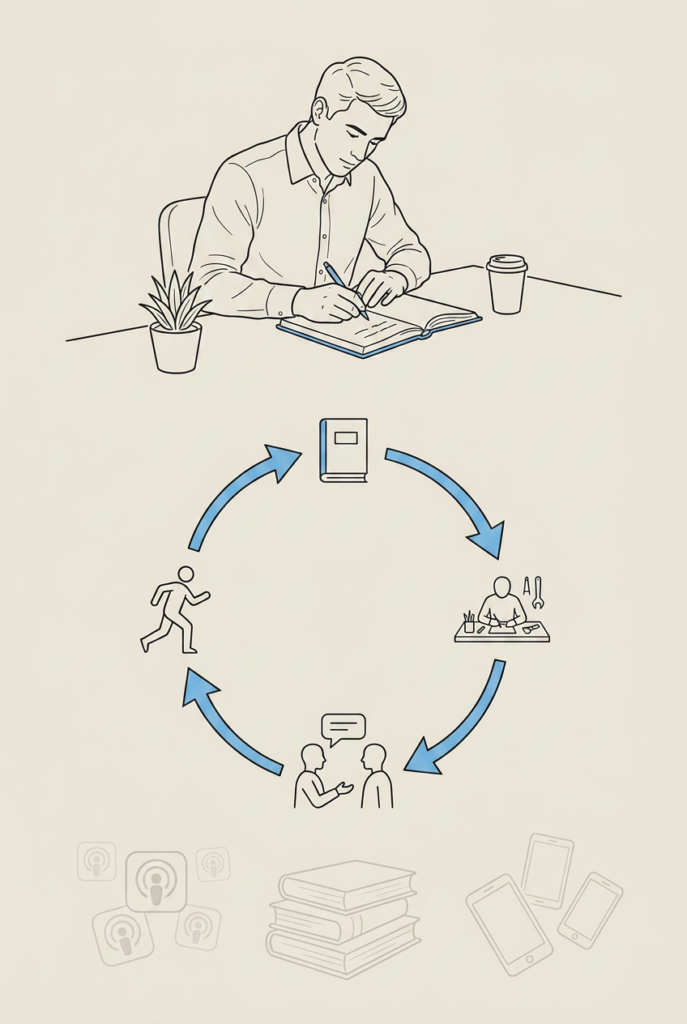
Then:
– Read or watch something about it
– Try one concrete action
– Talk it through with a peer or coach
– Adjust and try again
That’s how you actually build new mental models. And that’s what you would do if you wanted to improve your skills in a sport or other discipline.
You probably don’t have two-day blocks to spare for leadership training. But you do have fragments: a train ride, a solo lunch, or the 15 minutes before your next call.
Those moments usually get swallowed by email, chat, or doomscrolling. You can reclaim a few of them.
For example:
– Debrief a tricky situation
– Keep a tiny log somewhere: What did I try? What happened? What will I tweak next time?
It doesn’t look like much, but it compounds.
You can absolutely learn a lot from books. But some of the biggest shifts happen when you hear another manager say:
“That’s exactly what I’m going through”
and someone else replies:
“Here’s what we tried, and here’s what actually worked.”
You realize you’re not the only one wrestling with those conversations or that resistant stakeholder. And you get to see how others apply concrete tools in their context. That’s the power of learning in community, and it’s one of the core reasons M3K exists.
You don’t need an official program to “practice leadership.” You already have a lab: your day-to-day interactions. You can treat them as routine… or as experiments. For example:
– Run a Moving Motivators session and really notice where you were surprised
– Try a different way of giving feedback and ask your team member: “Out of curiosity, how did that land for you?”
– After a tough meeting, take three minutes to jot down: “What went well? What felt off? What do I want to try next time?”
No budget required. No permission needed. Just a shift from “I’ll work on my leadership when I finally have time” to “Every interaction is a chance to learn.”
The leadership development rhythm that fits busy managers
If there’s one idea to keep from this article, it’s this: When you’re busy, consistency beats intensity.
You don’t need to reinvent yourself as a leader overnight. You just need a rhythm that survives busy weeks.


Sign up our newsletter to get update information, news and free insight.