- Mon, 26 October 2026

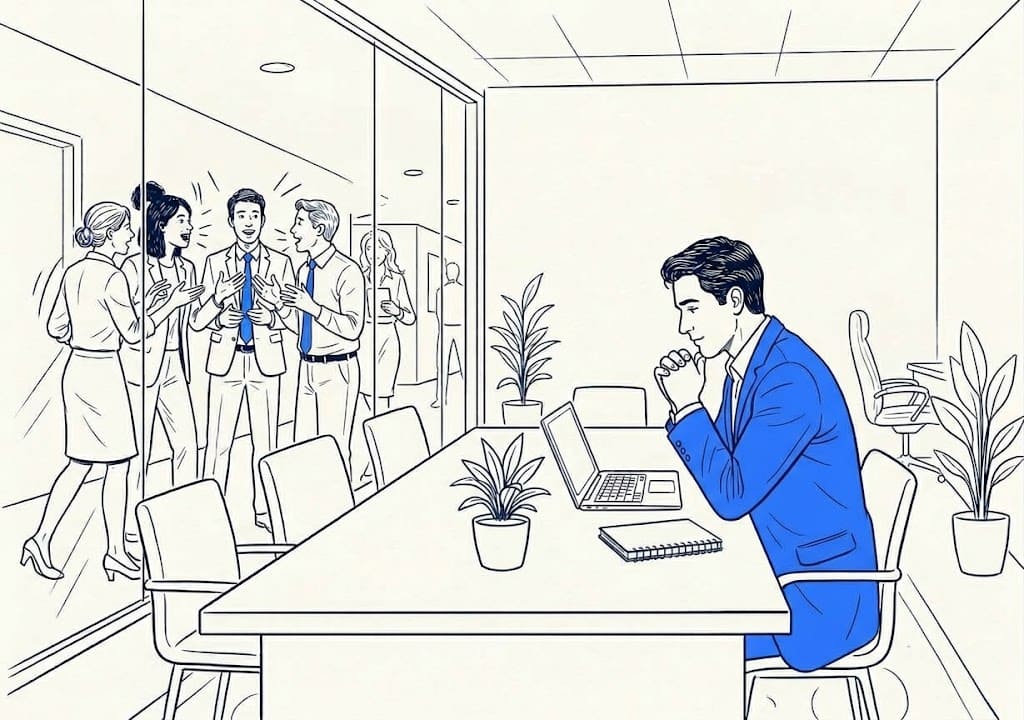
You’ve just left a two-hour brainstorming session and everyone else is already deep in a hallway conversation about next steps, building on ideas out loud in real time.
You, on the other hand, need twenty quiet minutes before you can even process what was decided, let alone form an opinion about it.
If you’ve ever been in that situation, you know exactly what we mean, and you understand the struggles of leading as an introvert in a system that was designed around extroverts.
Most advice for leading as an introvert tells you what to do with those twenty minutes: prepare harder, speak earlier, rehearse your point so you can get it out at the speed of the room.
Most of that advice quietly assumes that the way the room works is perfectly fine, and that you’re the one who needs to adapt.
Most of that advice quietly assumes that the way the room works is perfectly fine, and that you’re the one who needs to adapt.
In a previous article, Introvert Leadership: Tips for Managing Introverts, we explored the natural strengths of introverted leaders (listening, reflection, consensus-building, …).
The problem is that many organizations still reward people who can form an answer and say it out loud immediately.
That format is cheap and fast, and it systematically discards the contribution of anyone whose best thinking happens after the meeting rather than during it.
And, to be fair, there wasn’t always a practical alternative : writing the meeting up, circulating it, collecting considered responses and reconciling them cost more than the decision was worth, so teams defaulted to the room, and people with introverted tendencies learned to cope.
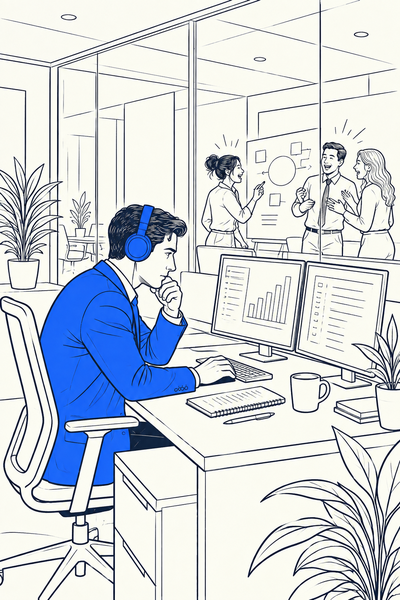
An AI meeting assistant is usually sold as a note-taker. But there’s another way to think about it, and honestly, your extroverted colleagues enjoy it just as much as you do. Treated differently, it is something else: it makes the meeting reproducible.
A decision that used to exist only in the memories of whoever was in the room now exists as a document within minutes, accurate enough to argue with.
That changes what a meeting is : now the meeting stops being the place where decisions are made and becomes the place where they are drafted.
Here is what that looks like in practice:
It gives everyone a second pass at the decision and that includes the person who was most confident in the room, who may also see things differently the next morning. A better decision process, that happens to suit how you work.
Try this as a team agreement, in plain words: decisions from this meeting are provisional until 10am tomorrow, written input counts the same as spoken input, and whoever holds the decision reconciles both before it is final.
Changing the meeting process helps with meetings and decisions. It does not cover the conversation where you tell someone their work is not good enough, or where two people on your team have stopped speaking to each other.
Those conversations are synchronous by nature and they should stay that way. They are also the ones that drain introverted leaders most, mainly because the anxious rehearsal happens anyway, at 3am, unstructured and unproductive.
Move the rehearsal to a more convenient location. Provide the context to an AI assistant and ask it to play the role of your conversation partner, then ask it to give you its opinion.
Something like this works:
The goal isn’t to write a script for you: a conversation prepared in advance is a bad conversation.
The real benefit is simply that you’ve already thought through some of the difficult moments before you walk into the conversation, so that once you’re in the room, you’ll have enough mental bandwidth to truly listen to what the other person is saying, something you’re naturally good at, but which a script tends to undermine.


All of this can make leadership easier for introverts. But there’s a downside: if everything can be handled asynchronously, it becomes tempting to avoid some interactions altogether.
If your preference is to write instead of talk, a toolset that turns every interaction into a document is not neutral, because it removes friction from the thing you were already inclined to over-use.
For example : the hallway check-in, the unprompted “how are you doing”, the moment where you sit with someone in silence because there is nothing useful to say… It gets easier to skip.
As we explored in Are You Handing Over Your Humanity to AI?, the goal is not to replace human connection but to protect the energy you need for it.
Willpower is a bad safeguard, so use a structural one: decide in advance where the reclaimed time goes. If AI hands back three hours a week, book one of them as unstructured, non-agenda contact with your team, before anything else claims it. Put it in the calendar as a commitment rather than an intention.
If you cannot name where last month’s saved hours went, they went to more work, and that is the failure mode, the most common one.
None of this replaces the practices that make leadership work: a Feedback Wrap is still a human conversation, Moving Motivators still works best face to face. AI can remove some of the administrative work, but the actual leadership still has to come from people.
As explored in 7 Soft Skills for Leadership in the Age of AI, the capabilities AI cannot reproduce are the ones many introverted leaders already have: deep listening, reflection, and the patience to let other people finish.
At Management 3.0 and M3K, we don’t think introverted leaders need to become louder versions of themselves, and the more useful question is whether the decision process gives enough room to people who contribute differently.
So, one concrete ask: try it with one meeting over the next month, make the decision provisional until the following morning and give everyone the option to add written input. Run it for four weeks.


Sign up our newsletter to get update information, news and free insight.