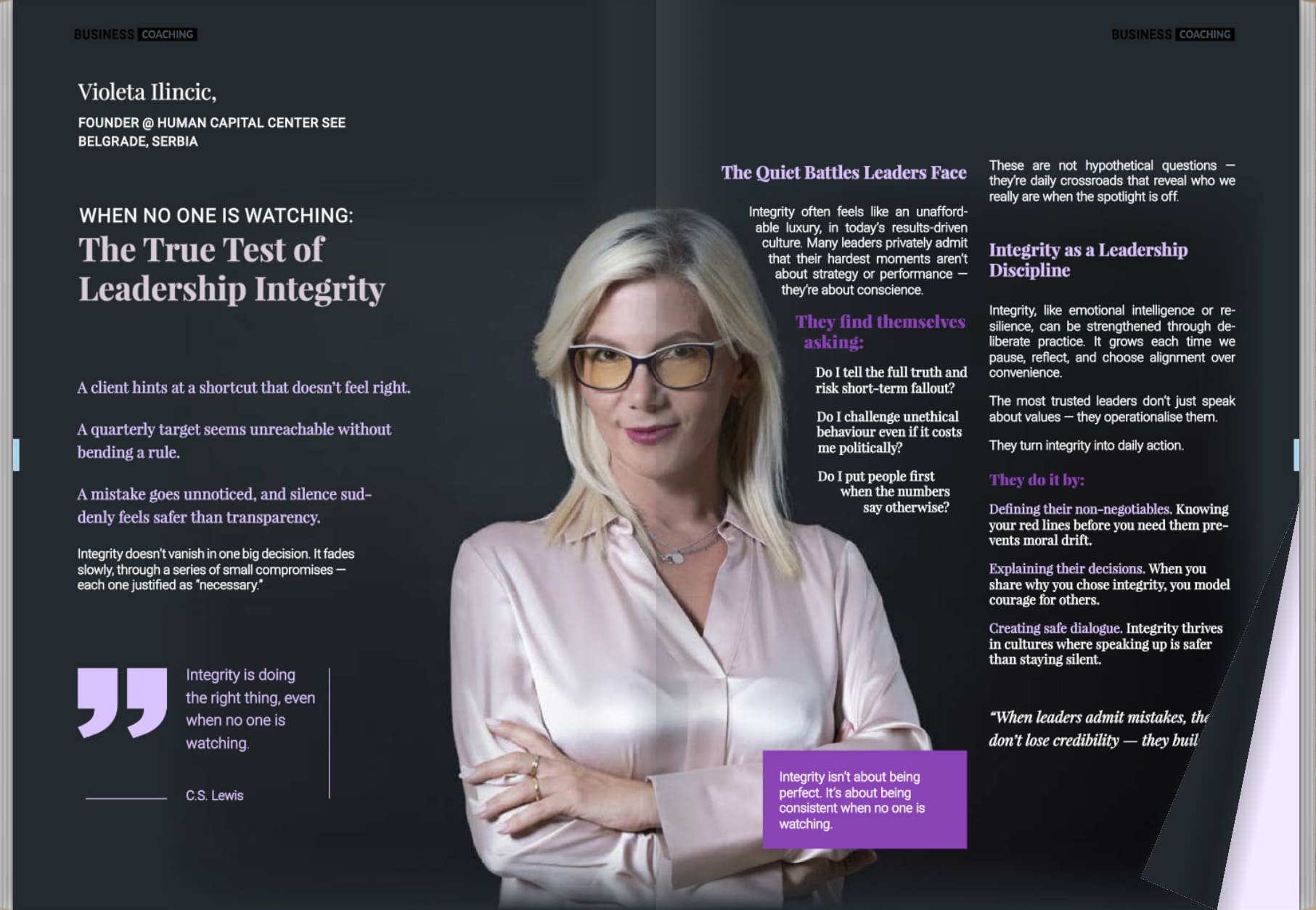
“Integrity is doing the right thing, even when no one is watching.” — C.S. Lewis
Every leader likes to believe they lead with integrity — until the first real test arrives.
A client hints at a shortcut that doesn’t feel right.
A quarterly target seems unreachable without bending a rule.
A mistake goes unnoticed, and silence suddenly feels safer than transparency.
Integrity doesn’t vanish in one big decision. It fades slowly, through a series of small compromises — each one justified as “necessary.”
The Quiet Battles Leaders Face
Integrity often feels like an unaffordable luxury, in today’s results-driven culture. Many leaders privately admit that their hardest moments aren’t about strategy or performance — they’re about conscience.
They find themselves asking:
- Do I tell the full truth and risk short-term fallout?
- Do I challenge unethical behaviour even if it costs me politically?
- Do I put people first when the numbers say otherwise?
These are not hypothetical questions — they’re daily crossroads that reveal who we really are when the spotlight is off.
Integrity isn’t about being perfect. It’s about being consistent when no one is watching.
Integrity as a Leadership Discipline
Integrity, like emotional intelligence or resilience, can be strengthened through deliberate practice. It grows each time we pause, reflect, and choose alignment over convenience.

The most trusted leaders don’t just speak about values — they operationalise them.
They turn integrity into daily action.
They do it by:
- Defining their non-negotiables. Knowing your red lines before you need them prevents moral drift.
- Explaining their decisions. When you share why you chose integrity, you model courage for others.
- Creating safe dialogue. Integrity thrives in cultures where speaking up is safer than staying silent.
“When leaders admit mistakes, they don’t lose credibility — they build it.”
Turning Integrity into Organisational Strength
Leaders set the tone. When people see that ethical choices are valued — even when inconvenient — integrity becomes contagious.
Reward transparency as much as results. Encourage open conversations about dilemmas and trade-offs. Celebrate not just what was achieved, but how it was achieved.
Integrity and performance are not opposites; they are interdependent. Teams that trust their leaders’ integrity perform better, innovate more, and remain committed even when challenges arise.
The Quiet Power That Endures
In a business world obsessed with visibility, integrity is the quiet differentiator. It doesn’t make the loudest noise — it makes the deepest impact.

Clients, partners, and employees may not always articulate it, but they feel when leadership is grounded in authenticity. And that feeling builds trust that no marketing strategy can replace.
Integrity doesn’t make leadership easier. It makes it meaningful.
A Coaching Reflection
If you paused reading this for a moment and asked yourself one question —
“Where in my leadership am I tempted to choose convenience over integrity?” —
what would your honest answer be?
That moment of reflection is where true leadership begins.
Because integrity isn’t a standard we declare — it’s a practice we live, quietly, courageously, every day.