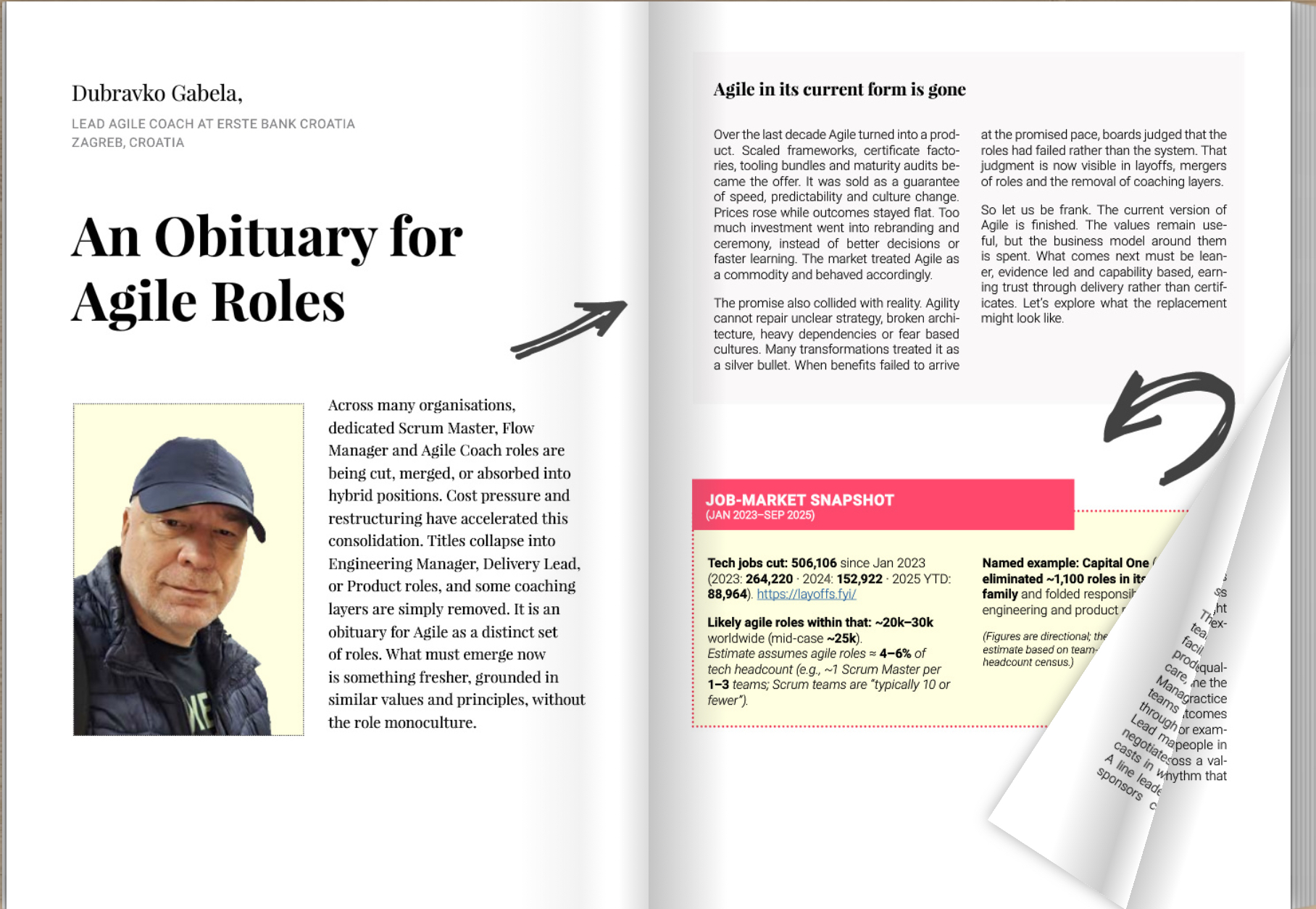
Across many organisations, dedicated Scrum Master, Flow Manager and Agile Coach roles are being cut, merged, or absorbed into hybrid positions. Cost pressure and restructuring have accelerated this consolidation. Titles collapse into Engineering Manager, Delivery Lead, or Product roles, and some coaching layers are simply removed. It is an obituary for Agile as a distinct set of roles. What must emerge now is something fresher, grounded in similar values and principles, without the role monoculture.
Agile in its current form is gone
Over the last decade Agile turned into a product. Scaled frameworks, certificate factories, tooling bundles and maturity audits became the offer. It was sold as a guarantee of speed, predictability and culture change. Prices rose while outcomes stayed flat. Too much investment went into rebranding and ceremony, instead of better decisions or faster learning. The market treated Agile as a commodity and behaved accordingly.
The promise also collided with reality. Agility cannot repair unclear strategy, broken architecture, heavy dependencies or fear based cultures. Many transformations treated it as a silver bullet. When benefits failed to arrive at the promised pace, boards judged that the roles had failed rather than the system. That judgment is now visible in layoffs, mergers of roles and the removal of coaching layers.
So let us be frank. The current version of Agile is finished. The values remain useful, but the business model around them is spent. What comes next must be leaner, evidence led and capability based, earning trust through delivery rather than certificates. Let’s explore what the replacement might look like.
From roles to capabilities
First, a candid point. Many of these roles will not be absorbed. People are being laid off, and others are folded into broader jobs with less time for coaching. What is actually happening is a shift from role identity to capability identity. Consolidation, new tooling, and an emphasis on outcomes pull Agile expertise into neighbouring roles. The risk sits with people whose professional story depends on a disappearing title. It is practical and human. It affects employability and pay. It erodes professional identity and community. It increases workload and strains wellbeing when authority is unclear. It also creates ethical exposure when coaching continues without supervision. The opportunity is to name and grow the underlying capabilities across many positions so the craft continues to matter.
Think of Agile as a capability stack that can be carried by different leaders. There is facilitation that results in clear decisions, coaching that protects autonomy and learning, literacy in flow and delivery, product thinking that keeps attention on outcomes, basic organisation design and change skills, and a habit of improving with data that people can understand. When development focuses on these capabilities, careers unfold beyond a single role.

This translation is already visible in many teams. An Engineering Manager uses clean facilitation to navigate architectural and product trade offs, coaches one to one with care, and stabilises delivery flow. A Product Manager frames outcomes, slices value so teams can move, and aligns stakeholders through simple rituals. A Project or Delivery Lead makes risk and dependencies visible, negotiates decisions across teams, and forecasts in ways that calm rather than alarm. A line leader designs an operating rhythm, sponsors communities of practice, and leads change without the need for a specific framework. In each case, the same values and principles apply. Only the labels change. Yet this translation does not help everyone. Consolidation brings real human costs: redundancies, loss of professional identity, and heavier loads for those who remain.
A practical ninety day path
Leaders often ask for something practical after a restructure to anchor this shift. A simple ninety day path is usually enough. In the first month, listen and stabilise after the reduction. Make the new structure explicit, reset expectations, and address concerns in plain language. Make work visible in one place, reduce work in progress on one value stream, shorten feedback loops, and agree how decisions are made and recorded. Set a modest change management plan that names sponsors and stakeholders, clarifies the why and the how, and sets a clear communication rhythm. Establish a regular space for reflective practice so ethical concerns and team dynamics can be surfaced early. In the second month, turn observation into habit. Introduce a weekly improvement rhythm that focuses on one impediment and one experiment at a time. Frame initiatives by problem, hypothesis, and leading indicator, and help product and engineering partners use that framing in real conversations. In the final month, check readiness for the next step, then scale what works through light cross team synchronisation that concentrates on dependencies and decisions rather than status. Hand over ownership to internal champions so the cadence outlives the sponsor.
Measurement should protect people and outcomes, not perform compliance theatre. Keep to a few signals that teams can influence and leaders can discuss without defensiveness. Track cycle time patterns and the balance of arrival to completion to show flow stability. Measure the time from decision proposal through implementation to expose decision latency. Note what changed because of each experiment to prove learning. Run a brief local pulse on psychological safety and sustainable pace. If a measure creates fear or gaming, change it or stop using it. Publish definitions and the review cadence. The test is simple. Are we making better decisions faster, with less human cost?
For practitioners
For practitioners, the career message is clear. Stop introducing yourself as a role and start with the results you enable. Prove it with clearer decisions, faster learning, and improved outcomes. Explain how you protect autonomy and consent. Invest in complementary knowledge that travels well, especially product discovery and basic organisation design. Together with coaching craft, these create a profile that fits multiple contexts and resists market swings. Your skills are still needed, but applied differently. Bridge engineering and business. Make constraints, trade offs and risks clear to decision makers. Make yourself integral to the new operating model. Anchor your contribution to one of three levers, such as customer value and revenue, risk reduction, or lower decision latency. Show the shift with concise before/after examples. Seek out the messy cross team dependency and take responsibility for making it flow. Pair with the Engineering Manager or Product Manager to frame outcomes and trade offs. Share progress in short, regular updates. Visibility built on outcomes, not noise, is what sustains relevance.

For leaders and HR
There are consequences for people development in large organisations. Leaders should plan for a two track transition: honest, humane exits for roles that will not continue, and reskilling pathways for those who can move into hybrid positions. Avoid the fiction that everyone will be absorbed. Publish clear criteria, timelines, and support.
Hiring only for fixed roles traps you in title swaps that do not improve outcomes. Hiring and growing for capabilities produces compounding benefits. Job families can evolve into bands that describe increasing mastery rather than a single track. Learning can move from courses to short practice cycles in the flow of work, supported by feedback and reflection. A small internal enablement group can curate methods, mentor practitioners across functions, and convene communities of practice without owning delivery. It is light on process and heavy on craft, which is exactly what most transformations need.
For executives and HR, the invitation is equally clear. Write job descriptions that name the capabilities you expect to see in practice rather than a list of tools. Ask for outcomes and behaviours, not brand names. For example, make decisions with the right people in the room. Improve cycle time across a value stream. Design an operating rhythm that reduces hand offs and rework. Coach two teams through conflict to agreement. Avoid shopping lists such as Jira, SAFe, Scrum, or Kanban. Pair managers with experienced coaches on real work, then reverse the shadowing so skills transfer in both directions.

Make coaching supervision part of the operating model and support communities of practice. As leaders and practitioners coach in sensitive contexts, the ethical and emotional load increases. Supervision creates structured reflection on boundaries, dilemmas and blind spots. It protects clients, supports practitioner wellbeing and accelerates learning. Treat it as risk management, not a perk. The cost is small and the cultural impact is significant.
Reward leaders who reduce decision latency and build teams that improve without heroics. In a market that prizes efficiency, the most efficient move is to grow people who make others better.
What comes after
Agile, as a collection of formal roles, is most likely outdated. The values remain useful, but the next chapter will not be built around those job titles. What replaces them is not a brand, certificate or framework. It is capability led delivery and coaching informed leadership. Whether we like it or not, the hiring market has already written the obituary. Our task now is to build what comes after, with clarity, evidence, care for the people who are leaving, and for those who stay and must learn to lead differently.