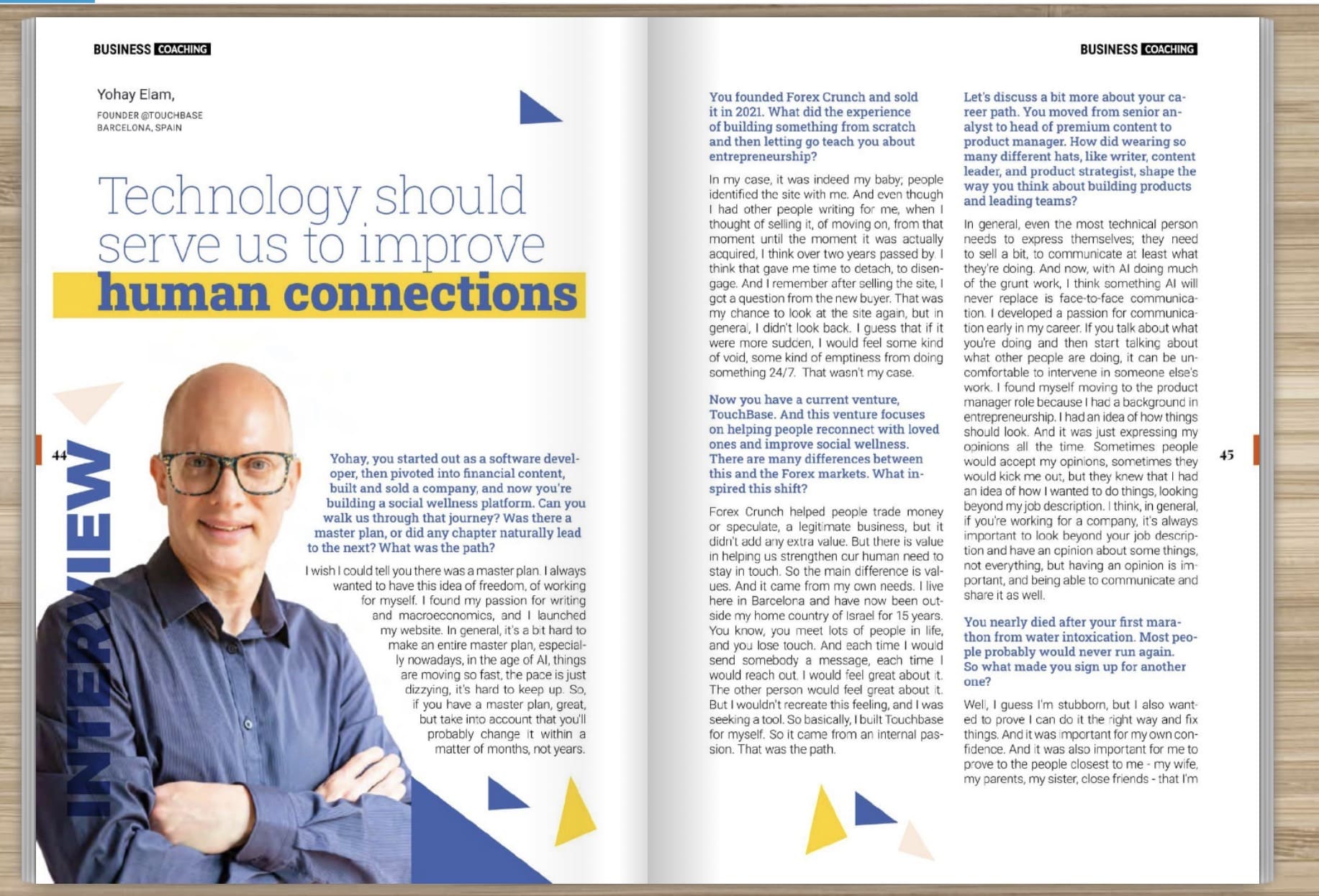
Technology should serve us to improve human connections
INTERVIEW
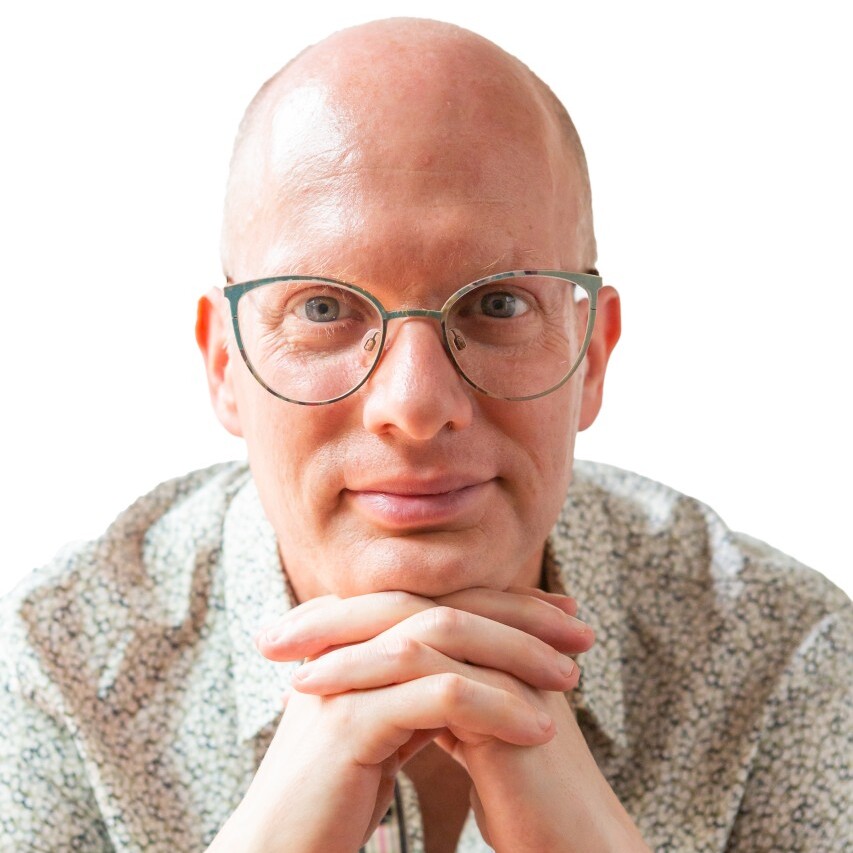
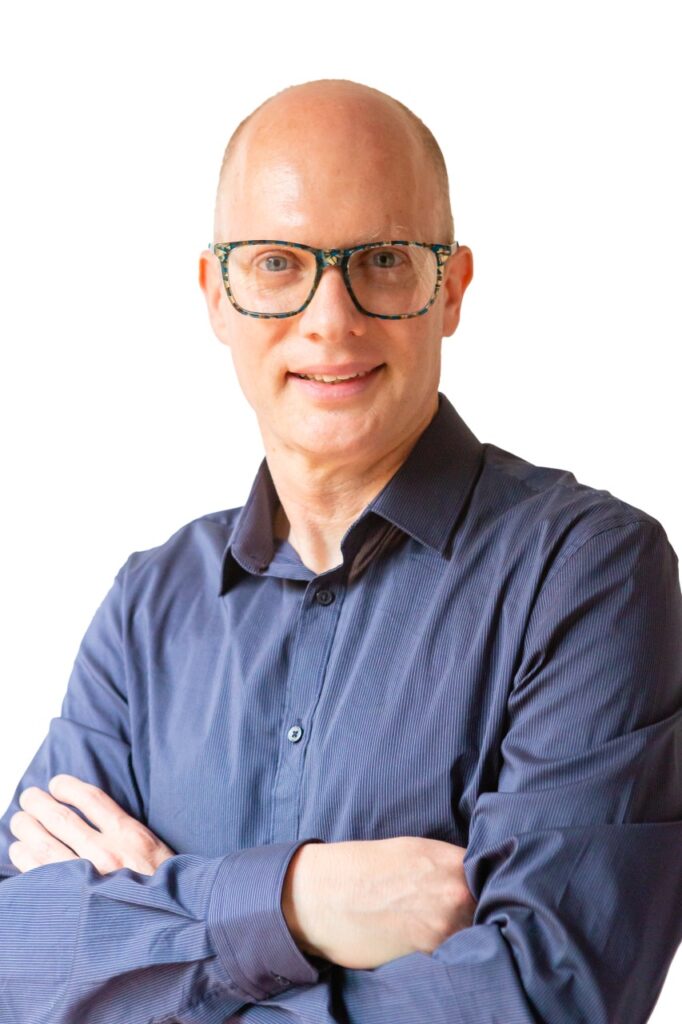
Yohay, you started out as a software developer, then pivoted into financial content, built and sold a company, and now you’re building a social wellness platform. Can you walk us through that journey? Was there a master plan, or did any chapter naturally lead to the next? What was the path?
I wish I could tell you there was a master plan. I always wanted to have this idea of freedom, of working for myself. I found my passion for writing and macroeconomics, and I launched my website. In general, it’s a bit hard to make an entire master plan, especially nowadays, in the age of AI, things are moving so fast, the pace is just dizzying, it’s hard to keep up. So, if you have a master plan, great, but take into account that you’ll probably change it within a matter of months, not years.
You founded Forex Crunch and sold it in 2021. What did the experience of building something from scratch and then letting go teach you about entrepreneurship?
In my case, it was indeed my baby; people identified the site with me. And even though I had other people writing for me, when I thought of selling it, of moving on, from that moment until the moment it was actually acquired, I think over two years passed by. I think that gave me time to detach, to disengage. And I remember after selling the site, I got a question from the new buyer. That was my chance to look at the site again, but in general, I didn’t look back. I guess that if it were more sudden, I would feel some kind of void, some kind of emptiness from doing something 24/7. That wasn’t my case.
Now you have a current venture, TouchBase. And this venture focuses on helping people reconnect with loved ones and improve social wellness. There are many differences between this and the Forex markets. What inspired this shift?
Forex Crunch helped people trade money or speculate, a legitimate business, but it didn’t add any extra value. But there is value in helping us strengthen our human need to stay in touch. So the main difference is values. And it came from my own needs. I live here in Barcelona and have now been outside my home country of Israel for 15 years. You know, you meet lots of people in life, and you lose touch. And each time I would send somebody a message, each time I would reach out, I would feel great about it. The other person would feel great about it. But I wouldn’t recreate this feeling, and I was seeking a tool. So basically, I built Touchbase for myself. So it came from an internal passion. That was the path.
Let’s discuss a bit more about your career path. You moved from senior analyst to head of premium content to product manager. How did wearing so many different hats, like writer, content leader, and product strategist, shape the way you think about building products and leading teams?
In general, even the most technical person needs to express themselves; they need to sell a bit, to communicate at least what they’re doing. And now, with AI doing much of the grunt work, I think something AI will never replace is face-to-face communication. I developed a passion for communication early in my career. If you talk about what you’re doing and then start talking about what other people are doing, it can be uncomfortable to intervene in someone else’s work. I found myself moving to the product manager role because I had a background in entrepreneurship. I had an idea of how things should look. And it was just expressing my opinions all the time. Sometimes people would accept my opinions, sometimes they would kick me out, but they knew that I had an idea of how I wanted to do things, looking beyond my job description. I think, in general, if you’re working for a company, it’s always important to look beyond your job description and have an opinion about some things, not everything, but having an opinion is important, and being able to communicate and share it as well.
You nearly died after your first marathon from water intoxication. Most people probably would never run again. So what made you sign up for another one?
Well, I guess I’m stubborn, but I also wanted to prove I can do it the right way and fix things. And it was important for my own confidence. And it was also important for me to prove to the people closest to me – my wife, my parents, my sister, close friends – that I’m capable of correcting my mistakes and doing it right. I’ve been running all my life, maybe because I never had any talent in football or basketball. I don’t know how I found myself doing that, but running — and for other people, it can be other sports — is a good way to vent emotions, to process things. So, I felt it especially a few years later when I just got injured and being unable to run was sort of brought me down. I was a lower version of myself.
In one of your TED talks, you made a key distinction between short and long runs and compared it with the difference between tactical and strategic thinking. And you said that during the long runs, you see things clearly and focus on the things that matter. How can business leaders create their own version of the long run, given what’s happening in the world? We constantly see what we need to do only for tomorrow.
AI is moving fast. We should dedicate a bit of time in our calendar to zoom out from the day-to-day stuff, and to just have a bit more time to either process the day-to-day stuff and get everything together, or take even one step further and think, okay, we had a strategy at the beginning, this is where we are, should we adapt? What’s going on? Because things are always moving fast, and plans are great, it’s better to have a plan than not to have one; it’s important to adapt. So for me, any kind of time-boxing, I do it running, but it doesn’t necessarily have to be pounding the sidewalk. I think we should all find time to do that.
You said the best time to have a hard conversation with a teenager is in a car, both staring forward, not making eye contact. And you compared that to the deep conversations that happen during long runs as well. How can leaders foster this kind of open, pressure-free dialogue within their teams?
A few things that I’ve learned. If you have a face-to-face conversation with somebody, it’s better not to sit one in front of the other, but on the side, with a sort of 90-degree angle. Then it creates less of a confrontational thing. And I know that many leaders just go for a walk with somebody; walk with me instead of just going to a meeting room. Now, it’s not always possible. We’re having this conversation online, and we’re stuck in our chairs. But if possible, relaxing that eye contact allows us to go a bit deeper. And I think, and movement in general helps as well, this kind of movement and lack of eye contact can help in concentrating better and diving deeper. That’s my experience.
The advice you offered in one TED Talk was really great: “Name your North Star, build a team around your dream, and don’t forget to eat.”
Can you explain what “don’t forget to eat” really means for leaders?
Well, it can be literal, physical. In my case, I didn’t eat enough, and that almost cost me my life in my first marathon. I think leaders and especially founders of startups can get carried away in work, and they feel energetic, and they feel that every minute they dedicate really brings the company forward. But there’s also a chance, as we know, that the extra time at work is counterproductive, or at least there are diminishing returns after you just get tired. And it’s still important to eat—even if you stay late—get a pizza and maintain some kind of routine. Don’t give up on food, don’t give up on exercise we mentioned before. Regarding “build the team” — I find that if I tell somebody, okay, this is my goal, people want to help more than we appreciate. People appreciate being reached out to more than we think. We don’t bother them as much as we think we do. When I ask somebody for help, it gives that person a sense that they’re worthy, they can do something. Of course, until a limit — we can all be annoying — but usually we underappreciate how much people want to help. And even just telling your big goal to somebody will get them to offer to help, connect you with people, and keep you accountable. So I think communicating your goals, even to people who are outside your team, is important.
You’ve gone from coding to financial journalism, to product management, to founding two companies. So what role has continuous learning and unlearning played in your ability to reinvent yourself?
Yeah, yeah, I should unlearn a lot of things for sure, we should all do. I think curiosity and flexibility are the most important things. We have plans, but in some cases we need to go with the flow and explore other things we currently find attractive to markets or to ourselves, or that we discover we’re good at. So if we get that intersection of these three things and we discover something new, we can go with this flow, or at least give it a fair chance, explore it. And I think, in general, we as people don’t always fit into a specific niche. Nobody’s born a programmer. Maybe there are exceptional football players or musicians. For most of us mortals, maybe what makes us special is not that one thing, but a mix of a few things. And I think it’s constant exploration. I unlearned how to be a programmer. And of course, I would like to have as much knowledge as possible, but I don’t think you have to unlearn on purpose. But if you accept that you moved away from something new to something else, you automatically unlearn something. Yeah. That provides space for your new thing.
And do you have anything to unlearn right now?
Unlearn right now… I have some AI shortcuts that I’ve learned, but it doesn’t mean I’ve unlearned the old ways of doing things. And sometimes I go back to the old ways, which are less productive, when it comes to some of the coding I do for my app. And yeah, I think sometimes habits are hard to get rid of. In general, if a new solution needs to be much better, some people say 10 times better than the current solution should have an immediate adoption. And yeah, I would like to unlearn some of the things I did in the past, and I wish it were faster for me to make more space for new things.
With TouchBase, you’re tackling something really, really deeply human, the anxiety of reaching out to someone after a long silence. As AI reshapes how we communicate, where do you see the balance between technology and genuine human connection?
For me, technology should serve us to improve human connections. And in some cases today, it’s the other way around with social media. It’s more polarizing, it’s more entertaining. People who only doomscroll actually feel lonelier when using something that is supposed to be social. That’s a paradox, of course. Social media doesn’t need to be bad if it’s an extension of our online lives; it’s okay. If I speak with you, then look at your social media and comment on it, and we follow up face-to-face, it’s all good. With TouchBase, I’ve learned, as mentioned before, that we don’t always appreciate how good the other person feels when they’re reached out to. And what I’m using AI here for is just to generate a message suggestion. If I haven’t spoken with you for a long time and I want to reach out, the application just takes me one step forward, but it’s actually me who has to send the message. My idea here is not to take over social life and make it superficial, but just to push users — Yeah, holding the hand, pushing, empowering. Many possible verbs, but the general idea is to take people one step closer to that actual human connection.