In business coaching, conversations often begin with familiar themes. Sometimes it’s about achievement – helping a leader reach ambitious goals, improve performance, or elevate influence. Other times, it’s about emotional regulation – staying grounded under pressure or managing conflict with calm. In complex organizations, the focus is often strategic adaptability – learning to lead through uncertainty. And sometimes, coaching simply supports sustainable growth – helping senior leaders remain effective, inspired, and fulfilled. But beneath all these topics lies a deeper layer that often remains unnamed … the question of identity.
When we work with experienced leaders, especially those in senior or executive roles, we often reach a point where the challenge is no longer about what they do but about who they are becoming. They already have the knowledge, tools, and skills. What limits their next stage of development is not competence – it’s identity rigidity: the inability to shift into a new way of being that matches the complexity they face.
That’s where My Identity Journey comes in.
The Stage of Middle Adulthood
According to Erik Erikson’s psychosocial model, adults in midlife face a tension between generativity and stagnation. They’ve spent decades delivering results, building teams, managing operations, and shaping careers. Yet at some point, many begin to sense a quiet shift, a drive to contribute beyond results, to create something lasting: meaning, culture, legacy. In coaching, this shift often appears as restlessness.
Leaders say, “I’ve achieved what I set out to do, but something still feels missing.”
They begin to question trade-offs they once accepted … between success and presence, ambition and balance, leadership and authenticity.

This moment signals the beginning of identity evolution.
The coach’s role here is to help clients expand their identity … to integrate their achievement-oriented self with a deeper sense of purpose and connection.
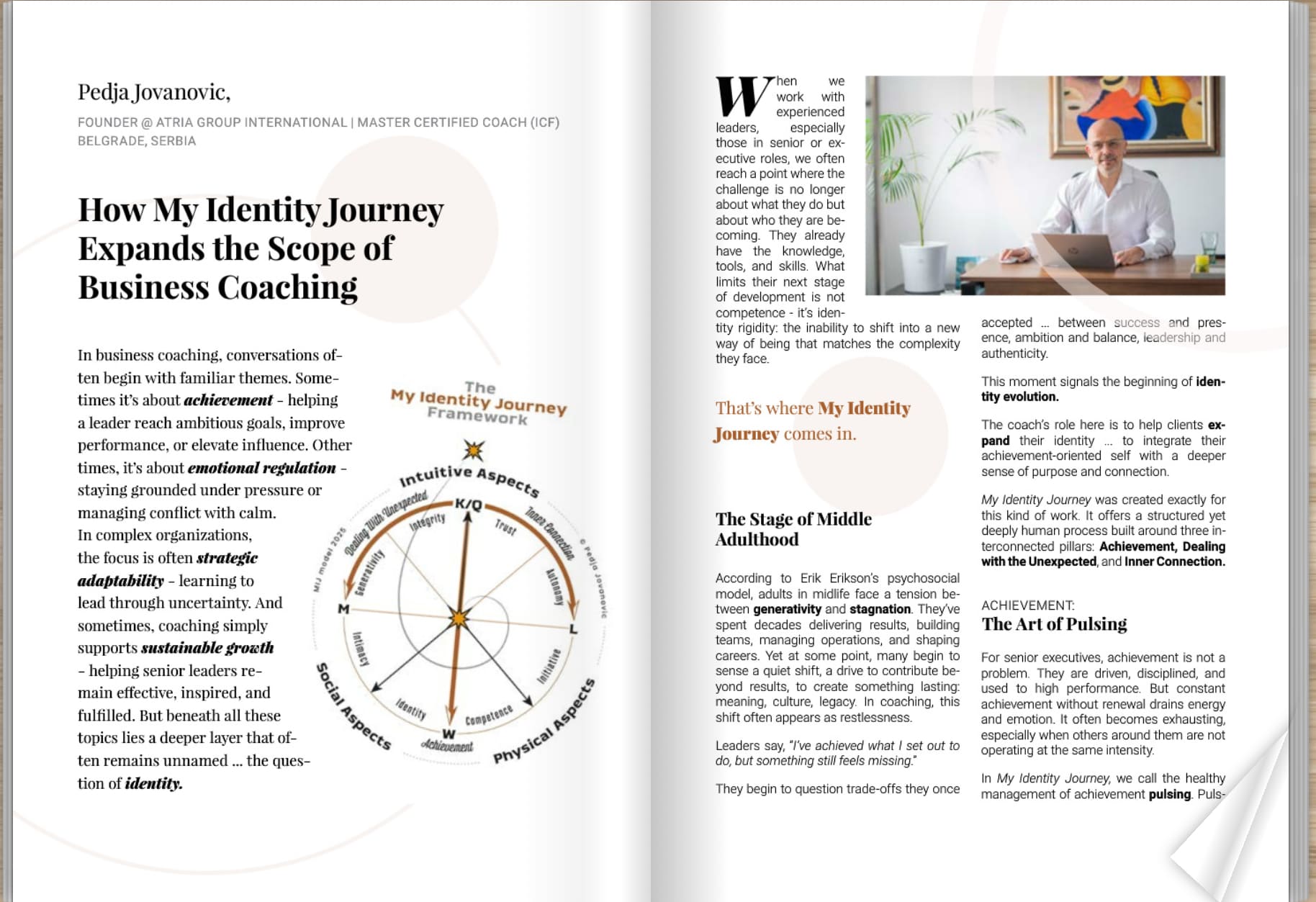
My Identity Journey was created exactly for this kind of work. It offers a structured yet deeply human process built around three interconnected pillars: Achievement, Dealing with the Unexpected, and Inner Connection.
Achievement: The Art of Pulsing
For senior executives, achievement is not a problem. They are driven, disciplined, and used to high performance. But constant achievement without renewal drains energy and emotion. It often becomes exhausting, especially when others around them are not operating at the same intensity.
In My Identity Journey, we call the healthy management of achievement pulsing. Pulsing means knowing how to fully engage (to give maximum focus and effort when it matters) and then how to step out of that mode when it’s time to rest or connect personally.
A client once told me, “I realized I was still in competition mode at home. Even small family moments felt like negotiations.” Through coaching, he learned to consciously move between modes – to bring his drive to work, and his presence home. Achievement remains vital, but it becomes rhythmic instead of constant. Leaders who master pulsing can perform at their peak while protecting their energy. They stay motivated, but they also know when to disconnect. This flexibility creates not only better results but also a more sustainable version of success.
Dealing with the Unexpected: Flexibility as Leadership Maturity
If achievement is about creating results, this pillar is about adapting to change. The higher a leader climbs, the less control they truly have. Mergers, restructurings, and market disruptions have become normal parts of corporate life. When unpredictability hits, many leaders instinctively tighten their grip. But sustainable leadership requires the opposite – openness, curiosity, and trust in one’s ability to navigate the unknown.

One of my clients, a senior executive in the banking industry, faced this challenge when her company began a digital transformation. She was suddenly asked to lead a division she knew little about. Her first thought was, “I’m not ready for this.” Through coaching, she discovered that readiness is not a skill – it’s a mindset. She started asking questions instead of giving orders, listening to younger experts, and building cross-departmental trust. The more she released control, the more influence she gained. The unexpected did not weaken her – it expanded her. This pillar teaches leaders to meet uncertainty with curiosity instead of fear.
Inner Connection: The Core of Sustainable Leadership
Achievement drives leaders forward. Flexibility helps them adapt. But what keeps them whole is Inner Connection – the ability to stay centered, emotionally balanced, and self-aware in the middle of constant motion. In fast-paced environments, leaders easily lose that connection. The noise of decision-making and deadlines often drowns out intuition, empathy, and creativity. Inner connection brings these qualities back.
During a leadership training, a CFO shared, “I spend my entire day regulating everyone else’s emotions – investors, teams, the board – but I never check my own.” Through reflection and short embodiment practices, he learned to pause before high-stakes meetings and to breathe intentionally between transitions. Within weeks, people noticed that he communicated with more calm and clarity – without losing authority.
Inner connection gives leadership depth. It replaces reactivity with response, noise with presence, effort with flow. It makes performance sustainable.
From Doing to Being
In today’s business world, adaptability, authenticity, and awareness are the foundation of sustainable leadership. Leaders who act from identity coherence handle complexity without being consumed by it. They lead with presence instead of pressure. For years, leadership development has been heavily cognitive – focused on frameworks and analysis.
These tools bring structure, but they can also create the very problems leaders struggle with: overthinking, overcontrolling, overcalculating, and overpushing.
The modern executive often lives entirely in their head, disconnected from the intelligence of their body.
The next stage of growth demands integration of awareness and embodiment.
In My Identity Journey, we combine cognitive reflection with embodied practices that activate the full human system.
Participants learn to use breathwork to regulate energy, essential oils to trigger calm or focus through sensory memory, and light-and-sound technology to synchronize brain activity and balance logic with intuition. These experiences engage both hemispheres of the brain – analytical and creative – helping leaders reconnect with their own inner rhythm.
They rediscover that the body is not just a carrier of the mind but a source of intelligence that guides decision-making, intuition, and empathy. When awareness meets embodiment, leadership becomes grounded and alive. Clarity comes with ease. Action happens without strain. Confidence flows without control. My Identity Journey helps leaders become more: more centered, more connected, more conscious. It guides them from constant performance toward authentic presence, from mental effort toward embodied flow.
When that happens, strategy becomes simpler, teams align naturally, and leadership turns from a role into a state of being.

The Future of Business Coaching
As business coaching evolves, its greatest impact will happen not at the level of performance metrics, but at the level of identity and embodiment.
Organizations already have enough tools for thinking. What they now need are practices for feeling, sensing, and integrating. The leaders of the future will not succeed by controlling complexity, but by staying fully human within it. They will lead from the nervous system as much as from the intellect — trusting intuition as much as logic.
Helping leaders reconnect with their full intelligence – cognitive, emotional, and physical – is the next frontier of coaching. It marks the shift from knowledge acquisition to self-alignment, from performance management to energy management.
That is the future of executive development: coaching the whole person – the mind that plans, the body that feels, and the awareness that observes both.
My Identity Journey offers a structured yet experiential path toward that future – combining achievement that expresses authenticity, adaptability that grows from trust, and embodied inner connection that anchors everything.