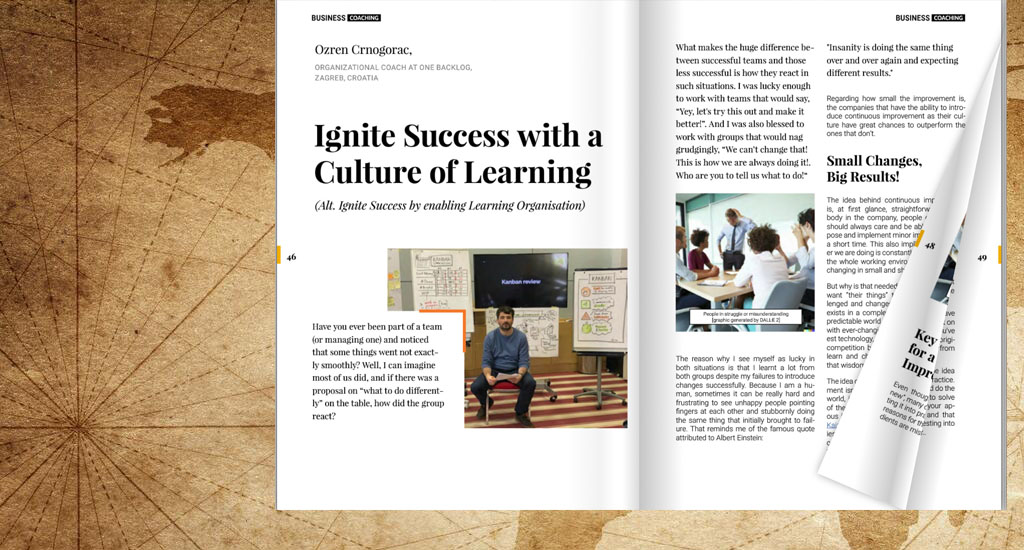
Have you ever been part of a team (or managing one) and noticed that some things went not exactly smoothly? Well, I can imagine most of us did, and if there was a proposal on “what to do differently” on the table, how did the group react?
What makes the huge difference between successful teams and those less successful is how they react in such situations. I was lucky enough to work with teams that would say, “Yey, let’s try this out and make it better!”. And I was also blessed to work with groups that would nag grudgingly, “We can’t change that! This is how we are always doing it!. Who are you to tell us what to do!“
The reason why I see myself as lucky in both situations is that I learnt a lot from both groups despite my failures to introduce changes successfully. Because I am a human, sometimes it can be really hard and frustrating to see unhappy people pointing fingers at each other and stubbornly doing the same thing that initially brought to failure. That reminds me of the famous quote attributed to Albert Einstein:
“Insanity is doing the same thing over and over again
and expecting different results.”
Regarding how small the improvement is, the companies that have the ability to introduce continuous improvement as their culture have great chances to outperform the ones that don’t.
Small Changes, Big Results!
The idea behind continuous improvement is, at first glance, straightforward. Everybody in the company, people on all levels, should always care and be able to see, propose and implement minor improvements in a short time. This also implies that whatever we are doing is constantly challenged, and the whole working environment is regularly changing in small and short increments.
But why is that needed? Why would anybody want “their things” to be constantly challenged and changed? Well, our businesses exists in a complex, volatile, and highly unpredictable world. The only way we can deal with ever-changing customer needs, the latest technology, new disruptive products, and competition breathing down our neck is to learn and change our business based on that wisdom.
The idea of continuous learning and improvement isn’t a new one. But in our fast-paced world, it’s more important than ever. Some of the amazing knowledge around continuous improvement can be found in Toyota’s Kaizen philosophy. Starting from the 1950-ies we have witnessed how the company became a leading global car manufacturer with the highest quality and most innovative cars while keeping production costs low. Many successful leaders say their company’s success comes from always learning and constantly trying to do things better.
“The ability to learn faster than competitors may be the only sustainable competitive advantage.”Arie de Geus
Key Ingredients for a Culture of Improvement
Even though this idea is “simple and not new”, many companies have a hard time putting it into practice. There are many different reasons for that, and often, some base ingredients are missing.
Here are some I have witnessed the most:
- Openness for change – On the opposite side is thinking that we are as good as we are now and there is nothing to be better! Well, if we think we are the best version of ourselves, there is nothing to be changed, nothing to improve, and no direction to strive for, all ideas for improvements, good or bad, will be dismissed in the first seconds.
“Having No Problems Is The Biggest Problem Of All” Taiichi Ohno
I often invite people to look on the work from the lens of practice. Like practising yoga, playing basketball or playing any musical instrument, maybe guitar or violin. There is always something to try out, be better and expand. So every individual should be aware of this and aspire to grow inside their existing role and outside, too!
- No blame, safe culture – We need to make sure to create an environment where everybody, people on all levels, are able to express their opinions frankly and openly. To be heard with respect and give them support to try out new things and even if the experiment ended up “Boom!” to be safe to fail. People should feel free to fail in order to share the learnings that came out of their effort. Otherwise, failure will stay only failure.
- Small ideas trump big ones – Some people think that improvement ideas should be “big”, groundbreaking, with a huge budget and hundreds of people. We can do and plan big changes, but this should not be the main focus because those ones usually require long planning cycles, lots of approvals and waiting time, so they are slow and just a few are selected to be “exceptional”. We recognise that small, continuous changes can have enormous impacts on the future. Smaller improvements are more likely to be implemented, and often, no special permission is required. The agreement is between the few and, preferably, granted upfront.
- Provide support – Sometimes, the best way to encourage change is by leading by example, meaning you should strive for your own improvement and support others in doing so. People need time and space for learning and be mindful that we all have different preferences when modes of learning are in question. Sending people to training is great but real support from “top” management is in providing opportunities for people to use the acquired knowledge. Connect it with everyday work, support slack time and experimentation. There should be time and opportunity to try new things in short intervals, learning is not once per quarter or year!
Having all that in place, or just starting to work on it, is a crucial way to begin creating the right conditions and ensuring support from your peers and management. Also, there are a few tips on working on individual learning and improvement actions.
Ways to foster learning & improvements?
Often, when I talk with people about those prerequisites, people become uncomfortable. What bothers them often is feeling that they will encourage failure if they ensure a safe-to-fail environment, slack time and give support for experimentation. Because why would anyone give their best if successes and failures are treated equally? Don’t we want to succeed?
Instead of creating a paradise for slackers, we need to ensure that there is a system of work that will minimise the risk of failure. One of the well-known and effective approaches is Kata. A Kata is an expression borrowed from Japanese martial arts, often karate and represents a set of practices that help develop a new routine or skill. It is a structured method for learning that breaks down complex things into manageable parts, allowing beginners to master small techniques step by step. Also, it is a helpful way whose application helps to achieve improvements through continuous learning. There are four main steps to pursue:
- Understanding the problem – Take time to thoroughly analyse and understand the situation you’re trying to solve. If you misunderstand the problem, likely, you won’t be able to solve it correctly. Make sure that everyone knows where you are heading to. What do we want to achieve? Where are we now?
- Plan Your Solution – Before starting, think about the solution you want to implement. This will help you decide what resources or tools you need to provide and potential obstacles.
- Review and Reflect – After you have completed, take some time to reflect on how it is working now and what you’ve learned? It’s about validating the original solution, testing it, and learning from your results.
- Repeat & repeat again – The idea of a kata is that it’s repetitive practice. After completing one, you should do the next one. The goal is not just to solve the problem, but to improve your approach to solving problems, and that comes with repetition and investing into being a better problem-solver..
Doing Katas is one of the ways how we can take care of the improvement and learning but also it is not strict rules, more guidelines. Do you notice how similar they are with PDCA, Plan > Do > Check > Act cycle, also known as Deming cycle?
The most important part of a any feedback cycle is that you’re learning and improving. If you find that a different approach works better for you, feel free to use it. Whatever you choose, make sure that a short feedback loop is an essential part of your practice.
The Time is Now!
If there is just one message I wish you take with you, it would be “Don’t postpone it. Start right now, today!”. The improvements should be part of our everyday work. Doing it frequently, preferably daily, is much more effective for improving your organisation than waiting for the right time or next year’s budget.
The things around us are changing so fast and unpredictably that planning big things is just obsolete next month after you drafted the first proposal. This is the only way that can keep your business sustainable and successful in the long run! The essential part of learning and improving culture are people themselves. Give them the opportunity and support and experience the benefits of having involved, motivated people who bring their best knowledge and innovation to their work. Peter Senge was right:
“People don’t resist change, they resist being changed.” Peter Senge