Neocharismatic Leadership® is based on transformational leadership theory which encompasses 10 behavioral roles in 3 intertwining phases. The essence of this theory is explored in this theory where altruism is introduced to balance individualism to enhance collective awareness and sustainability as leaders make decisions that affect the life of organizations and the communities they serve. In all the literature around ethics from as early as Aristotle to impersonalism, our human efforts to agree on the definition of ethics have not been very fruitful. Neocharismatic Leadership® is a simple way of looking at ethics. This simplicity may not be appreciated in a complex world where individual behavior is now encouraged and applauded regardless of how their choices impacted the collective.

In the old charisma there is a dark shadow that takes over many who transform the organization and make challenging almost impossible to achieve decisions. After the climb has ended, they tend to be overtaken by the fame and status or personal gains that they hold dearly to them. As eluded by the scholars Mendonca & Kanungo in ‘Ethical Leadership’, to strike a balance between egoism in the individuals, and the collective as a system that requires sustainability of what has been achieved or of the results that serves the purpose, a leader must build their altruism. This means, a leader must create deep awareness of their egoistic personal gains that can negatively impact the collective system. On the other hand, the model encourages truth and authenticity when the decision of the collective appears to negatively impact the individual. Moreover, it requires a leader to gather courage to challenge the status quo in a calculative manner. In doing so, A Neocharismatic leader may incur sacrifices and risks so others can thrive, an organization serve its purpose, and a system sustained for future generations. Along with this comes a great deal of humility, empathy, and ability to say no to one’s own needs and desires. Two practices are required from a Neocharismatic leader: Building altruism and defining their ethical frame of reference. Culturally speaking, I believe the frame of reference has become problematic with the increase of secularism, individualism and the decline of collective living arrangements (See Grossmann & Varnum). Plus, different global regions have their own cultural heritage, making it difficult to generalize right and wrong on arising new issues.
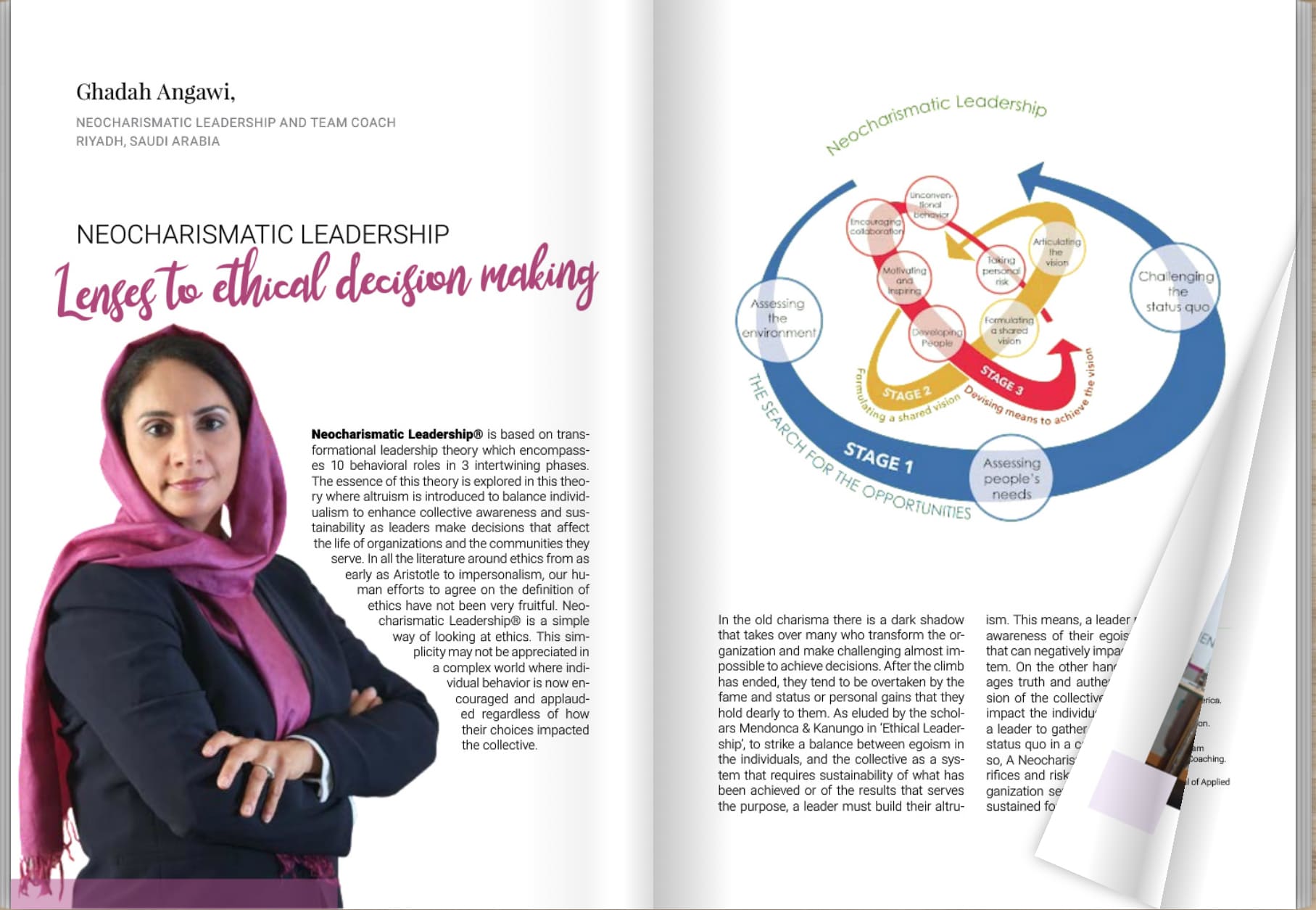
The research conducted on Neocharismatic Leadership is very clear on defining the organizational transformational roles in 3 stages and 10 behavioral roles. When leaders learn the model, they can’t go wrong with organizational transformation provided they have done the foundations. The behavioral roles are cyclic and orbital as they repeat over the three stages in an interrelated manner and continuous manner. The best way to describe this interrelatedness of roles is by imagining them as planets orbiting in a system where everything is
precise and interconnected.
Stage one is all about spotting opportunities for transformation and alignment. It contains the role of (1) assessing the environment externally or internally, while also (2) assessing people’s needs as the core operators and collaborations of this system, and (3) arriving at the idealistic vision of what it looks like to be transformed, hence challenging the existing paradigm or status quo with a strategic calculated transformational decision. Meanwhile, the second stage has been initiated to help the first actualize in two roles (4) formulate a shared vision, and (5) articulate the vision, which are both instrumental to (3) challenging the status quo, role. While all of this is picking momentum the Neocharismatic leader is also setting stage three of ‘devising means to achieve the vision’, through (6) taking personal risks and being (7) unconventional. This started in stage one role (3) challenging the status quo. A leader is shaking the core of the system to bring about the required transformation. But they are doing it in a novel and unprecedented way that requires (8) encouraging collaboration, (9) inspiring and motivating, and (10) developing people. The last three may be familiar in many transformational leadership styles, but in this one, it is altruism and an ethical frame of reference that continuously guide Neocharismatic leaders. Thus, when they are at the top, they exhibit extreme humility and ability to be (2) attentive, sense, and listen to people’s needs.
I cannot stress enough how many transformational leaders have succeeded over the history of humanity to be charismatic, until they hit arrogant, indifferent, insensitive, and maybe act in a criminal way towards humanity. Altruism deals with corruptive tendencies, individualistic thinking, and antisocial behavior. It also keeps a leader in check with what is culturally and socially important for the bigger system to thrive and sustain.

My approach with leaders is handing over the relevant book to where a leader is in their own developmental phase and level. Then invite them to join the Neocharismatic Leadership® foundations program to work on (1) deepening self-awareness, (2) increasing empathy and consideration and (3) creating a noble vision and purpose. I call this method: ‘Coach You Thoughts and Emotions®’. The book is published in two languages. The program is approved as 40 CCEs by ICF. I encourage leaders and coaches to personally take the journey to build their own capabilities to prepare for a future Neocharismatic Leadership®.
When a leader is ready and has built the foundations, they will naturally want to move to support their team and members in their teams to grow and be more effective. That brings us to the ‘Neocharismatic Team Coaching’ first Arabic reference book and program. The program is 65 hours of ICF approved AATC training where leaders and coaches simulate a team and bring best insight and practices in a continuous spiral of learning and reflecting. Leaders who come get the best of both, designing and launching a team based on 6 Team Condition approach lead by Ruth Wageman & Krister Lowe. At the startegic level, leaders developent take a deeper curve to incorporate the previous and embark on the one year journey of transformation with the program and book “Neocharismatic Leadership: A comprehensive self-coaching model”.
In this article I have displayed a three-level approach to leadership: Foundational, Team leadership, and strategic level. The programs are available in both English and Arabic as my signature programs. I encourage the reader to benefit from the 30-episode ‘Neocharismatic Leadership’ podcast in English or in Arabic with the same name found on applications like iTunes and Spotify. I hope I have brought a way to counter individualism and support collective awareness through true altruism. I hope to support leaders and coaches to create and lead ethical transformational teams and systems that continue to benefit our future generations.