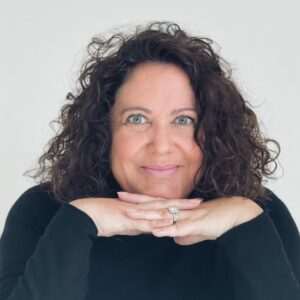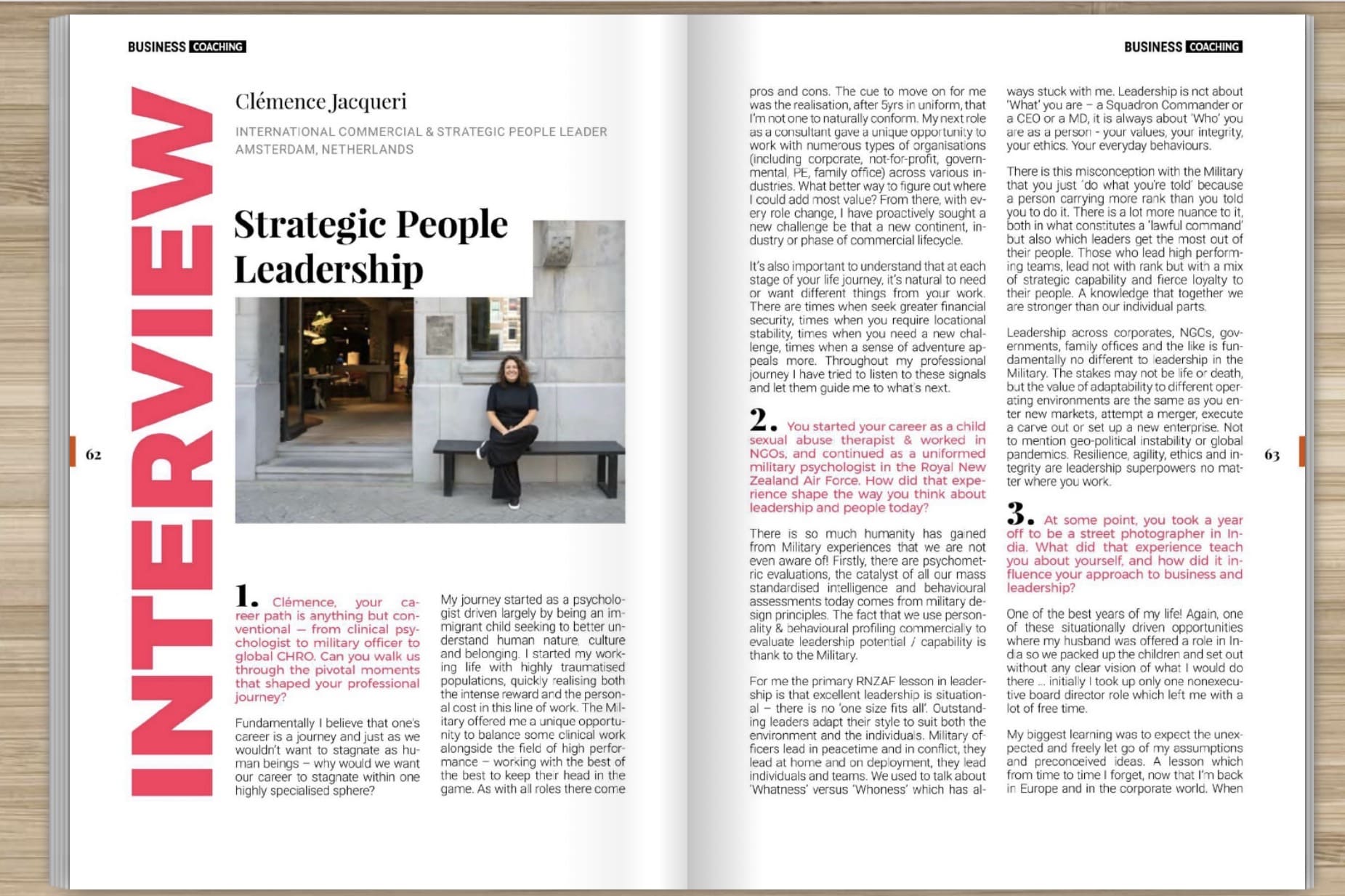
- Clémence, your career path is anything but conventional — from clinical psychologist to military officer to global CHRO. Can you walk us through the pivotal moments that shaped your professional journey?
Fundamentally I believe that one’s career is a journey and just as we wouldn’t want to stagnate as human beings – why would we want our career to stagnate within one highly specialised sphere?
My journey started as a psychologist driven largely by being an immigrant child seeking to better understand human nature, culture and belonging. I started my working life with highly traumatised populations, quickly realising both the intense reward and the personal cost in this line of work. The Military offered me a unique opportunity to balance some clinical work alongside the field of high performance – working with the best of the best to keep their head in the game. As with all roles there come pros and cons. The cue to move on for me was the realisation, after 5yrs in uniform, that I’m not one to naturally conform. My next role as a consultant gave a unique opportunity to work with numerous types of organisations (including corporate, not-for-profit, governmental, PE, family office) across various industries. What better way to figure out where I could add most value? From there, with every role change, I have proactively sought a new challenge be that a new continent, industry or phase of commercial lifecycle.
It’s also important to understand that at each stage of your life journey, it’s natural to need or want different things from your work. There are times when seek greater financial security, times when you require locational stability, times when you need a new challenge, times when a sense of adventure appeals more. Throughout my professional journey I have tried to listen to these signals and let them guide me to what’s next.
You started your career as a child sexual abuse therapist & worked in NGOs, and continued as a uniformed military psychologist in the Royal New Zealand Air Force. How did that experience shape the way you think about leadership and people today?
There is so much humanity has gained from Military experiences that we are not even aware of! Firstly, there are psychometric evaluations, the catalyst of all our mass standardised intelligence and behavioural assessments today comes from military design principles. The fact that we use personality & behavioural profiling commercially to evaluate leadership potential / capability is thank to the Military.
For me the primary RNZAF lesson in leadership is that excellent leadership is situational – there is no ‘one size fits all’. Outstanding leaders adapt their style to suit both the environment and the individuals. Military officers lead in peacetime and in conflict, they lead at home and on deployment, they lead individuals and teams. We used to talk about ‘Whatness’ versus ‘Whoness’ which has always stuck with me. Leadership is not about ‘What’ you are – a Squadron Commander or a CEO or a MD, it is always about ‘Who’ you are as a person – your values, your integrity, your ethics. Your everyday behaviours.
There is this misconception with the Military that you just ‘do what you’re told’ because a person carrying more rank than you told you to do it. There is a lot more nuance to it, both in what constitutes a ‘lawful command’ but also which leaders get the most out of their people. Those who lead high performing teams, lead not with rank but with a mix of strategic capability and fierce loyalty to their people. A knowledge that together we are stronger than our individual parts.
Leadership across corporates, NGOs, governments, family offices and the like is fundamentally no different to leadership in the Military. The stakes may not be life or death, but the value of adaptability to different operating environments are the same as you enter new markets, attempt a merger, execute a carve out or set up a new enterprise. Not to mention geo-political instability or global pandemics. Resilience, agility, ethics and integrity are leadership superpowers no matter where you work.
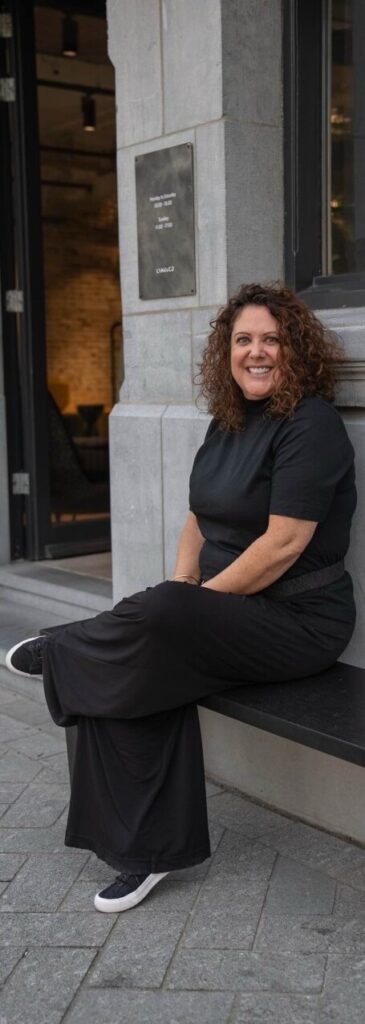
At some point, you took a year off to be a street photographer in India. What did that experience teach you about yourself, and how did it influence your approach to business and leadership?
One of the best years of my life! Again, one of these situationally driven opportunities where my husband was offered a role in India so we packed up the children and set out without any clear vision of what I would do there … initially I took up only one nonexecutive board director role which left me with a lot of free time.
My biggest learning was to expect the unexpected and freely let go of my assumptions and preconceived ideas. A lesson which from time to time I forget, now that I’m back in Europe and in the corporate world. When something is so different to anything you’ve experienced before, it’s easy to come with an openness and curiosity as you seek to understand and learn about what you are seeing / hearing / feeling. When you step back into the familiar it is more intuitive to fall back on your assumptions and jump to conclusions more quickly. Our brains leap to ‘I’ve heard this narrative before’ or ‘this is how it goes here’ without really seeing or listening for cues. In business when we recruit for our organisations from the same industry, same culture, same background, we are losing the opportunity to look through a different lens and broaden our learning.
India has a massive heart, a huge amount of curiosity and a strong desire to connect. These are things that drive us as human beings. When strangers approached me with these driving traits, despite having no language in common, I felt valued, heard and connected. Office politics, burnout and lack of psychological safety thrive when these exact traits are missing.
You’ve worked across an extraordinary range of geographies — New Zealand, the Middle East, India, Europe, the South Pacific. How has that global exposure shaped your cultural intelligence and leadership style?
Cultural intelligence is such an interesting subject. When I think of cultural intelligence I see it as driven by identity and belonging yet hampered by stereotypes and generalisations. Every nation is made up of individuals who ride somewhere along the spectrum of their cultural stereotype, I have not lived or worked in any geography where everyone is the same. For me the first step in working to better understand a specific culture is to understand their history. Just as people are shaped by their shared experience, cultures and generations are shaped by their shared history. When I take the time to understand the history of a country, a region or a specific geography, then I begin to better understand the people. What they value, what they prioritise and why. Behaviour is mostly an adaptation driven by a specific set of experiences.
I have found that the most consistent factor driving the culture or operating style of any geographical location, is the leadership of that organisation. When I was working for a global company responsible for leadership development across our South African, Gulf Region, Indian, Turkish & Israeli offices, there were two key cultural intelligence needs – one for the culture of the company itself (the values and behaviours we drove internally) and one driven by the MD of each specific regional HQ. Interestingly these local MD roles may be filled by either an expat or a local hire. One of my key learnings has been the criticality of having a mix of global and local leaders in any regional management team for a global organisation. This enables a blend of cultural intelligence with commercial execution.
You founded your own consultancy delivering leadership audits and board-level restructuring across multiple continents. What drove you to step out on your own, and what did you learn from building something from scratch?
The impetus to step out on my own came from the transition into parenthood. At the time I was pregnant with our first child, I was GMHR (what they used to call the CHRO/CPO role) driving a large-scale merger involving seven stand alone entities. It was important to me to be a fully engaged parent, and I knew that GMHR role wasn’t one I could effectively balance with parenting a newborn. I resigned, then was quickly contacted by a couple of my previous employers for ‘small’ projects. This seemed to me to be workable as a great balance between being a mum and having some form of intellectual stimulation – so my consultancy practice was born.
My consultancy practice led to the most effective lessons in time management, priority setting, work-life balance and leaning into your strengths!
I learnt:
- That following the energy, both for me and for my clients, led to the best commercial results.
- That the best results come from partnership, not just expertise
- That grit and determination as a founder are critical
- Not to say no to things outside my comfort zone
When I look back through my career I believe that being a consultant makes me a better in-house senior leader, and being an in-house senior leader makes me a better consultant.
Having worked both as an independent consultant and as a senior executive inside large organisations, what are the biggest differences in how you create impact in each setting?
To be honest I have found more similarities than differences in creating impact across both settings. In both instances, I have found the depth and breadth of my impact to be largely driven by my understanding of their commercial ambition. The better that I am able to understand what the organisation is trying to achieve, what has been successful, and where their ‘failures’ sit – the more effectively I am able to tailor my own capabilities to their specific needs.
There is this misconception that ‘HR’ is there primarily to understand people. From my perspective, the People Function (HR if you prefer) is there to understand the roadmap for the organisation and then to drive the best match between people and that ambition. Throughout the journey of: attract – onboard – develop – retain – develop – redeploy (last two on repeat) – retire, the purpose is to match individual capability with commercial need. This is no different whether you are a consultant or a senior executive.
Depending on the type of consulting assignment, the key difference for me has been time and scope of delivery. As a senior executive my focus is on the long-term viability and profitability of the organisation. As an independent consultant my focus may be only on the delivery of a specific component of a specific (usually change management) project. This of course differs on whether I am consulting to the Supervisory Board where it is usually focused on longer term commercial viability, or the Management Team where it may be a more transactional deliverable.
You’ve described yourself as a ‘Strategic People Leader.’ For our readers who are building their own leadership practice, what does that term really mean to you in day-to-day work?
There are so many buzz words used in business, and I guess this self description is trying to summarise a deeper concept in only three words! As you will have gleaned from my previous answers; for me being an effective leader comes through balancing both the commercial needs of the organisation (Strategy) and the individuals/teams who are enabled to deliver that ambition (People).
Being great at strategy but not understanding people will not get you far – neither being a fabulous people person but not understanding what the organisation is trying to achieve. In day-to-day work it is a continual focus on balancing those two elements in a sustainable way.
You’ve spoken about ‘people enablement’ as a key challenge. Can you unpack that concept? How do you ensure every employee truly understands and connects with the company’s mission?
For me people enablement is both a lifelong lesson and a moving feast. When I engage with people, I realise that what motivates and energises someone today is not necessarily the same as what will motivate them in 2 years or 5 years or 10 years. Similarly, organisations go through different life cycles so what works today is not the same thing that will drive the ambition in 5 years or 10 years or 20 years. For this reason, I don’t fear turnover and I don’t seek to build homogenous workforces. People enablement is then a concept which continually seeks to understand both the employer and employee ambitions to discover where the synergies lie.
From my experience the most important drivers in this relationship are openness and honesty. How can I as an individual fully engage with a company where the values and ethos written on paper are not aligned with the behaviours of our senior leaders?
As a CPO or CHRO I need to design the conditions including organisation design, spans of control, compensation structures, delegated authorities, total rewards frameworks, processes etc where people can succeed without constant oversight. Even with absolute best in class solutions, these cannot work in an environment where the behaviours of the senior leaders in the organisation are not congruent with the company’s mission. In many cases then, for the CHRO/CPO roles to be a true people enablement role, it becomes a position that calls out the elephant in the room or holds up a mirror for the executive leadership. In this time of Agentic AI and transformational change, it is still people who ultimately determine the success of our companies and organisations – what they see, hear and feel matters. Employees belief in a company’s mission is undoubtably driven by the behaviours of its leaders.
You’ve been vocal about the idea that hiring diverse talent is not enough — the culture has to genuinely value diversity, or people will leave. What does it take to build that kind of culture, practically speaking?
At the risk of sounding controversial, I believe the only way to build that kind of culture is top down. The CEO / MD must believe in diversity and demonstrate this in their everyday behaviours and decisions. You cannot hire diverse talent within the organisation and have a leadership team that is all one gender, or one ethnicity, or one generation or one socioeconomic group. Similarly, you cannot hire diverse talent then only listen to the voices of select groups of employees without the disengagement or loss of diverse talent.
Once the MD / CEO commits to building an inclusive culture, in addition to their own everyday behaviours, they need to consciously and explicitly reinforce these behaviours across the organisation. This means raising awareness of the value of diverse teams, challenging opposing mindsets, rewarding inclusive decision making and celebrating wins. Practically this can be structured through specific policies (EDI, parental leave, job share etc), processes (hiring targets, promotion criteria, project allocation etc) and opportunities (leadership development, HiPo programmes, secondments etc).
The most critical component to be effective is data collection and tracking. It’s not about headcount; it is ensuring effective tracking of diverse talent across the organisation across all levels and through all processes from entry to exit. Once you have the data, effective inclusive culture is built on continual reiteration of systems and processes that ensure equal opportunity for success across your diverse talent pool.
You once mentioned changing ‘Christmas gifts’ to ‘end-of-year gifts’ as a small but meaningful cultural shift. How important are these micro-signals in driving real inclusion?
Micro signals are critical in driving real inclusion. A grouping of these micro signals will quickly connect to build a more significant collective impact greater than their individual parts. Here are a handful of examples:
- End of year gift rather than Christmas gift (can also be end of financial year not necessarily December)
- Ability to swap religious holiday leave days (Christmas / Eid al-Fitr / Hanukkah / Diwali / Vesak / Vaisakhi etc)
- Celebrate different festivities through the year with culturally specific food and ‘fun facts’ about the festivities (such as the above listed celebrations)
- Have a mixture of well labelled food and beverage options at all events (vegetarian, halal, kosher, non alcoholic etc)
- Align charitable and philanthropic efforts with broader humanitarian impact that are not culturally specific (disaster relief, education programmes etc)
- If your organisation has open plan seating, ensure availability of quiet rooms or focus zones free of intrusive noise and distractions
- Doing round table quick fire check ins at the start of critical meetings (strategic planning days, monthly LT meetings etc)
- Give employees the opportunity to establish ERGs in groupings important to them (LGBTQ+, women in leadership, working parents, neurodiverse, community impact etc)
Each of these micro signals are significant in their own right to specific groups of employees, and collectively they are greater than their individual parts in creating positive cultural shift.
When asked about leading remote teams, your answer was simply: ‘Be human.’ Can you expand on that? What does being human look like in a leadership context, especially in a hybrid world?
In line with some of the previous questions, being human for me means approaching others with a level of curiosity about who they are as a person – not just what they deliver professionally. Investing time to understand what motivates them, both what lights their fire and conversely what dims their light.
It is also about showing up myself as a person. Being open about my own successes and failures. I’ve been known to come to office and letting my team know I’ve had a couple of days of sh*t sleep (unintended consequence of family emergency when split between Europe and New Zealand) so I proactively let them know that if I’m grumpy or curt ‘it’s me not you’.
Leading remote teams effectively is dependent on building a relationship with each individual team member. When the team grows so large that it is no longer possible to build a close working relationship with each individual team member, then it becomes my job to empower my direct reports to build a good working relationship with their direct reports and so on across the team. I understand that I become the senior leader whose everyday behaviours drive the sub-culture within my own team.
A few of the hacks I’ve used to build human connection in a hybrid world include:
- The group chat (Slack, Mattermost, Teams, WhatsApp) to share announcements, updates, celebrations, memes etc
- Friyay meetings where we quickfire name the highlight of the week – professional or personal
- Team Birthday Buddy where everyone is anonymously allocated a buddy who is responsible for their birthday gift
- Monthly scheduled team lunch where we book the conference room for us all just to eat our lunch together & zoom in other offices
Some of these have been initiated by me, others have been put forward by my teams based on their experiences in different organisations. It’s always worth asking ‘what would make a good work environment great for you?’. When pushed I’ve found that most teams come up with some budget friendly ideas.
You’ve talked about proximity bias as a real danger for leaders managing distributed teams. What practical advice would you give to leaders who are struggling with this?
As with any challenge, the first step is recognising that this is an issue. Once you have proximity bias on your radar, it is easier to be purposeful in your actions to mitigate it.
In the first instance I would use the same hacks that I listed in the previous question to bring people together and keep them connected. They can all be implemented virtually and at times individuals from other offices can plan their trips around the regularly scheduled team lunch to be in person. These activities work to ensure visibility of all team members regardless of their physical location. Sending out emails for feedback on strategy, projects, processes rather than only doing this verbally in meetings (in person or virtual) also provides everyone with the same opportunity to contribute.
At least annually, and preferably bi-annually I would encourage leaders of distributed teams to bring their people together. A mixture of team building, strategic planning, project prioritisation and the like will ensure you hear all the individual voices of your team members and give them a sense of inclusion/belonging. I also make a point of travelling to each of the offices within my remit at least once a quarter and encouraging my direct reports with dispersed teams to do the same. Not only does this give face time with those team members, it also provides the opportunity to better understand the unique commercial challenges of each geographical location.
You’ve witnessed HR evolve from an administrative function to a strategic partner over two decades. Where do you see the People function heading in the next five years?
I’m not sure that the transformation journey is fully complete … unfortunately there are still many senior leaders and organisations who view the People Function as largely an administrative tool. This is reflected in the number of CPO/CHRO roles that either do not report directly to the CEO/MD or whose reporting line is direct, but they are not considered part of the C-suite. It is also reflected in the entry into new markets without due consideration of the talent pools required to drive that diversification/growth. None-the-less we are heading in the right direction!
In the next five years I see the People Function becoming increasingly more commercially astute. This will be reflected in the whole function (HR Operations, Business Partnering, L&D, Talent Acquisition, Total Rewards etc) connecting more directly with the ambitions of the organisation. This will move beyond merely understanding the strategic goals of the business, to being held accountable for direct impact on top line growth or bottom-line profitability. For some governmental organisations, not-for-profits and the like it will be measurable positive mission impact.
Within the context of Agentic AI, I also see the People Function playing a more active role in business ethics and integrity. One of the most important (last couple of decades) lessons for the CPO/CHRO has been to partner with the CFO and grow their data related skills. Significant focus has been on data integrity, analysis, reporting and forecasting to allow for trend analysis, pattern recognition and effective data-based decision making. Looking forward 5-10 years, I believe the critical CPO/CHRO collaboration will be with Risk and Compliance. Together we will both monitor and shape to become the organisations conscience or ethical compass. We will identify how and where AI can be safely relied on to add considerable value, and where human decision making remains critical.
If you could go back and give your younger self one piece of career advice, what would it be — and has that advice changed over the years?
‘Be careful what you wish for’
I know this sounds like weird advice, perhaps even more like a warning than actual advice. There have been times in my career where I have wanted something very badly – a promotion, a different job title or a developmental project. Now I’d tell myself there’s nothing wrong with ambition or goals, but not to paint myself into a corner with it.
Looking back, there have been times that I’ve put myself into a very specific career path box. Where I’ve identified so strongly with a particular organisation, or trajectory – that I failed to look at other options or (even worse) looked at other options as failures.
I would advise myself to keep stay open to all options, going with what resonates intrinsically rather than focusing on what fits with others’ expectations. I guess this comes full circle to your first question about my career journey being ‘anything but conventional’. I would give my younger self permission to be even less driven by convention – and yes, that advice would’ve been different over the years.
Earlier I would’ve advised myself to focus on ethics and integrity, now I know that I have never compromised those values and never will.
- Finally, for the business professionals and aspiring leaders reading this interview, what’s the one mindset shift you’d encourage them to make right now?
I would encourage a mindset shift to Ardent Curiosity – about People and the Business
- Keep asking why and how
- Dig deeper than what’s showing on the surface
- Seek new ideas, perspectives and knowledge
- Challenge stereotypes and assumptions
- Own the change