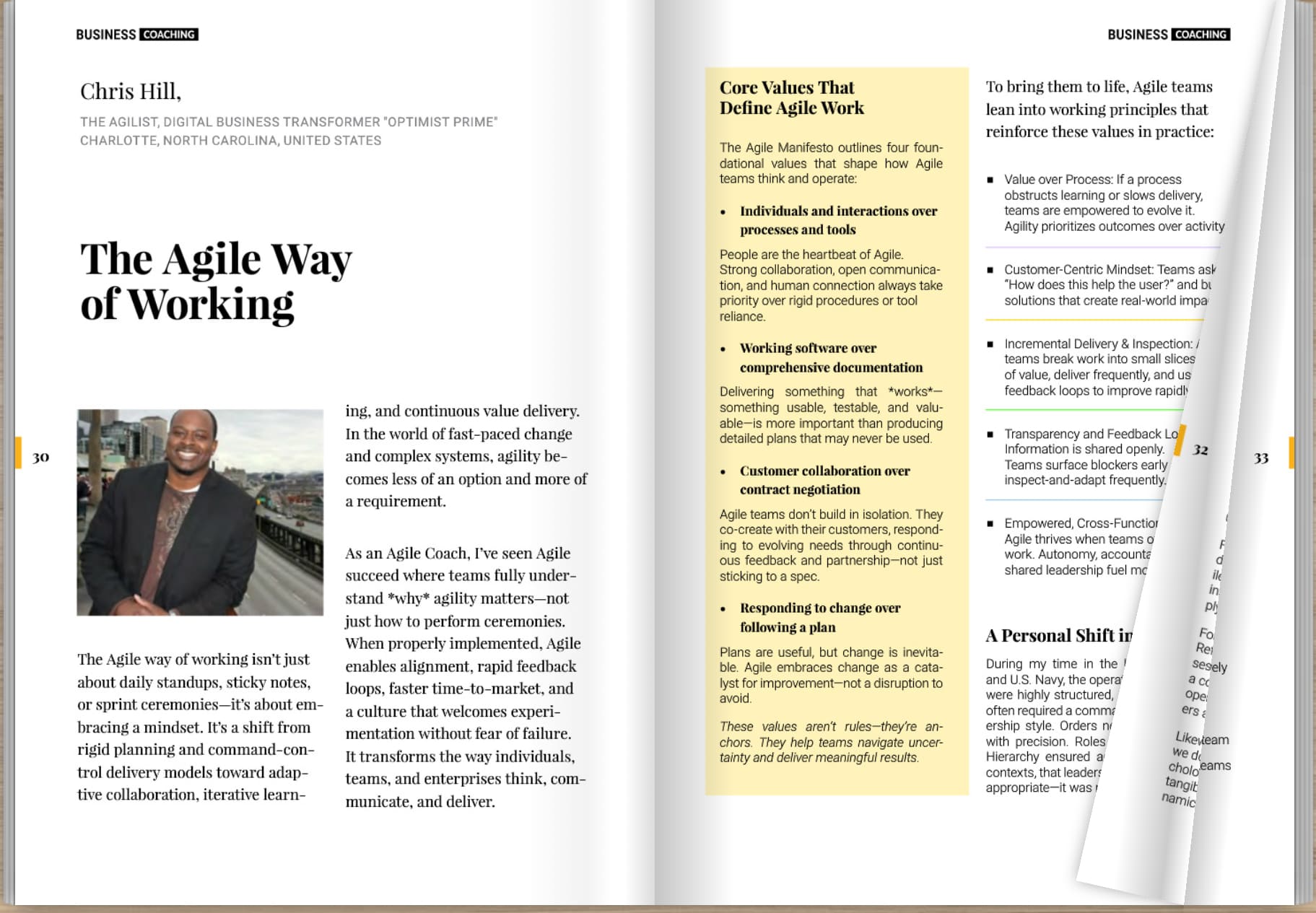
The Agile way of working isn’t just about daily standups, sticky notes, or sprint ceremonies—it’s about embracing a mindset. It’s a shift from rigid planning and command-control delivery models toward adaptive collaboration, iterative learning, and continuous value delivery. In the world of fast-paced change and complex systems, agility becomes less of an option and more of a requirement.
As an Agile Coach, I’ve seen Agile succeed where teams fully understand *why* agility matters—not just how to perform ceremonies. When properly implemented, Agile enables alignment, rapid feedback loops, faster time-to-market, and a culture that welcomes experimentation without fear of failure. It transforms the way individuals, teams, and enterprises think, communicate, and deliver.
Core Values That Define Agile Work
The Agile Manifesto outlines four foundational values that shape how Agile teams think and operate:
– Individuals and interactions over processes and tools
People are the heartbeat of Agile. Strong collaboration, open communication, and human connection always take priority over rigid procedures or tool reliance.
– Working software over comprehensive documentation
Delivering something that *works*—something usable, testable, and valuable—is more important than producing detailed plans that may never be used.
– Customer collaboration over contract negotiation
Agile teams don’t build in isolation. They co-create with their customers, responding to evolving needs through continuous feedback and partnership—not just sticking to a spec.
– Responding to change over following a plan
Plans are useful, but change is inevitable. Agile embraces change as a catalyst for improvement—not a disruption to avoid.
These values aren’t rules—they’re anchors. They help teams navigate uncertainty and deliver meaningful results.
To bring them to life, Agile teams lean into working principles that reinforce these values in practice:
– Value over Process: If a process obstructs learning or slows delivery, teams are empowered to evolve it. Agility prioritizes outcomes over activity.
– Customer-Centric Mindset: Teams ask, “How does this help the user?” and build solutions that create real-world impact.
– Incremental Delivery & Inspection: Agile teams break work into small slices of value, deliver frequently, and use feedback loops to improve rapidly.
– Transparency and Feedback Loops: Information is shared openly. Teams surface blockers early and inspect-and-adapt frequently.
– Empowered, Cross-Functional Teams: Agile thrives when teams own the work. Autonomy, accountability, and shared leadership fuel momentum.
A Personal Shift in Mindset
During my time in the U.S. Marine Corps and U.S. Navy, the operational environments were highly structured, mission-critical, and often required a command-and-control leadership style. Orders needed to be followed with precision. Roles were clearly defined. Hierarchy ensured accountability. In those contexts, that leadership model was not only appropriate—it was necessary.
But when I transitioned into Agile leadership and eventually became an Agile Coach, I had to *unlearn* parts of that structure to thrive in complex, adaptive systems. In the business world and enterprise cultures—where ambiguity, interdependency, and constant change are the norm—rigid control slows teams down. It limits autonomy, suppresses innovation, and erodes shared ownership.
Agile requires a different way of leading—one that is grounded in trust, shared ownership, and a willingness to let go of certainty in order to discover better outcomes. This mindset shift didn’t happen overnight. It was earned through experience, coaching, and learning how to create environments where people feel safe to take risks, experiment, and grow.
Frameworks Are the Practices, Not the Purpose
The frameworks are the practices and processes focused around how to deliver the value. Scrum, Kanban, SAFe, LeSS—they’re all structured approaches that provide scaffolding, not solutions. I often coach teams to use these as starting points, not destinations.
Following every rule of Scrum without understanding the “why” behind it leads to Agile theatre. The goal is to build a sustainable, inspectable, adaptable system—not to comply with a checklist.
For example, when I guide teams in Backlog Refinement, I stress that it’s not a grooming session for the Product Owner to dictate. It’s a collaborative design moment where developers, testers, designers, and product leaders align around shared understanding.
Likewise, when facilitating a Retrospective, we don’t just point fingers—we facilitate psychological safety, pattern identification, and tangible experiments to improve team dynamics and flow.

Being Agile vs. Doing Agile
Where is your mindset?
The difference between *Doing Agile* and *Being Agile* is more than semantics—it’s foundational to long-term success. Many teams fall into the trap of “doing Agile” by performing ceremonies, using Jira, and renaming roles, without ever adopting the values and principles that drive true agility. But this is not Agile—it’s simply *doing the work*. Agile isn’t about checking boxes or going through motions. It’s about *how* and *why* we work the way we do.
Here’s a layered view of agility in practice:
– Processes & Tools are the most visible entry point. Think Scrum boards, burndown charts, and daily standups. But these alone don’t make a team Agile.
– Practices—like Kanban, XP, or Lean—introduce repeatable methods for collaboration and delivery. Still, practices without purpose often become ritual without result.
– Principles are the beliefs behind the practices. They guide decisions, priorities, and trade-offs. They’re the “why” behind the “how.”
– Values are the ethical core of agility—transparency, respect, courage, focus, and commitment.
– Mindset is the root. It’s where transformation begins. It’s a shift from control to trust, from perfection to iteration.
Doing Agile means you’re executing the practices, often with an overemphasis on rituals and tools, but without fully embracing the underlying values and mindset. It’s tactical, mechanical, and often short-term focused.
Being Agile means you’re applying an Agile mindset in how you evaluate options, make decisions, collaborate, and deliver value. It’s principles-driven, adaptive, and built on trust and continuous learning. Teams that are being Agile understand when to flex the framework, not abandon it.
We’re not trying to evolve from “doing” to “being” as if it’s a ladder. For teams already *doing Agile*, the next step is to assess what’s in place and ask:
Are we embodying the core Agile values? Are we leading with mindset—or just managing with tools?
For those already *being Agile* in how they evaluate, collaborate, and deliver—keep going. Keep growing. Keep adapting.
Becoming Agile is a lifelong journey, not a destination. It’s not about scaling frameworks—it’s about scaling *thinking*.
Agility is not about doing more work faster. It’s about doing the right work, better—together.
Teams Define Their Way of Working
At the heart of the Agile way of working is one simple truth: Agility lives at the team level. It’s where ideas become outcomes, feedback drives improvement, and values are practiced—not just preached.
The most effective Agile teams don’t just follow a framework—they define their own Way of Working (WoW) grounded in Agile values and team purpose. They take ownership of the What, Why, Who, When, Where, and How of their work:
– What they’re solving and delivering—and why it matters to the customer
– Why this work is important now, and how it ties into the product vision or business goals
– Who is doing the work—roles and responsibilities within the Scrum Team (e.g., Developers, Product Owner, Scrum Master); who prioritizes (Product Owner); and who to include when external inputs, dependencies, or specialized skills are needed
– When and how often they collaborate, plan, deliver, reflect, and adapt (cadences, sprint rhythms, etc.)
– Where they work—whether co-located, hybrid, or distributed—and how they stay aligned and connected
– How they work together: how they show up for one another as a team, how they support the client, and how they maintain a culture of respect, accountability, and continuous improvement
This is where emotional intelligence (EQ) becomes essential. High-EQ teams:
– Build psychological safety
– Navigate tension and feedback with empathy
– Respect diverse strengths and working styles
– Communicate clearly and constructively
– Support each other under pressure and celebrate wins together
– Hold themselves and each other accountable to the work and to the team
To bring this shared mindset to life, teams create Working Agreements.
These agreements—whether defined at the team, cross-functional, or organizational level—make Agile values actionable:
– Respect is shown in how we listen, challenge, and resolve disagreement
– Commitment is reflected in how we follow through on sprint goals and team norms
– Openness appears in retrospectives, async updates, and honest feedback
– Courage emerges when we speak up, try something new, or own a mistake
– Focus is sustained by aligning on priorities and reducing distractions
Working Agreements aren’t documents to file away. They’re living frameworks—revisited, refined, and realigned over time.
When organizations empower teams to define how they work—anchored in values and supported by EQ—they unlock true agility: team-driven, human-centered, and built to last.
Conclusion: The Agile Way Is a Journey
The Agile way of working is a journey—a continuous loop of learning, unlearning, and improving. It’s not about perfection. It’s about building resilient teams who deliver value early, often, and sustainably.
Agility isn’t chaos—it’s disciplined adaptability. It’s about creating conditions where people are safe to fail fast, learn fast, and deliver real value together.
That’s the Agile way of working. And like any worthwhile mission, it’s not a one-time task—it’s a lifelong journey of evolving how we think, lead, and serve.