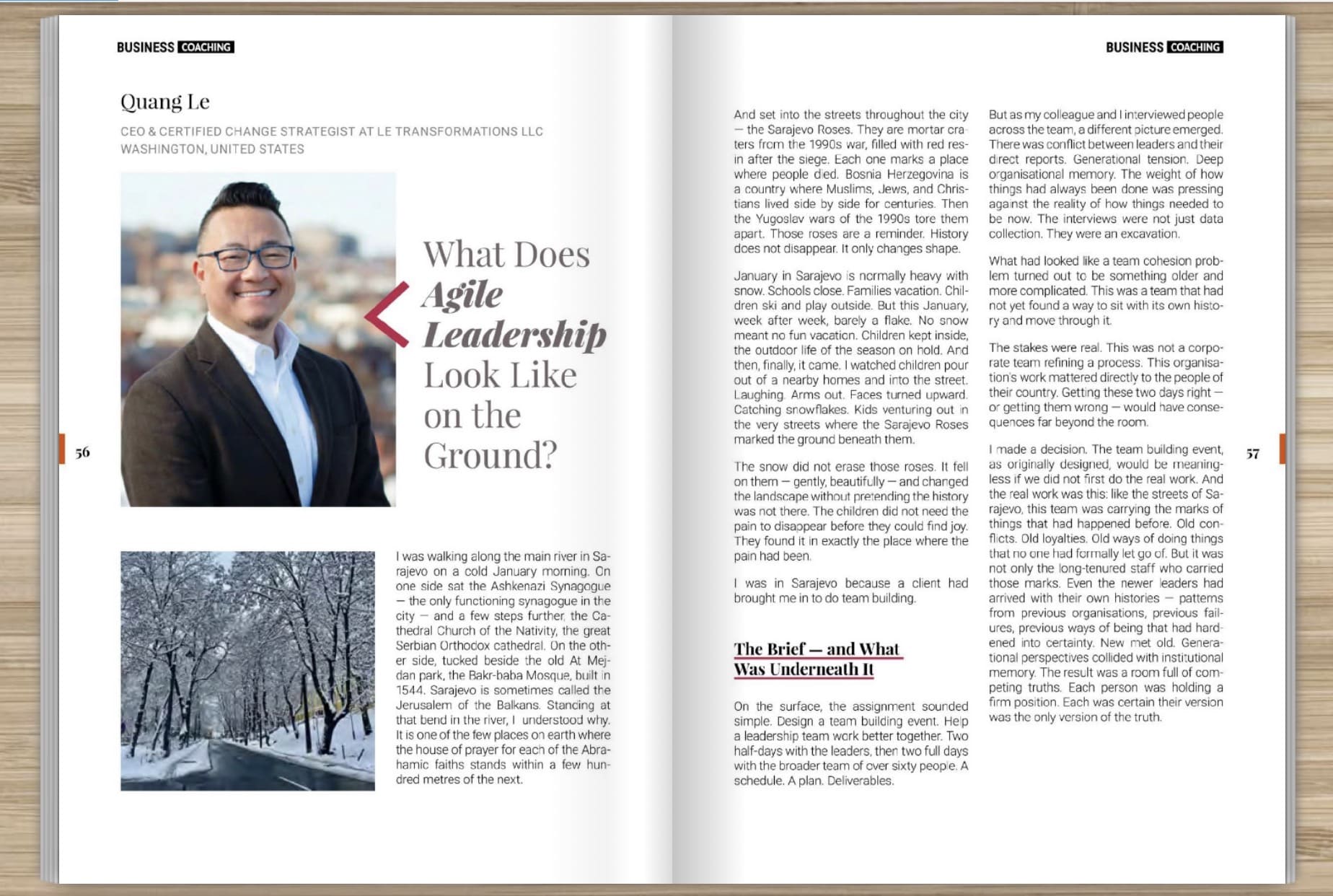

I was walking along the main river in Sarajevo on a cold January morning. On one side sat the Ashkenazi Synagogue — the only functioning synagogue in the city — and a few steps further, the Cathedral Church of the Nativity, the great Serbian Orthodox cathedral. On the other side, tucked beside the old At Mejdan park, the Bakr-baba Mosque, built in 1544. Sarajevo is sometimes called the Jerusalem of the Balkans. Standing at that bend in the river, I understood why. It is one of the few places on earth where the house of prayer for each of the Abrahamic faiths stands within a few hundred metres of the next.
And set into the streets throughout the city — the Sarajevo Roses. They are mortar craters from the 1990s war, filled with red resin after the siege. Each one marks a place where people died. Bosnia Herzegovina is a country where Muslims, Jews, and Christians lived side by side for centuries. Then the Yugoslav wars of the 1990s tore them apart.
Those roses are a reminder. History does not disappear. It only changes shape.
January in Sarajevo is normally heavy with snow. Schools close. Families vacation. Children ski and play outside. But this January, week after week, barely a flake. No snow meant no fun vacation. Children kept inside, the outdoor life of the season on hold. And then, finally, it came. I watched children pour out of a nearby homes and into the street. Laughing. Arms out. Faces turned upward. Catching snowflakes. Kids venturing out in the very streets where the Sarajevo Roses marked the ground beneath them.
The snow did not erase those roses. It fell on them — gently, beautifully — and changed the landscape without pretending the history was not there. The children did not need the pain to disappear before they could find joy. They found it in exactly the place where the pain had been.
I was in Sarajevo because a client had brought me in to do team building.

The Brief — and What Was Underneath It
On the surface, the assignment sounded simple. Design a team building event. Help a leadership team work better together. Two half-days with the leaders, then two full days with the broader team of over sixty people. A schedule. A plan. Deliverables.
But as my colleague and I interviewed people across the team, a different picture emerged. There was conflict between leaders and their direct reports. Generational tension. Deep organisational memory. The weight of how things had always been done was pressing against the reality of how things needed to be now. The interviews were not just data collection. They were an excavation.
What had looked like a team cohesion problem turned out to be something older and more complicated. This was a team that had not yet found a way to sit with its own history and move through it.
The stakes were real. This was not a corporate team refining a process. This organisation’s work mattered directly to the people of their country. Getting these two days right — or getting them wrong — would have consequences far beyond the room.
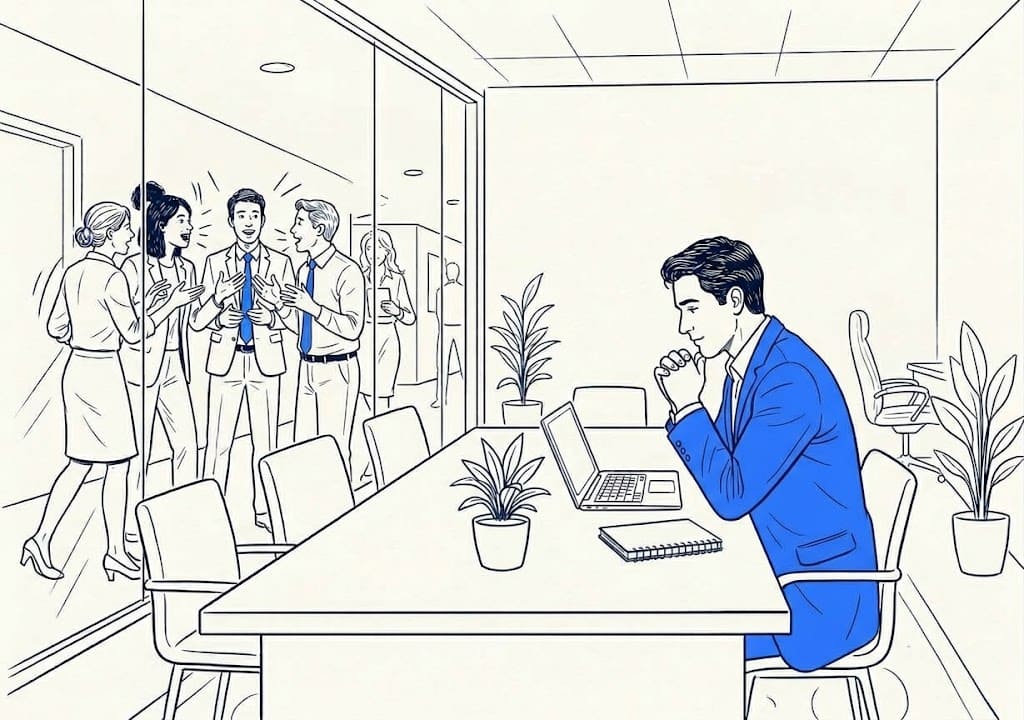
I made a decision. The team building event, as originally designed, would be meaningless if we did not first do the real work. And the real work was this: like the streets of Sarajevo, this team was carrying the marks of things that had happened before. Old conflicts. Old loyalties. Old ways of doing things that no one had formally let go of. But it was not only the long-tenured staff who carried those marks. Even the newer leaders had arrived with their own histories — patterns from previous organisations, previous failures, previous ways of being that had hardened into certainty. New met old. Generational perspectives collided with institutional memory. The result was a room full of competing truths. Each person was holding a firm position. Each was certain their version was the only version of the truth.
What they needed was not a smoother process or a better agenda. They needed snow. They needed to discover that conflict — the thing they had been managing around, smoothing over, avoiding — did not have to be brutal. Like snow falling on the Sarajevo Roses, it could be approached differently. It could even be beautiful.
They needed to discover that conflict — the thing they had been managing around — did not have to be brutal. Like snow falling on those roses in the street, it could be approached differently. It could even be beautiful.
Two Fronts, One Leadership Challenge
Agile leadership works on two fronts at the same time. The people front — trust, conflict, identity, and how leaders shape the human experience of change. And the business front — systems, decisions, alignment, and how work actually flows. Ignore the human side and people resist. Ignore the business side and change stalls.
Most Agile transformations get stuck because leaders treat these as separate steps. First we fix the process, then we address the culture. Or they misread the real problem. The presenting problem on one front is hiding a deeper failure on the other.
Here, the presenting problem was team cohesion. The actual problem was that this leadership team had not yet built the trust or the tools to handle conflict well. “Generational differences” and “organisational history” were the convenient explanations. They kept the real issue — how leaders were experiencing each other and why — safely out of the room.
A framework I use consistently shows this clearly: Successful Change = (Clarity × Capability × Commitment) – Resistance © Le Transformations 2023. Any one of those variables at zero collapses the whole equation. Here, Clarity was missing. Not clarity about vision or goals. Clarity about what was actually happening between people, and why. Until that was named honestly, nothing would shift.
Building The LETS Agile Leadership Container: How Leaders Make It Safe to Speak
Before the real work could begin, one thing had to happen first. The leadership team had to trust me. Quickly. Across all their differences. Without that trust, surfacing their tensions would have just become another confrontation. Another thing to manage around.
People often ask me how I build trust fast. I find it hard to answer. I do not experience it as a technique. What clients say afterwards: that I am calm when the room is not. That I listen for what is underneath what is being said — the implied things, the things people are circling but not naming. That I ask before I push. That I reflect back the feeling, not just the surface content of what was said. These qualities do not arrive one at a time. They arrive together, or not at all.
What I was building — what every Agile leader must build first — is what I call The LETS Agile Leadership Container © (Le Transformations 2023). It is the conditions where people feel safe enough to tell the truth. Where they can surface conflict without fear. Where they can engage honestly with difficult information. Psychological safety is not a cultural value. It is not an HR initiative. It is the direct and repeatable outcome of specific leader behaviours. The LETS Agile Leadership Container does not appear by itself. You build it — deliberately — through how you show up. Here is what that looks like:
- Diagnose before deciding. Before any intervention, conduct qualitative interviews across the whole group. No programme design. No action. Just listening. Agile leaders resist the pull toward solutions. They ask first: “What truth are we not yet facing?” They treat the presenting problem as a signal — not a destination. This tells people: your reality will be heard before it is acted on.
- Ask before pushing. What built trust in that room was not credentials. It was presence. Being calm when the room was not. Listening beneath what was being said. Asking permission before moving forward. “May I share what I’m observing? Would you be willing to say more about that?” These are not courtesies. They are acts of respect. They signal: you have agency here.
- Give people a shared language for difference. We used DiSC to give the team a way to talk about their differences without it becoming personal. Each style group named four things: what I bring, my fears, how I’m misunderstood, and what actually helps when working with me. When people read each other’s charts, the energy in the room changed. It moved from suspicion toward curiosity. People started asking each other: “When you do this, is that what’s happening for you? Because I read it completely differently.” Think of it this way. You ask a colleague for chopped carrots. You do not specify a small dice or a rough chop. You get one. You are both frustrated. Each certain the other should have known. Neither aware they were working from completely different, unstated assumptions. Agile leaders make those assumptions visible before they become grievances. This tells people: differences here are discussable, not dangerous.
- Name what others are not saying. The shift in that room came when the leadership team stopped accepting “generational differences” as the explanation. They started asking each other direct questions. Agile leaders do not wait for someone else to name the difficulty. They name what they see. “I notice we have been circling this same issue for weeks.” Then they hold the space for honest response — without rushing to resolve it. This tells people: the things that feel unspeakable can be spoken here.
- Treat decisions as hypotheses, not verdicts. A leader who can say “we made the best call we had — and now we’re changing it because the evidence shifted” is showing something important. Being wrong is survivable. Learning out loud is the expectation. When leaders pretend certainty they do not have, teams learn to mirror it. The real information stops flowing. This tells people: being wrong here is not a career risk.
Together, these five behaviours are The LETS Agile Leadership Container. Not separately — together. Each one tells the people in the room, in a different way, that it is safe to speak. That is not a soft outcome. It is the foundation for every other form of Agile leadership to work.
Freeze, Fracture, or Flex
By the end of the engagement, the leadership team had something they did not have before. A shared action plan. One that all of them had agreed to, written down, put in order, and given timelines. Not a team building plan. A practical, human commitment — to communicate more deliberately, spend time together on purpose, and deal with conflict when it arose instead of filing it under history. The work ahead was relational. And they left knowing that.
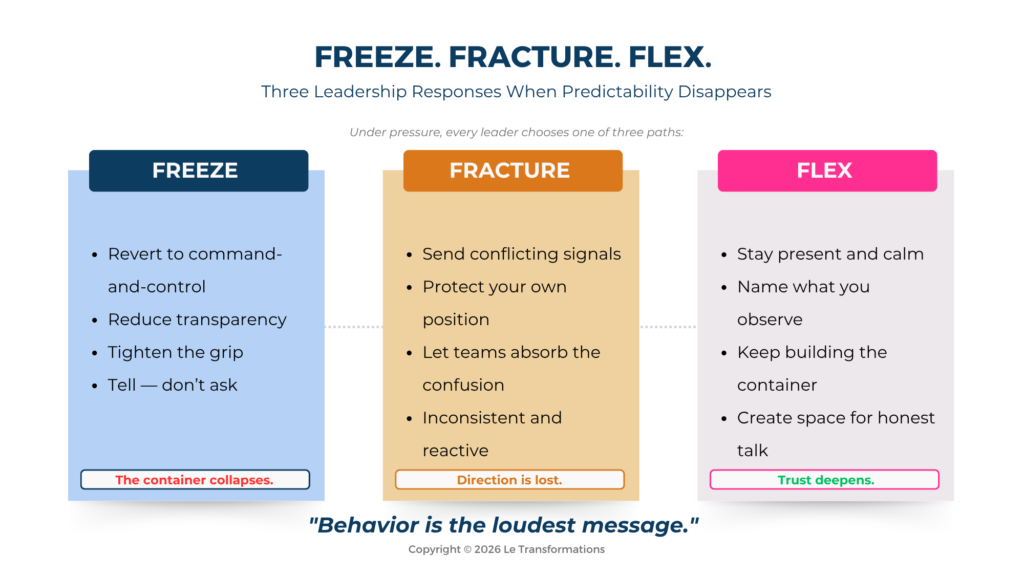
When predictability disappears — when conflict surfaces, when teams fracture, when resistance starts to look like personality — Agile leaders face a defining choice. They can freeze: revert to control, tighten their grip, become less open as uncertainty grows. They can fracture: send mixed signals, protect their own position, let the team absorb the confusion. Or they can flex: stay present, keep building The LETS Agile Leadership Container, name what they observe, and create the conditions for honest conversation — especially when that conversation is uncomfortable. © Le Transformations 2023.
Behaviour, in these moments, is the loudest message. An Agile leader who talks about psychological safety and then shuts down a challenge in a planning meeting has communicated something more powerful than any value statement. The LETS Agile Leadership Container is not built once. It is maintained — or dismantled — in every interaction. What you do under pressure is your actual leadership philosophy.
The LETS Agile Leadership Container is not built once. It is maintained — or dismantled — in every interaction. What you do under pressure is your actual leadership philosophy.
The Practice
The children in Sarajevo did not need the Sarajevo Roses to be paved over before they could play. They did not need the history resolved. The wounds healed. The complexity of their country sorted out first. The snow came. And they found joy in exactly the place where the pain had been. The roses were still there. The snow fell on them anyway.
The leadership team in Bosnia Herzegovina did not need their organisational history to disappear either. They needed The LETS Agile Leadership Container — a place where it was safe enough to feel the snow. To discover that conflict, approached differently, does not have to be painful/hurtful. It can bring people back to life in the very place they expected to find only hardness.
On my last evening in Sarajevo, a client took me to a mulled wine bar. I shared a rolled cigarette with a Serbian. Raised my glass with an American. Waved across the room at a table of young Bosnian professionals. Thanked the waitress who brought another round. Beneath our feet, the Ottoman compass was set into the pavement — the marker locals call the Sarajevo Meeting of Cultures, the point where East meets West in this city.
Nobody was holding a firm position. Nobody needed to be the only version of the truth in the room.
That was the work. Agile — not in the traditional book version, but something more precise and more human than that. Poignant for these people, for this region, for this moment.
That is what Agile leadership looks like on the ground. Not the absence of conflict. Not the management of it from a careful distance. The courage to stand in the middle of it — calm, present, asking before pushing — and create the conditions for something unexpected to happen.
The next time conflict surfaces in your team — or conspicuously does not — resist the first explanation. Resist especially the convenient one. Ask what is underneath. Build The LETS Agile Leadership Container: diagnose before you act, ask before you push, give people language for their differences, name what is not being said, and let your own fallibility be visible.
When people feel safe to speak, the real problems surface. When the real problems surface, they can actually be solved.
Sometimes, what looks like a long grey January is simply waiting for the right conditions. When the snow finally comes, the children know what to do.