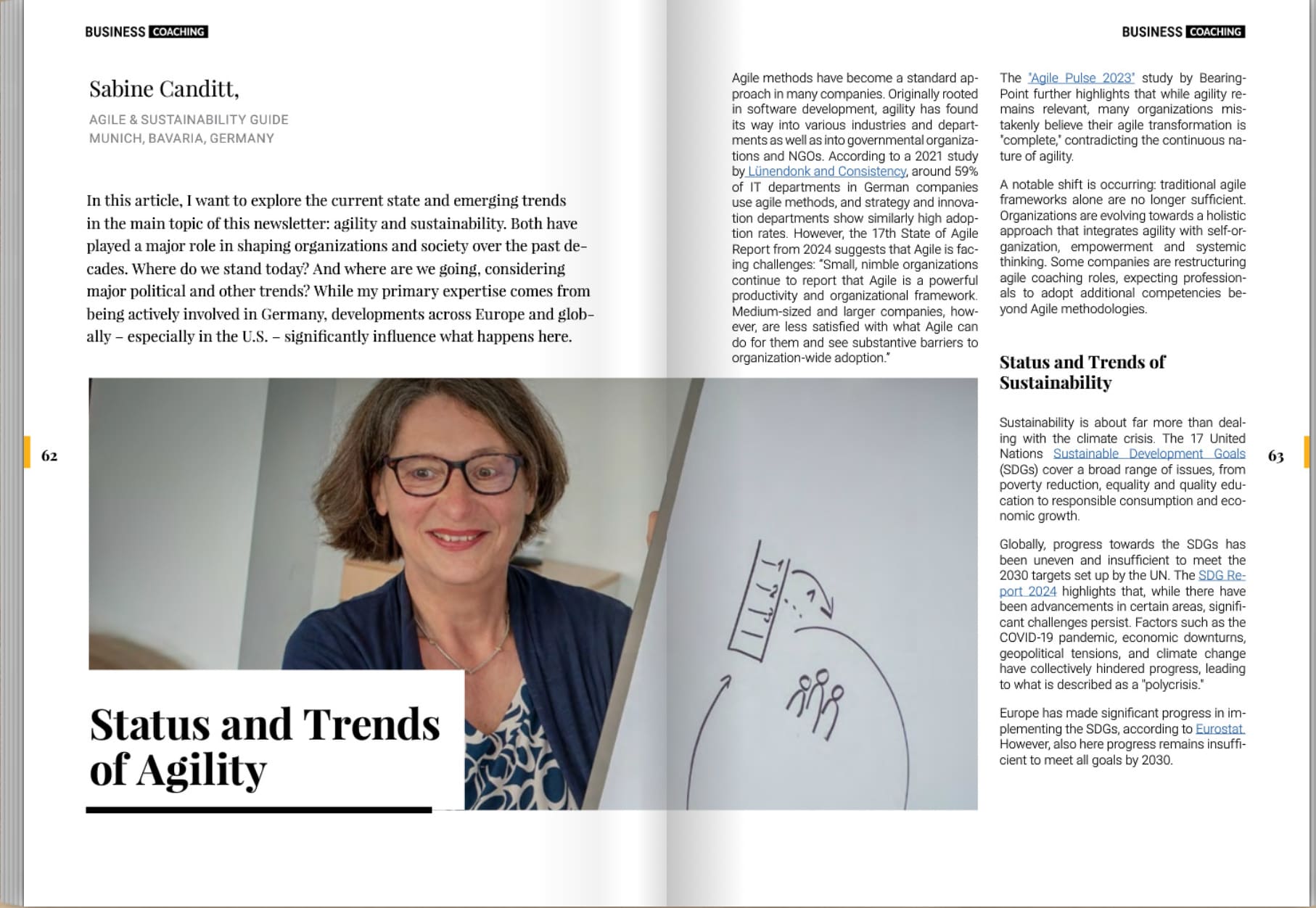
In this article, I want to explore the current state and emerging trends in the main topic of this newsletter: agility and sustainability. Both have played a major role in shaping organizations and society over the past decades. Where do we stand today? And where are we going, considering major political and other trends? While my primary expertise comes from being actively involved in Germany, developments across Europe and globally – especially in the U.S. – significantly influence what happens here.
Status and Trends of Agility
Agile methods have become a standard approach in many companies. Originally rooted in software development, agility has found its way into various industries and departments as well as into governmental organizations and NGOs. According to a 2021 study by Lünendonk and Consistency, around 59% of IT departments in German companies use agile methods, and strategy and innovation departments show similarly high adoption rates. However, the 17th State of Agile Report from 2024 suggests that Agile is facing challenges: “Small, nimble organizations continue to report that Agile is a powerful productivity and organizational framework. Medium-sized and larger companies, however, are less satisfied with what Agile can do for them and see substantive barriers to organization-wide adoption.”
The “Agile Pulse 2023” study by BearingPoint further highlights that while agility remains relevant, many organizations mistakenly believe their agile transformation is “complete,” contradicting the continuous nature of agility.
A notable shift is occurring: traditional agile frameworks alone are no longer sufficient. Organizations are evolving towards a holistic approach that integrates agility with self-organization, empowerment and systemic thinking. Some companies are restructuring agile coaching roles, expecting professionals to adopt additional competencies beyond Agile methodologies.
Status and Trends of Sustainability
Sustainability is about far more than dealing with the climate crisis. The 17 United Nations Sustainable Development Goals (SDGs) cover a broad range of issues, from poverty reduction, equality and quality education to responsible consumption and economic growth.
Globally, progress towards the SDGs has been uneven and insufficient to meet the 2030 targets set up by the UN. The SDG Report 2024 highlights that, while there have been advancements in certain areas, significant challenges persist. Factors such as the COVID-19 pandemic, economic downturns, geopolitical tensions, and climate change have collectively hindered progress, leading to what is described as a “polycrisis.”
Europe has made significant progress in implementing the SDGs, according to Eurostat. However, also here progress remains insufficient to meet all goals by 2030.
Several regulatory initiatives are shaping sustainability efforts, particularly in Europe:
- The European Green Deal aims to make the EU climate-neutral by 2050.
- The EU Taxonomy defines what counts as sustainable economic activity, steering investments toward greener projects.
- The Corporate Sustainability Reporting Directive (CSRD) expands sustainability reporting requirements for companies, increasing transparency and accountability.
In Germany, additional regulations are reinforcing sustainability commitments:
- The Building Energy Act (Gebäudeenergiegesetz – GEG, also known as “Heizungsgesetz”) sets standards to improve energy efficiency in the real estate sector.
- The Supply Chain Due Diligence Act (Lieferkettensorgfaltspflichtengesetz) mandates large companies to monitor and address human rights and environmental risks in their supply chains.
- The Climate Protection Act (Klimaschutzgesetz) establishes legally binding greenhouse gas reduction targets, requiring significant emissions cuts across sectors.
The Building Energy Act became a cautionary example of how populist narratives, sensationalist media coverage, and fossil sector investors can derail climate policy. While the revised law is now in effect and improving energy efficiency, the controversy reinforced the distorted image of the Green Party as a ‘ban party,’ a narrative that continues to shape public perception and political discourse.
At the same time, people strongly involved in the sustainability transformation more and more share the conviction that aiming at sustainability is not enough in the long run: We also have to heal the wounds of the human activities on earth by regenerative approaches.
Political Threats to Sustainability
Despite these efforts, sustainability initiatives face political opposition. The re-election of Donald Trump signals a return to policies like “Drill, Baby, Drill,” a withdrawal from the Paris Climate Agreement, and substantial cuts to environmental and social governance (ESG) initiatives.
Unfortunately, climate and environmental protection have been overshadowed in the current German election campaign by topics such as migration and economic growth. As voter priorities shift, sustainability has also lost prominence on the agendas of major political parties. The Free Democratic Party (FDP) has proposed a “sabbatical year” from sustainability reporting to reduce bureaucracy. The FDP also supports expanding domestic natural gas extraction. The Christian Democratic Union (CDU) and FDP oppose a general speed limit on highways and plan to repeal the Building Energy Act (Heizungsgesetz).
The extreme right Alternative für Deutschland (AfD) outright denies human-caused climate change. Their manifesto calls for Germany’s withdrawal from the Paris Climate Agreement and the EU Green Deal, arguing that climate policies harm economic prosperity. They also propose abolishing climate protection subsidiesand state-funded sustainability programs entirely. We see similar tendencies in the EU parliament, where more and more right wing parties influence the political direction of the EU.
These developments highlight the fragility of sustainability initiatives. If major economies deprioritize climate action, it could weaken global climate efforts, affecting trade policies, investments, and corporate commitments worldwide.
Business Risks and Chances of Sustainability

Sustainability is often perceived as a cost driver rather than a business opportunity. However, evidence suggests that sustainability is increasingly linked to financial performance and competitive advantage. Companies that integrate sustainability into their core strategy often experience cost savings through energy efficiency, waste reduction, and optimized resource management. Firms with strong environmental, social, and governance (ESG) practices tend to outperform competitors in resilience, risk mitigation, and investor attractiveness. The circular economy is gaining traction as a financial strategy, prioritizing reuse and recycling to reduce waste and resource dependencies. Sustainability reporting frameworks like the German Sustainability Code (DNK) help companies showcase progress and attract ESG-conscious investors.
At the same time, there is a risk that organizations lag behind technological advancements. Just as the German automotive industry underestimated the shift toward electric mobility, companies that ignore sustainability trends may struggle to remain competitive in an evolving market. Digitalization and AI are transforming sustainability efforts – while AI optimizes resource use, the growing energy demands of cloud computing and data centers pose new challenges.
The question remains: How can businesses transition from viewing sustainability as a moral or compliance obligation to recognizing it as a driver of innovation, profitability, and adaptability in general?
Initiatives Bridging Agility and Sustainability
In these uncertain times, Agility’s iterative and adaptive approach allows businesses and other organizations to experiment with a higher level of participation, sustainable solutions, quickly pivot when necessary, and scale impactful initiatives more effectively. Agile teams embrace continuous learning, feedback loops involving more stakeholders, and decentralized decision-making, which align well with sustainability goals that require long-term commitment, innovation, and systemic change.
Another crucial area in organizations is well-being and stress prevention, which contribute to resilience in organizations. By fostering psychological safety, promoting sustainable work practices, and helping teams manage complexity without burnout, Agile Coaches can support both agility and sustainability. Additionally, they can play a vital role in guiding organizational transformations toward sustainability or even climate-positivity, ensuring that sustainability initiatives are not isolated efforts but deeply embedded into business culture and decision-making processes.
Movement to connect agility and sustainability recognize that the two can reinforce each other. Some of the most noteworthy initiatives include (for links see comments):
- Agilists4Planet – A community of agile practitioners (joannestone@rogers.com and others) committed to integrating sustainability into agile work environments. The initiative has published three editions of the “We Hope” magazine with inspiring stories. It has hosted numerous “The Week” sessions that have reached more than 150 people in 23 countries.
- Agile Sustainability Manifesto – A set of principles linking agile values to sustainable business practices.
- Sustain-Agility Verein – A think tank in Germany to foster the connection between agility and sustainability in businesses
- Green PO – A Community for Sustainable Product Professionals
- Programs for leaders to to thrive in the fluid business environment, like the EPiC Leadership Agility podcast by lyssa@lyssaadkins.com or Evolvagility
- Initiatives to make software environmentally friendly, like Green Software Foundation and Bundesverband Green Software e.V.
- Green Teams Network – A support for people and groups who want to engage for sustainability within their organization
Call to Action
Do you know of other initiatives that bring agility and sustainability together? Have you encountered inspiring examples in your work? Share them in the comments! I would also love to interview people leading such initiatives – reach out if you’re interested.