When coaching or supervision sessions turn into a “one-size-fits-all” model which does not fit at all… Do not hesitate to jump from talking to building!
The background
Before becoming a coach, I was a professional translator and interpreter, and since then I have worked closely with hundreds of clients as a communication coach, helping them develop their speaking, reading, listening and writing skills in English as a second language. For over three decades I have witnessed their fears, frustrations, limiting beliefs, and how their frames of reference – sometimes ideological – stood in the way between their desires and their outcomes.
This is how I first came into contact with our “inner chatter”, how we tell ourselves stories of possibilities or failure, how language creates worlds. “I’ll never learn a language”, or “I’m too bad at languages” they would tell themselves. However, those who were really motivated, who had a “what for”, were definitely the extra milers. These people were resilient, didn’t mind trying over and over again, surfed their learning curve naturally without impatience or resistance, while telling themselves “I can make it”.
At that time I lacked the tools and skills I have today as an executive coach, but the vast experience I gained perceiving the vulnerability of those human beings who had trouble admitting their limited knowledge of the language, or who felt embarrassed when they made mistakes and struggled hard with pronunciation, or just could not manage to “think in English” shaped me into the coach, mentor and supervisor I am today.
Transition towards partnering with clients to achieve loftier goals
Over a decade ago my career developed naturally into the field of executive coaching, in the corporate world, where I feel most comfortable particularly with middle managers from virtually all business areas. I’ve always enjoyed partnering with clients so that they can unleash their potential, and unveil what they are completely unaware of…the stories they tell themselves.
Already as a coach I had no intention of stepping back from my role as trainer, which I find quite satisfying and enjoy heartily. I like sharing experiences and motivating trainees, because I’m a lifelong learner myself, and there’s nothing like training from our own experience. However, I’m aware that everyone has their own ways of learning, their own pace, and their willingness to take action. “Not everyone is coachable or ready for coaching” we usually say. It’s true, we’re not all the same, but it’s just a matter of lighting the fuse… rather than blaming it on the client: “he’s not committed enough”, “she avoids reflecting…”, perhaps we should take a look at ourselves as coaches and supervisors, and try something creative for a change!

The value of professional coaching
What attracts me to coaching is that it draws on other disciplines such as positive psychology, humanism, neuroscience, communication, and behavioral sciences, basically. It’s a professional practice that inspires self-reflection, self-knowledge, self-regulation. A good coach prompts us to explore why we behave the way we do, what triggers our emotions, what our moods enable us to do or not to do, and what we need to change in ourselves to achieve different goals and results. However, we must be very clear about the differences with other disciplines, such as psychotherapy. Coaching focuses on the future, on creating worlds of possibilities, tapping into our own resources, delving into what we don’t know that we know or that we don’t know.
Common patterns in most clients
Over the years as a coaching student, trainer, mentor and supervisor I’ve observed common patterns in most of my clients, regardless of my interventions: they tend to lose focus or find it hard to speak about sensitive or challenging issues, express feelings or take action; they may have trouble setting clear goals, they find it hard to “see the whole picture”. This is a challenge for experienced coaches and supervisors, and much more for junior professionals. A good session depends upon a clear agreement, but other tools in addition to questions might help coaches and supervisors become more effective with their clients.
What if I get my clients to play?
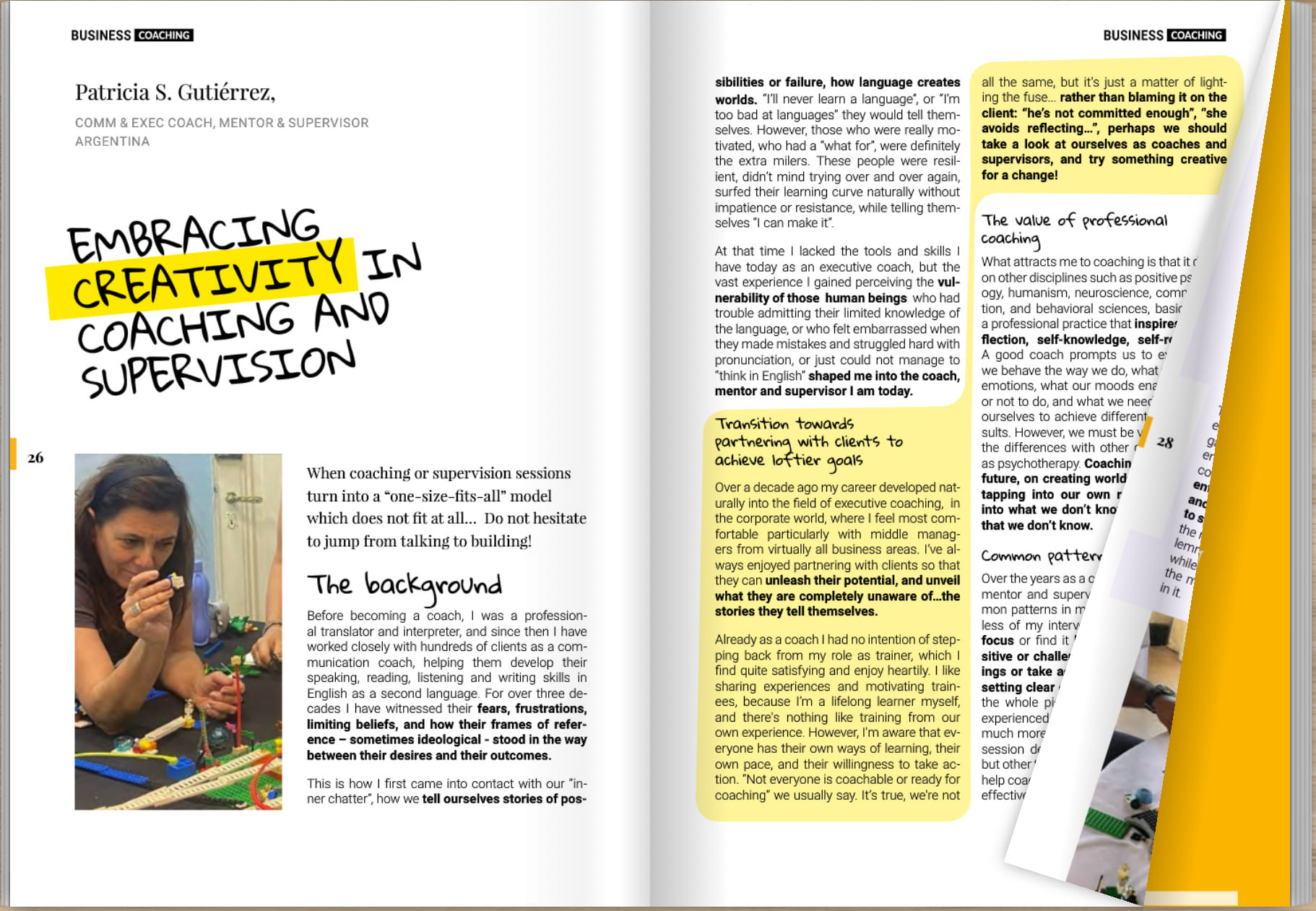
A little over a year ago I certified as a LEGO® SERIOUS PLAY® facilitator to work with top-level teams on the development of their real-time strategy. Little by little, I started using the bricks in my coaching and supervision in hopes of making my sessions more powerful, effective and revealing…
It all began when I proposed a client who was unable to put into words what he wanted to achieve in the session “not to talk about it but just to build it”. Building the dilemma is an innovative, hands-on approach that enhances problem-solving and creativity. The method leverages physical play to unlock insights, and connects the hands with the three brains: rational, emotional, intuitive.
The 3D models represent thoughts, experiences, and solutions to challenges. By engaging both the hands and the mind, LSP enables deeper engagement and expression compared to traditional verbal methods. Clients think with their hands, while coaches and supervisors listen with their eyes, so to speak. They see the congruence between the model (a metaphor of the situation or dilemma) and the story the client tells about it while using their hands to describe what’s in the model and what each piece represents in it.
The coach asks typical coaching questions but also focuses on the model: colors, locations, sizes, what’s missing, shapes, orientation, distance… Clients literally play as if they were kids and keep focused while exploring sensitive topics. Building models allows coaches / supervisors and clients to visualize abstract concepts, making it easier to identify patterns, opportunities, and solutions. The methodology fosters a sense of ownership and accountability, as clients create and share their insights, leading to stronger commitment to actions and decisions.
Conclusion
Creative resources are a powerful tool in coaching and supervision, transforming the way individuals engage with challenges. By tapping into creativity and fostering open dialogue, a method such as LSP (or any other alternative creative resource that the professional wishes to try) promotes a collaborative environment where innovative solutions can thrive. Embracing creativity not only enriches coaching and supervision practices, but also enhances overall organizational effectiveness.
Who do we serve when we do our work as coaches and supervisors: the client, the organization they work for, their stakeholders and the community as a whole.
Do not hesitate to get outside the box. Help clients tackle problems from a different perspective.