The Importance of Developing and Nurturing Reflective Practice in Business and Life
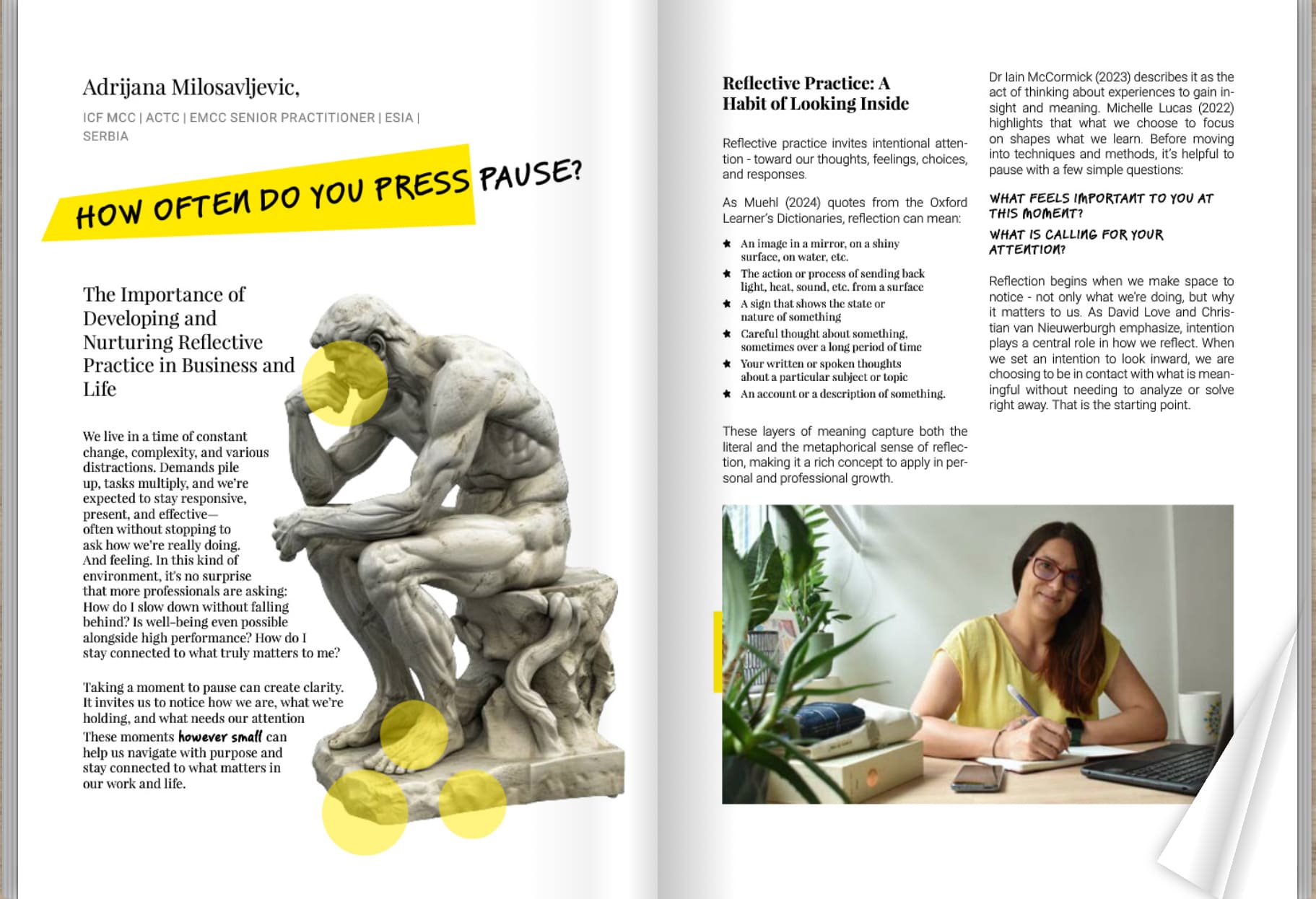
We live in a time of constant change, complexity, and various distractions. Demands pile up, tasks multiply, and we’re expected to stay responsive, present, and effective—often without stopping to ask how we’re really doing. And feeling. In this kind of environment, it’s no surprise that more professionals are asking: How do I slow down without falling behind? Is well-being even possible alongside high performance? How do I stay connected to what truly matters to me?
Taking a moment to pause can create clarity. It invites us to notice how we are, what we’re holding, and what needs our attention. These moments—however small—can help us navigate with purpose and stay connected to what matters in our work and life.
Reflective Practice: A Habit of Looking Inside
Reflective practice invites intentional attention – toward our thoughts, feelings, choices, and responses. As Muehl (2024) quotes from the Oxford Learner’s Dictionaries, reflection can mean:
- An image in a mirror, on a shiny surface, on water, etc.
- The action or process of sending back light, heat, sound, etc. from a surface
- A sign that shows the state or nature of something
- Careful thought about something, sometimes over a long period of time
- Your written or spoken thoughts about a particular subject or topic
- An account or a description of something.
These layers of meaning capture both the literal and the metaphorical sense of reflection, making it a rich concept to apply in personal and professional growth.

Dr Iain McCormick (2023) describes it as the act of thinking about experiences to gain insight and meaning. Michelle Lucas (2022) highlights that what we choose to focus on shapes what we learn. Before moving into techniques and methods, it’s helpful to pause with a few simple questions:
What feels important to you at this moment?
What is calling for your attention?
Reflection begins when we make space to notice – not only what we’re doing, but why it matters to us. As David Love and Christian van Nieuwerburgh emphasize, intention plays a central role in how we reflect. When we set an intention to look inward, we are choosing to be in contact with what is meaningful without needing to analyze or solve right away. That is the starting point.
Creating Conditions for Insight
We don’t need special tools or long retreats to reflect. What matters is setting some time and creating the conditions—space, attention, and intention.
Reflection might look like:
- A quiet moment after a meeting to notice how things felt
- Carrying one question with you while walking
- A short note in your journal at day’s end
- A meaningful conversation with a trusted peer
- A visual expression—sketch, metaphor, collage…
Michelle Lucas offers some elements to consider that could support reflective habits: space, content, process, structure, purpose, reinforcement, and review.
Choosing What Works for You
Reflection can take many forms. The best approach is often the one that feels most valuable and meaningful in the moment. Here we present just some of them:
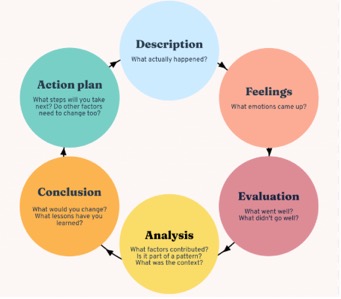
Gibbs’ Reflective Cycle (1988)
Perhaps the most familiar and widely used process for reflection, Gibbs’ model offers a clear, step-by-step framework that guides the thinker through different stages, encouraging both emotional awareness and practical learning. The stages are:
- Description – What happened?
- Feelings – What were you thinking and feeling at the time?
- Evaluation – Was the experience good or bad? What made it so?
- Analysis – What can you understand or learn from the situation?
- Conclusions – What else could you have done?
- Action Plan – What will you do if faced with a similar situation in the future?
This cyclical process supports deeper understanding by moving from concrete experience, through critical analysis, to actionable plans for improvement. It can be applied in individual reflection or adapted for team reflection, creating a shared space to explore experiences, surface insights, and agree on collective next steps.
Winter & Keroski’s four-step approach asks us to
describe experience, reflect, plan change, and review impact.
The PRAISE Model (Bayraktaroglu)
In conversations with leaders, business professionals, and even coaches, it’s common to hear well-developed reflective habits around what could be improved – yet much less reflection on what is already working well. This model offers a way to pause, become aware of, and truly appreciate our successes, so that we can learn from them just as intentionally as we do from challenges.
Phases of the model:
- Pause for understanding: Create time to reflect
- Recognize the success / good results: Appreciate the consequences
- Analyse the process: Discover reasons, cause-effect relations in the process
- Identify the success factors: Make a list of learnings
- Sharpen the factors: Create ways of strengthening these skills, mindset behind it
- Embody the model: Structure a model that can be replicated in similar situations

A Personal Practice
Reflection doesn’t demand structure—it demands openness and will.
Some reflect through writing, others through walking or recording voice notes. Some prefer silence; others enjoy when speaking. Some sketch or use metaphors. Some reflect daily, some weekly, others spontaneously.
Choose what fits you:
- A journal question like: “What energized me this week?”
- A drawing to represent how your energy feels
- A short voice memo after a meaningful interaction
- A conversation to unpack what surprised you or challenged you
An image or metaphor that shares how things feel - Or even a reflective conversation with your AI assistant…
Start small. Consistency matters more than time or format.
Looking Inward to See More Clearly
Reflective practice gives us the space to notice what’s shaping our thinking, decisions, and energy. It invites us to stay connected – to our values, our wellbeing, and our growth. It allows us to pause and reconnect with ourselves in the midst of action, change, and responsibility.
In a world full of distractions and noise, reflection helps us return to what’s essential. It keeps us aligned not only with our goals, but with who we are becoming.
So let’s finish this article with a similar question as in the title – What is your way to press the pause?