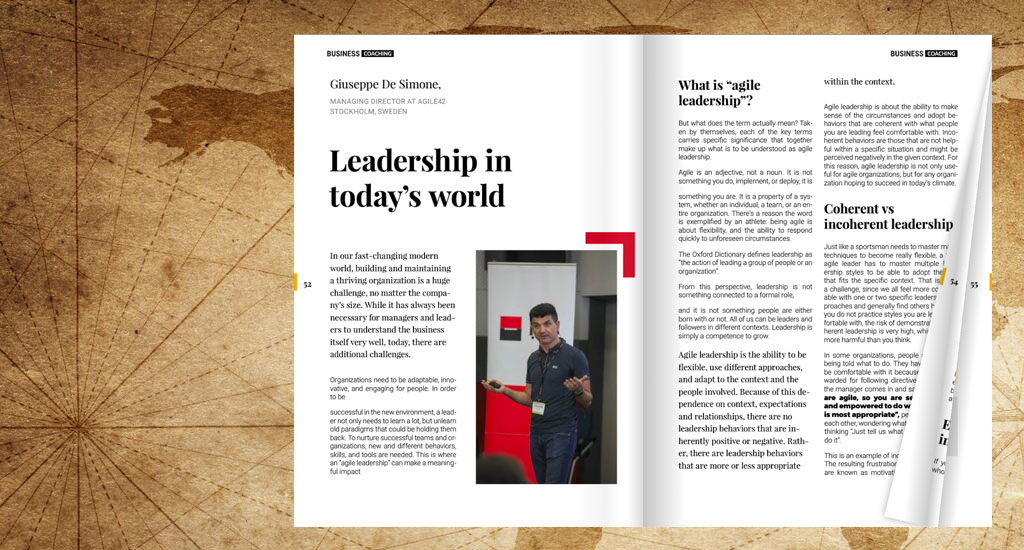
In our fast-changing modern world, building and maintaining a thriving organization is a huge challenge, no matter the company’s size. While it has always been necessary for managers and leaders to understand the business itself very well, today, there are additional challenges.
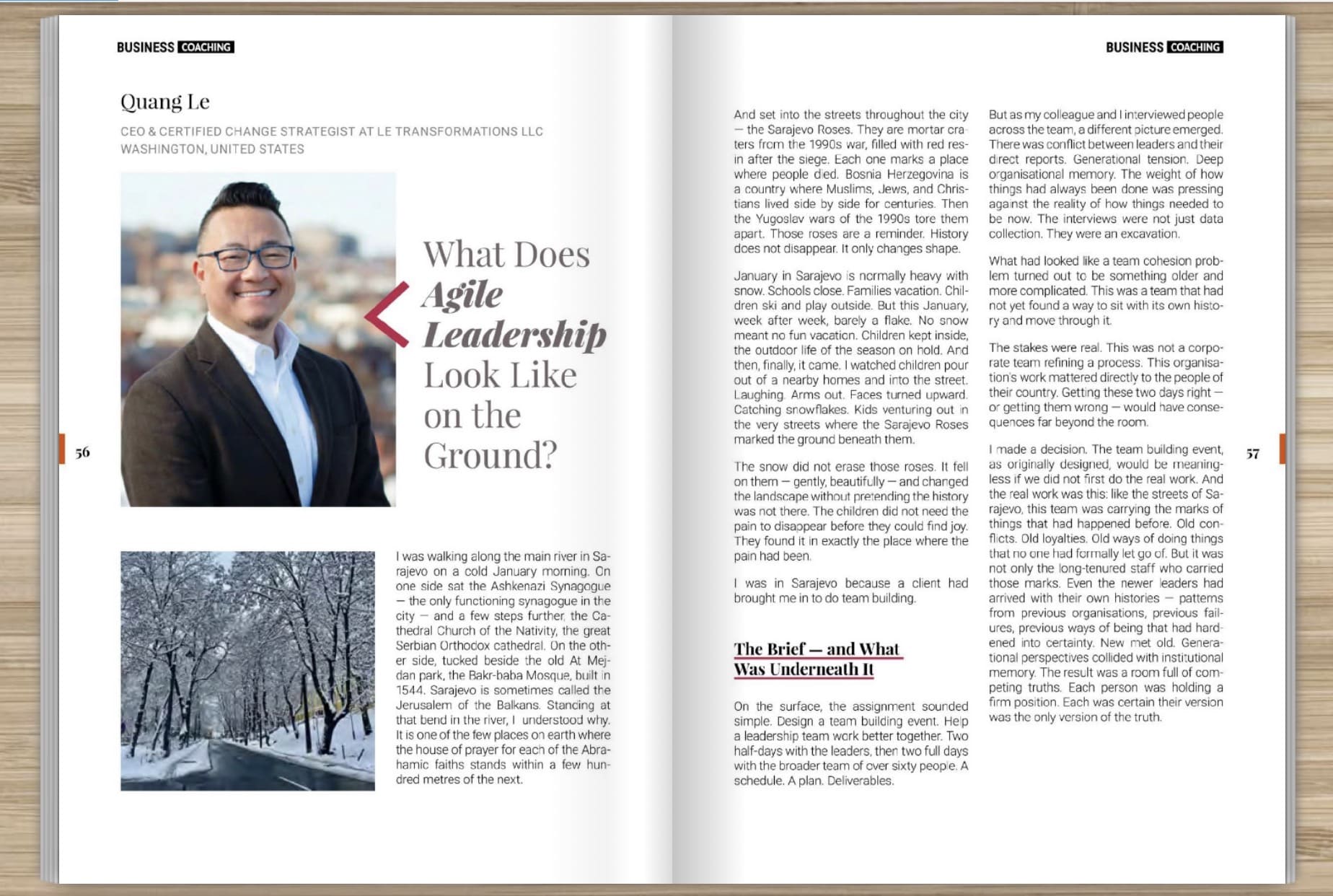
Organizations need to be adaptable, innovative, and engaging for people. In order to be successful in the new environment, a leader not only needs to learn a lot, but unlearn old paradigms that could be holding them back. To nurture successful teams and organizations, new and different behaviors, skills, and tools are needed. This is where an “agile leadership” can make a meaningful impact.
What is “agile leadership”?
But what does the term actually mean? Taken by themselves, each of the key terms carries specific significance that together make up what is to be understood as agile leadership.
Agile is an adjective, not a noun. It is not something you do, implement, or deploy, it is something you are. It is a property of a system, whether an individual, a team, or an entire organization. There’s a reason the word is exemplified by an athlete: being agile is about flexibility, and the ability to respond quickly to unforeseen circumstances.
The Oxford Dictionary defines leadership as “the action of leading a group of people or an organization”. From this perspective, leadership is not something connected to a formal role, and it is not something people are either born with or not. All of us can be leaders and followers in different contexts. Leadership is simply a competence to grow.
Agile leadership is the ability to be flexible, use different approaches, and adapt to the context and the people involved. Because of this dependence on context, expectations and relationships, there are no leadership behaviors that are inherently positive or negative. Rather, there are leadership behaviors that are more or less appropriate within the context.
Agile leadership is about the ability to make sense of the circumstances and adopt behaviors that are coherent with what people you are leading feel comfortable with. Incoherent behaviors are those that are not helpful within a specific situation and might be perceived negatively in the given context. For this reason, agile leadership is not only useful for agile organizations, but for any organization hoping to succeed in today’s climate.
Coherent vs incoherent leadership
Just like a sportsman needs to master many techniques to become really flexible, a true agile leader has to master multiple leadership styles to be able to adopt the one that fits the specific context. That is quite a challenge, since we all feel more comfortable with one or two specific leadership approaches and generally find others harder. If you do not practice styles you are less comfortable with, the risk of demonstrating incoherent leadership is very high, which can be more harmful than you think.
In some organizations, people are used to being told what to do. They have learned to be comfortable with it because they are rewarded for following directives. If one day, the manager comes in and says, “Now we are agile, so you are self-organized and empowered to do what you think is most appropriate”, people will stare at each other, wondering what this might mean, thinking “Just tell us what to do and we will do it”.
This is an example of incoherent leadership. The resulting frustration and dissatisfaction are known as motivational debt. Even if a specific leadership behavior seems appropriate to a situation, it needs to fit the expectations of the people involved and the culture in which they are used to operating. If it does not, it will very likely cause a negative emotional response and potentially increase motivational debt. In some cases, the impact can be so severe that people decide to leave. The Great Resignation, the elevated rate at which employees started to voluntarily quit their jobs beginning in early 2021, is a great example of what can happen in an extreme case of incoherent leadership combined with people being forced to re-evaluate life priorities.
Emotional Intelligence in the Workplace
If you want to become the kind of leader who masters multiple leadership behaviors and is able to read the situation and use an approach that is coherent with the context, you might want to develop your emotional intelligence.
Daniel Goleman was the first to popularize the idea of emotional intelligence and demonstrate evidence of its impact within organizations. He passionately argued for recognizing the relationship between someone’s emotional state and the actions driven by it and how those actions, in turn, impact others and the organization (essentially the people they work with), whether positively or negatively.
Emotional intelligence consists of four fundamental skills: Self-awareness, Self-management, Social awareness and Relationship management.
These are all essential qualities for leaders, even though not everyone seems to realize them. Many organizations still use a fundamentally wrong metaphor to describe how work functions. We keep thinking of our organizations as machines, where defined inputs are transformed into defined outputs, through defined processes and well designed connections of cogs. Is this the real nature of our organizations? How can such a machine adapt to ever changing circumstances and market needs?
We will have better chances at building agile and flexible organizations, which are more equipped to succeed in the world today, if we start describing them as living organisms. Organizations are networks of people, and human beings are not interchangeable and programmable machines. It is impossible to get rid of emotions in the workplace, so we’d better recognize and use them in an intelligent way rather than against us.
Effective leadership is more of a social activity than an engineering task.
How do you increase your emotional intelligence?
Here are some simple ways to grow your emotional intelligence:
● Journaling is the practice of keeping record of personal thoughts, feelings, insights
connected to certain events, through handwriting, typing or even drawing. Regular
journaling helps strengthen self-awareness: it is useful to spot our triggers and
understand their impact on work performance and relationships, as well as keep
disruptive emotions under control
● Self-reflection helps conceptualize experience and learn how to apply successful
patterns to similar contexts or dampen ineffective behaviors
● Peer feedback originates from trusted peers based on observations: it is a precious
resource to address improvement areas which we are unable to become aware of by
ourselves
● 360° feedback is feedback from many peers, leaders, and colleagues, rather than a
single manager in a top-down approach. It can be very helpful to learn how to sense
other peoples’ emotions and understand their perspective
● Get a coach and engage in a thought-provoking, creative and inspiring process to
maximize your personal and professional potential