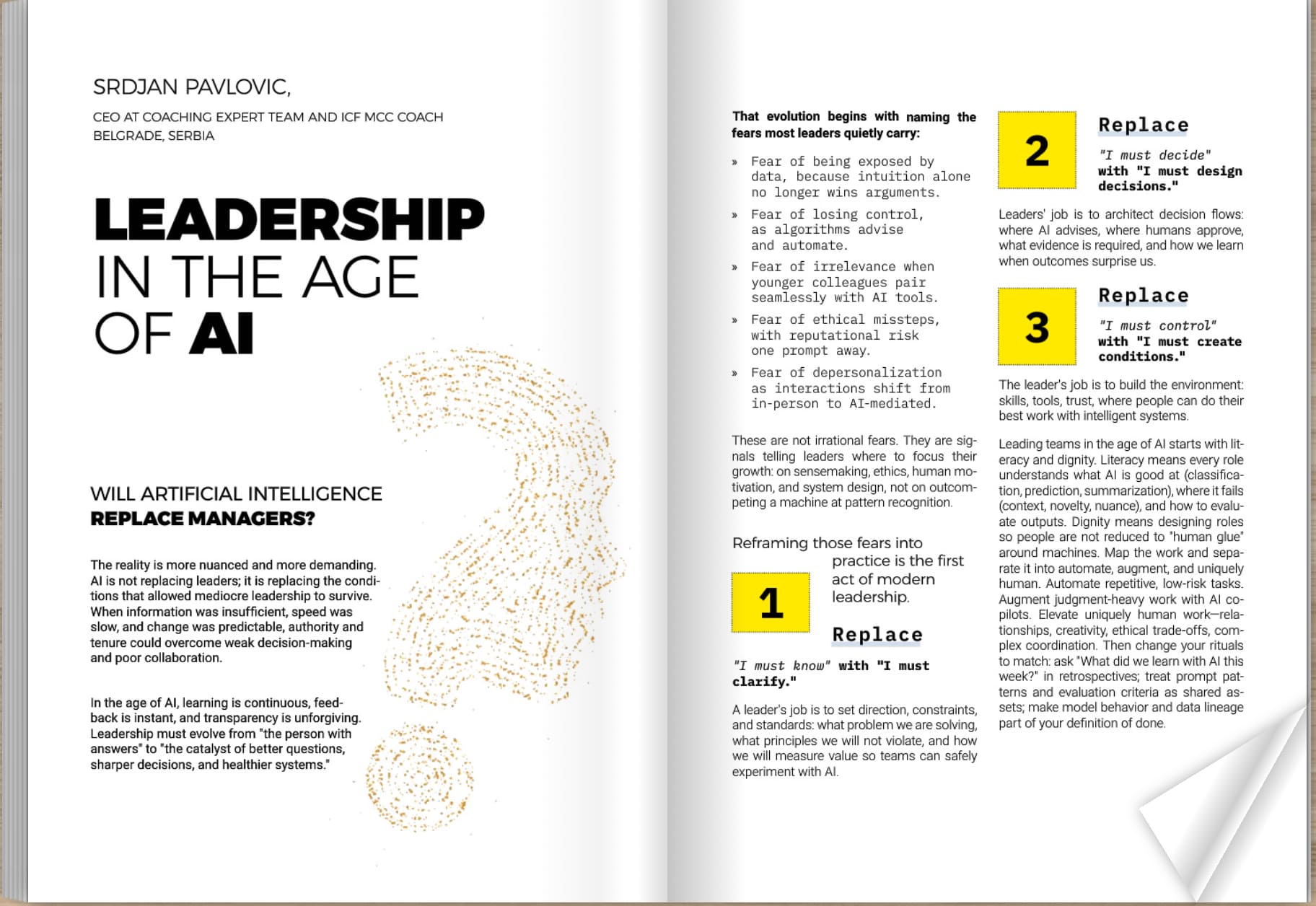
Will artificial intelligence replace managers?
The reality is more nuanced and more demanding. AI is not replacing leaders; it is replacing the conditions that allowed mediocre leadership to survive. When information was insufficient, speed was slow, and change was predictable, authority and tenure could overcome weak decision-making and poor collaboration.
In the age of AI, learning is continuous, feedback is instant, and transparency is unforgiving. Leadership must evolve from “the person with answers” to “the catalyst of better questions, sharper decisions, and healthier systems.”
That evolution begins with naming the fears most leaders quietly carry:
- Fear of being exposed by data, because intuition alone no longer wins arguments.
- Fear of losing control, as algorithms advise and automate.
- Fear of irrelevance when younger colleagues pair seamlessly with AI tools.
- Fear of ethical missteps, with reputational risk one prompt away.
- Fear of depersonalization as interactions shift from in-person to AI-mediated.
These are not irrational fears. They are signals telling leaders where to focus their growth: on sensemaking, ethics, human motivation, and system design, not on outcompeting a machine at pattern recognition.
Reframing those fears into practice is the first act of modern leadership.
Replace “I must know” with “I must clarify.”
A leader’s job is to set direction, constraints, and standards: what problem we are solving, what principles we will not violate, and how we will measure value so teams can safely experiment with AI.
Replace “I must decide” with “I must design decisions.”
Leaders’ job is to architect decision flows: where AI advises, where humans approve, what evidence is required, and how we learn when outcomes surprise us.
Replace “I must control” with “I must create conditions.”
The leader’s job is to build the environment: skills, tools, trust, where people can do their best work with intelligent systems.
Leading teams in the age of AI starts with literacy and dignity. Literacy means every role understands what AI is good at (classification, prediction, summarization), where it fails (context, novelty, nuance), and how to evaluate outputs. Dignity means designing roles so people are not reduced to “human glue” around machines. Map the work and separate it into automate, augment, and uniquely human. Automate repetitive, low-risk tasks. Augment judgment-heavy work with AI copilots. Elevate uniquely human work—relationships, creativity, ethical trade-offs, complex coordination. Then change your rituals to match: ask “What did we learn with AI this week?” in retrospectives; treat prompt patterns and evaluation criteria as shared assets; make model behavior and data lineage part of your definition of done.
Trust is the currency of productive human–AI collaboration, and it is built on clarity.
- Clarity of purpose: why we are using AI here.
- Clarity of data: what data is used, who owns it, and how it is protected.
- Clarity of boundaries: what decisions AI may advise on versus decide; what must be escalated to humans; when to switch off.
- Clarity of quality: what “good” looks like and how we test for it.
- Clarity of accountability: who is responsible when things go wrong.
AI can help you move faster; it cannot carry blame. Leaders who make these boundaries explicit reduce anxiety, improve adoption, and model the ethical backbone their organizations need.
Ethical dilemmas will not present themselves with warning labels. They will arrive as small optimizations that add up to big risks. Surveillance disguised as productivity tracking. Biased models masked as efficiency. Unconsented data use is framed as innovation. The leader’s task is to institutionalize slow thinking where it matters. Build a lightweight ethics review that teams can use before launch: “What stakeholders are affected and how could harm occur? What biases might be embedded in the data or objectives? What’s our plan for explainability when customers ask “Why?” What consent do we have and from whom? What off-ramps exist if the model drifts?”
Record decisions; make them auditable. Ethics is not a poster; it is a practice.
Algorithmic management uses AI to allocate work, set goals, and assess performance. It tempts leaders with precision. Handle with care. When leaders optimize for a single metric, they risk optimizing away culture. Use multiple measures that balance effectiveness (quality, cycle time), health (engagement, learning), and fairness (disparate impact, opportunity to improve). Keep humans in the loop for performance decisions; use AI for pattern detection, not verdicts. Explain the criteria in plain language. Allow appeals. And periodically review whether the incentives you’ve created align with the values you say you hold. In a world of infinite dashboards, judgment is your scarcest resource.
Can an AI agent be an equal part of the team?
It can be an effective collaborator; it cannot be a moral peer. Treat AI as a named contributor in your workflows; assign it clearly scoped tasks with inputs, outputs, and acceptance criteria; log its assumptions; evaluate its results; “invite” it to stand-ups by reviewing its outputs with the same rigor you would a junior teammate. But keep accountability human. An AI cannot consent, be coached, hold values, or be held responsible. For now. Give it voice in the process, not a vote on matters of ethics or people. The right metaphor is not teammate or tool; it is an instrument powerful in the hands of a skilled ensemble, dangerous without a conductor.
To make this concrete, lead a 90-day transition in four moves.
1) First, take inventory: list the top ten recurring workflows in your team and classify steps as automate, augment, or human. Identify two low-risk pilots where AI can meaningfully improve speed or quality.
2) Second, establish guardrails: draft a one-page AI use charter covering approved tools, data handling, confidentiality, review steps, and escalation points.
3) Third, upskill together: run short practice sessions where people solve real tasks with AI, compare prompts, critique outputs, and define evaluation checklists for accuracy, bias, and tone.
4) Fourth, measure and learn: baseline today’s outcomes; instrument your pilots; review weekly; document what worked and what did not; decide whether to scale, adjust, or stop.
Leaders’ communication stance matters as much as their technical stance. Fear thrives in silence; rumors fill the gaps. Share why you are adopting AI, what it means for roles, and where you are uncertain. Invite questions. Celebrate human wins created by AI-enabled workflows—a faster turnaround for a customer, a better insight from data, and a tedious task eliminated. Also, celebrate ethical decisions to not use AI in contexts where it would erode trust. Model humility by narrating your own learning: what surprised you, what you got wrong, what you changed. In complex systems, leaders teach most by what they pay attention to and what they tolerate.
The skills that differentiate leaders now are less about domain certainty and more about complexity competence.
- Sensemaking: turning noise into narrative without oversimplifying.
- Framing: defining problems and constraints in ways that unlock creativity.
- Facilitation: convening diverse perspectives and surfacing dissent before it becomes dysfunction.
- Experimentation: designing safe-to-fail probes and extracting learning quickly.
- Coaching: asking questions that grow ownership, not dependency.
These are not soft skills; they are the hardest skills to scale—and the ones AI cannot replace.
Organizationally, move from rigid structures to adaptive networks. Embed enabling roles such as AI product owner, data steward, and ethics liaison inside cross-functional teams. Shift from annual planning to rolling bets with explicit kill criteria. Replace approval layers with clear action thresholds. Invest in shared platforms: data, knowledge, and prompt libraries that compound learning. And integrate AI into your operating rhythm: review model performance alongside business performance; treat model drift as seriously as customer churn; include AI incidents in your postmortems; allocate time for model and prompt hygiene, just as you do for code.
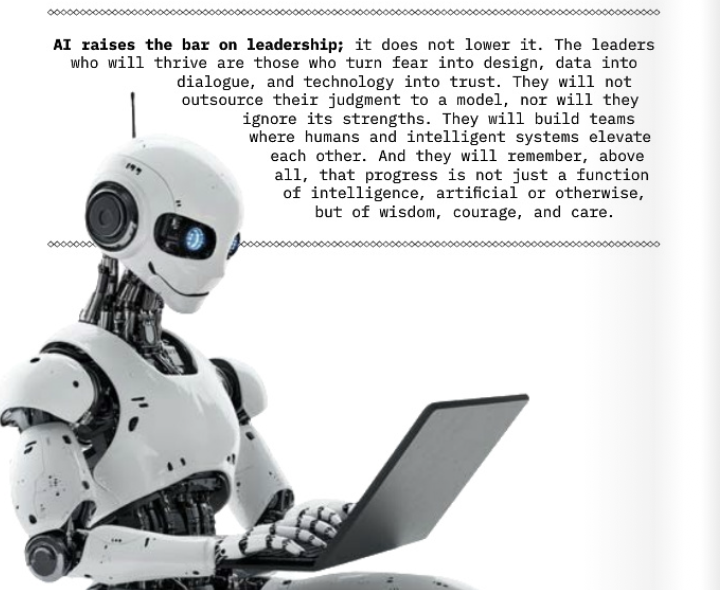
If there is a single mindset shift to anchor, it is this: leadership in the age of AI is stewardship. Stewardship of human potential, so that people spend more time on work that requires empathy, originality, and judgment. Stewardship of risk, so that speed does not outrun safety. Stewardship of values, so that what is technically possible never eclipses what is morally acceptable. And stewardship of learning, so that your organization gets a little bit smarter, kinder, and more adaptive with each experiment.