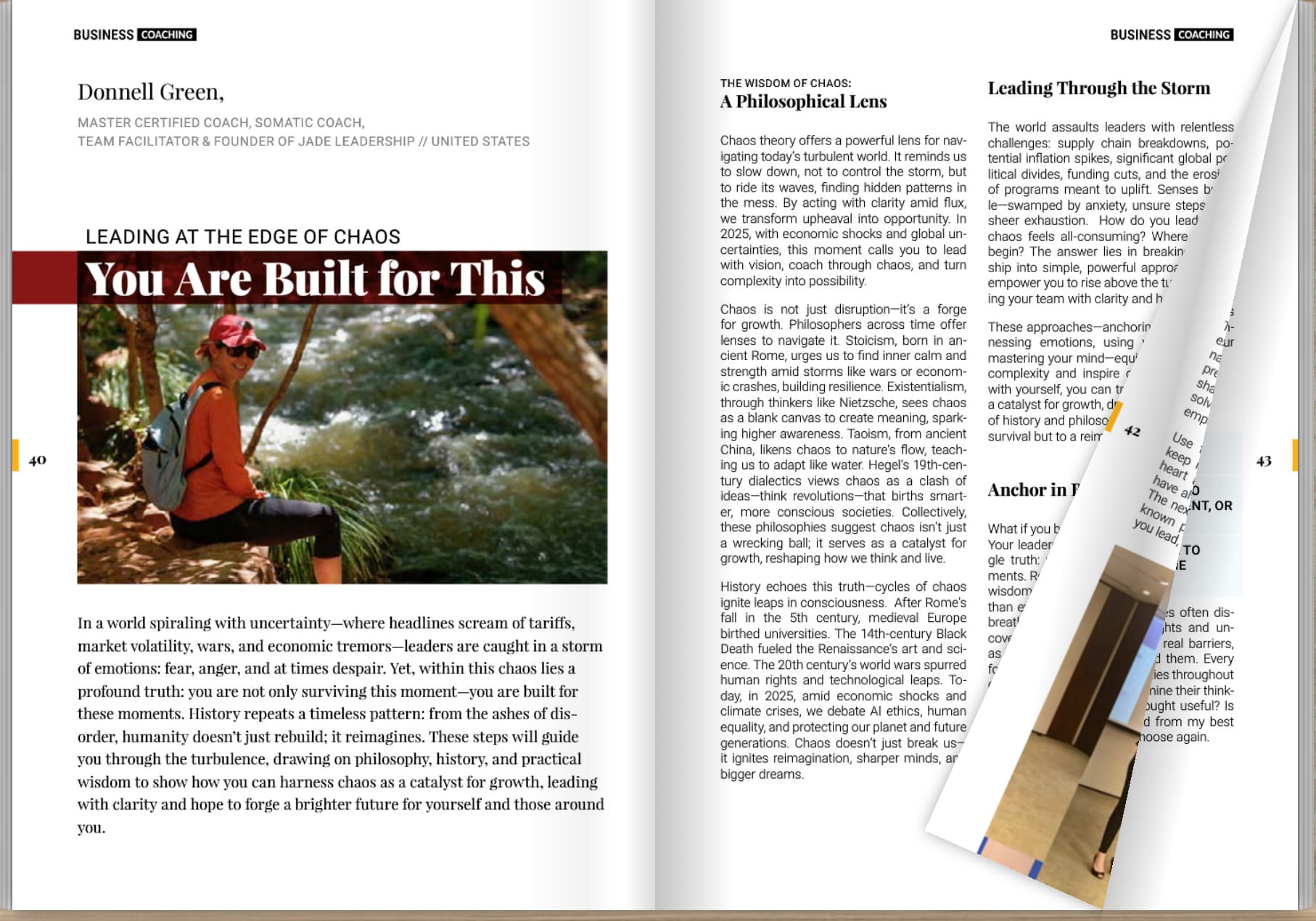
In a world spiraling with uncertainty—where headlines scream of tariffs, market volatility, wars, and economic tremors—leaders are caught in a storm of emotions: fear, anger, and at times despair. Yet, within this chaos lies a profound truth: you are not only surviving this moment—you are built for these moments. History repeats a timeless pattern: from the ashes of disorder, humanity doesn’t just rebuild; it reimagines. These steps will guide you through the turbulence, drawing on philosophy, history, and practical wisdom to show how you can harness chaos as a catalyst for growth, leading with clarity and hope to forge a brighter future for yourself and those around you.
The Wisdom of Chaos: A Philosophical Lens
Chaos theory offers a powerful lens for navigating today’s turbulent world. It reminds us to slow down, not to control the storm, but to ride its waves, finding hidden patterns in the mess. By acting with clarity amid flux, we transform upheaval into opportunity. In 2025, with economic shocks and global uncertainties, this moment calls you to lead with vision, coach through chaos, and turn complexity into possibility.
Chaos is not just disruption—it’s a forge for growth. Philosophers across time offer lenses to navigate it. Stoicism, born in ancient Rome, urges us to find inner calm and strength amid storms like wars or economic crashes, building resilience. Existentialism, through thinkers like Nietzsche, sees chaos as a blank canvas to create meaning, sparking higher awareness. Taoism, from ancient China, likens chaos to nature’s flow, teaching us to adapt like water. Hegel’s 19th-century dialectics views chaos as a clash of ideas—think revolutions—that births smarter, more conscious societies. Collectively, these philosophies suggest chaos isn’t just a wrecking ball; it serves as a catalyst for growth, reshaping how we think and live.
History echoes this truth—cycles of chaos ignite leaps in consciousness. After Rome’s fall in the 5th century, medieval Europe birthed universities. The 14th-century Black Death fueled the Renaissance’s art and science. The 20th century’s world wars spurred human rights and technological leaps. Today, in 2025, amid economic shocks and climate crises, we debate AI ethics, human equality, and protecting our planet and future generations. Chaos doesn’t just break us—it ignites reimagination, sharper minds, and bigger dreams.
Leading Through the Storm
The world assaults leaders with relentless challenges: supply chain breakdowns, potential inflation spikes, significant global political divides, funding cuts, and the erosion of programs meant to uplift. Senses buckle—swamped by anxiety, unsure steps, and sheer exhaustion. How do you lead when chaos feels all-consuming? Where do you begin? The answer lies in breaking leadership into simple, powerful approaches that empower you to rise above the turmoil, guiding your team with clarity and hope.
These approaches—anchoring in belief, harnessing emotions, using your body, and mastering your mind—equip you to navigate complexity and inspire others. By starting with yourself, you can transform chaos into a catalyst for growth, drawing on the lessons of history and philosophy to lead not just for survival but to a reimagined future.
Anchor in Belief
What if you believed you were made for this? Your leadership journey starts with this single truth: you’re built to rise in these moments. Remind yourself daily that your skills, wisdom, and heart are needed now more than ever. If doubt clouds your path, take a breath, step back, or seek a coach to rediscover your strength. A coach can help, just as I’ve coached leaders who, despite doubt, found their resolve by reminding themselves daily, “they are built for this.”
Start by examining your beliefs about yourself. Trust your ability to guide others through this unknown territory, emerging stronger, wiser, and more compassionate. With belief as your anchor, you have the foundation to generate something good for yourself and those around you.
Hope: Your True North
With belief anchoring you, hope becomes your true north, guiding you through emotional storms. Transitioning from states like uncertainty, fear, or resentment into creative, idea-generating spaces starts with this essential element: hope. By using history as a guide, we can courageously step into the unknown future with faith. Leaders serve as beacons of hope, cutting through the fog of uncertainty. And history reminds us: a new level of consciousness is always in the making.
The emotions you and those around you are experiencing aren’t obstacles—they’re signals. Great leaders and coaches don’t suppress them; they harness them. Fear can sharpen your focus. Anger can fuel your resolve. Sadness can deepen and expand your empathy.
Use these emotional states as fuel—and keep returning to hope. Let it center your heart and mind in the truth that humans have always emerged from chaos stronger. The next chapter of history is rich with unknown promise—and you, alongside those you lead, will help shape it.
The Body: A Shortcut to Emotional Shifts
How do you move quickly from lower emotional states—like fear, anxiety, or anger—into higher, more empowered ones? The body is your fastest route. While we understand the science behind workouts and intense physical activity, the truth is, we don’t always have time for the gym. But even small physical shifts can change our emotional state. Stepping into nature, feeling sunlight on your face, or simply standing outside and breathing fresh air can immediately begin to alter your body chemistry—opening the door to positivity and resourcefulness.

One powerful practice begins with the breath. Start by centering yourself: bring your attention to your feet, then slowly move your awareness up through your body to the center of your belly. Imagine creating spaciousness there. Breathe into that space. Next, do the same with your heart—breathe into it—and finally with your mind. This sequence unlocks access to calm, ease, curiosity, and creative possibility.
To create energy, try priming—a quick, invigorating technique that combines breath and movement. Rapidly raise your arms above your head and pull them back down to your chest in rhythm, doing this several times (10 or more). Feel the energy surge through your body. Pair this with empowering self-talk like: “I am built for this.” When energy is alive and moving through your body, it galvanizes your state of being, bringing a sense of purpose, power, and presence.
And finally—grounding. This is how you stabilize your energy and shift from reactive to resourceful. Grounding helps you feel calm and centered, even in the midst of chaos. It brings you back into your body and connects you to a deeper sense of strength.
Here’s a simple step-by-step grounding practice:
- Stand or sit with your feet flat on the floor.
Feel the weight of your body supported by the ground. - Bring your attention to your belly.
Imagine energy gathering and expanding at your center, just below your belly button. - Visualize that energy moving downward.
Picture it flowing from your belly through your legs and feet, then growing roots into the earth—like a tree. - Breathe slowly and deeply.
With each breath, feel more stable, calm, and connected. - Repeat a grounding phrase to yourself.
Something simple like: “I am centered. I am strong.”
When you ground your energy this way, you calm your nervous system, regain clarity, and feel more in control. Grounded leaders are thoughtful, clear, and capable of facing uncertainty with strength and vision.
Your physiology is more than just posture or breath—it’s a gateway to possibility. It can unlock creative thinking and emotional clarity. It’s the shortcut through uncertainty. When you learn to regulate your state through the body, you gain the power to take unfamiliar actions, hold transformative conversations, and lead others into an inspired and hopeful future.
Master the Mind Like a Jedi
If the body is the quick access lever to unlocking your higher states as a leader, the mind is the battlefield. In times of chaos and uncertainty, the mind can turn against us. It races, ruminates, and resists. It jumps from thought to thought, imagines worst-case scenarios, and struggles to hold still. Fueled by fear or helplessness, it can drag you into dark and reactive places.
But here’s the truth: as a leader, you have a choice. You can train your mind the same way you’d train a dog—to “sit and stay.” This isn’t just a metaphor. It’s a disciplined, conscious choice to gain control over your thoughts.
Ask yourself:
- What thoughts will I allow today?
- What boundaries do I need to establish on worry, judgment, or assumption?
- What beliefs will I choose to hold about myself and the people I lead?
Leaders who work with coaches often discover that their limiting thoughts and unchecked assumptions are the real barriers, not the circumstances around them. Every leader has multiple opportunities throughout the day to reflect on and examine their thinking. You can ask, “Is this thought useful? Is it true? Is it helping me lead from my best self?” And if not—you can choose again.
When we shift our thinking, we change how we move through the world. Our posture changes. Our communication shifts. Our ability to recognize opportunity—even in the fog—becomes sharper.
In times of chaos, this kind of mental mastery is not optional; it’s essential. Commit to a daily practice of thinking and reflecting on your thoughts. Cut off the rumination that drags you into an imagined negative or “worst-case” future. Instead, bring your mind back to what’s real, what’s possible, and what matters most.
This is how creative leadership emerges: not from a mind spinning in fear, but from a mind that is disciplined and present, ready to lead with versatility and shape a future of possibility.
Cultivating capacity and versatility
What does it take to lead when the ground keeps shifting? Only 9.3% of leaders demonstrate true versatility, according to recent research shared by Rob Kaiser, a thought leader in the field. In this context, versatility means the ability to adapt your mindset, emotional responses, and behaviors across a range of situations—especially when chaos prevails. That number is a wake-up call.
It highlights a deeper truth: rigid, one-dimensional leadership no longer works. The complexity and chaos of today’s world demand more. Leaders are being called into a new paradigm—one that requires expanded emotional and physical capacity, deeper awareness, and greater adaptability at every level.
In times of rapid change and constant unknowns, leadership isn’t about having the perfect plan—it’s about cultivating new ways of being, new ways of thinking, and the inner strength to stay grounded through it all.
Today’s leaders must stay mentally and emotionally centered in the midst of tension. That means:
- Holding compassion without letting go of accountability
- Pursuing vision while staying focused on execution
- Keeping faith in the future, even while navigating today’s uncertainty
This represents the new edge of leadership: showing up with clarity and calm, expanding your inner capacity, and responding with flexibility—not force—as the world continues to change around you.
The Opportunity of Now
Chaos isn’t coming—it’s already here. Systems are shifting, the stakes are high, and no leader stands untouched. We’ve crossed the line—from complexity to chaos—and there’s no going back.
This is the leadership moment of our time.
It starts with you. Lead yourself first. Regulate your state. Shift your mindset. Use your body to rise, not retreat. Ground in hope. Align your thoughts with purpose. Build the inner foundation that others can stand on when the ground shakes.
Leadership today isn’t about having all the answers—it’s about showing up with clarity, calm, and conviction. It’s about lifting others, seeing what’s possible when they can’t, and moving forward anyway.
This chasm between complexity and chaos? It’s not a pit to fear—it’s a platform to lead from.
The edge is yours to claim—and your invitation to lead from it.