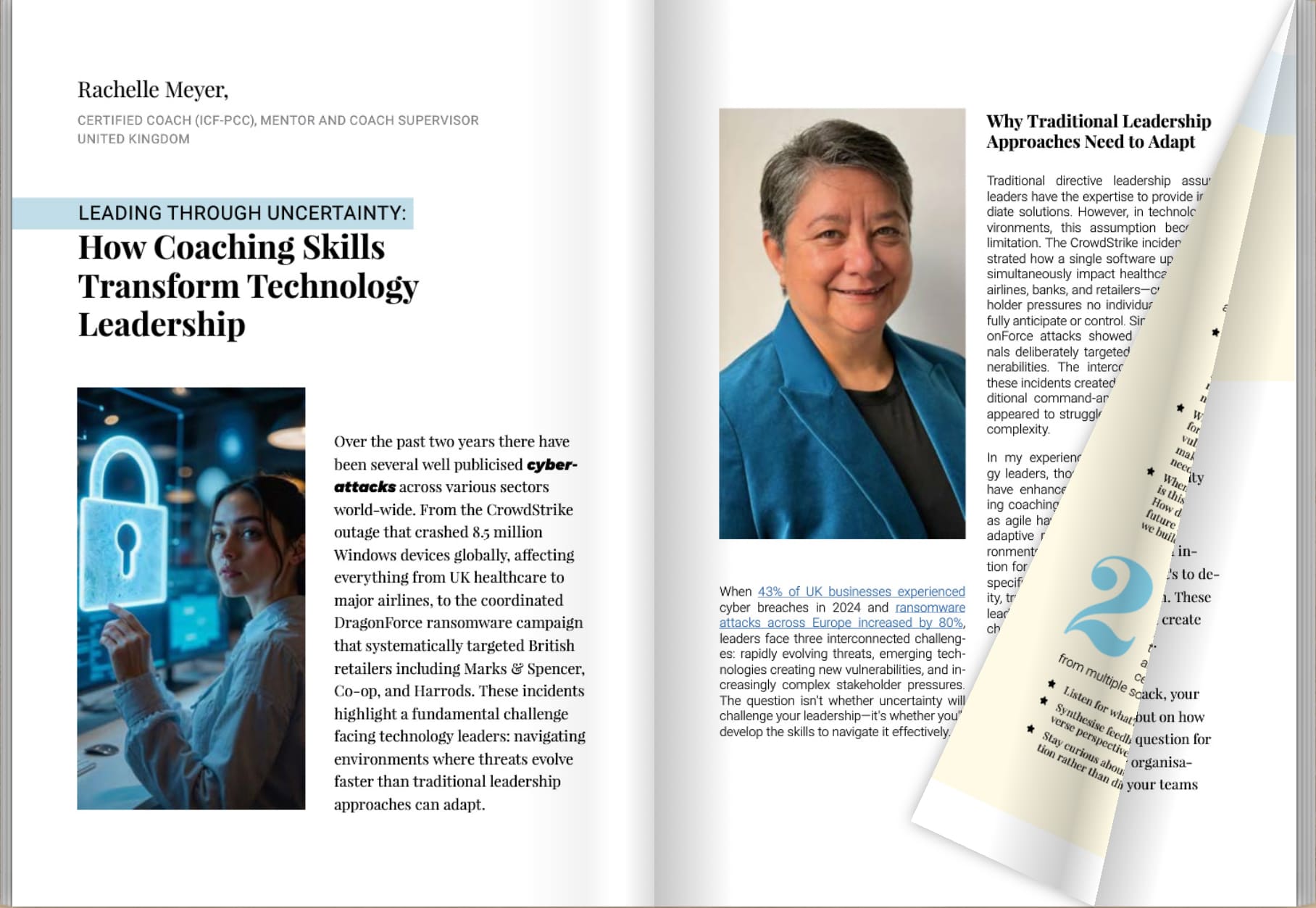
Over the past two years there have been several well publicised cyber-attacks across various sectors world-wide. From the CrowdStrike outage that crashed 8.5 million Windows devices globally, affecting everything from UK healthcare to major airlines, to the coordinated DragonForce ransomware campaign that systematically targeted British retailers including Marks & Spencer, Co-op, and Harrods. These incidents highlight a fundamental challenge facing technology leaders: navigating environments where threats evolve faster than traditional leadership approaches can adapt.
When 43% of UK businesses experienced cyber breaches in 2024 and ransomware attacks across Europe increased by 80%, leaders face three interconnected challenges: rapidly evolving threats, emerging technologies creating new vulnerabilities, and increasingly complex stakeholder pressures. The question isn’t whether uncertainty will challenge your leadership—it’s whether you’ll develop the skills to navigate it effectively.
Why Traditional Leadership Approaches Need to Adapt
Traditional directive leadership assumes leaders have the expertise to provide immediate solutions. However, in technology environments, this assumption becomes a limitation. The CrowdStrike incident demonstrated how a single software update could simultaneously impact healthcare systems, airlines, banks, and retailers—creating stakeholder pressures no individual leader could fully anticipate or control. Similarly, the DragonForce attacks showed how cybercriminals deliberately targeted supply chain vulnerabilities. The interconnected nature of these incidents created scenarios where traditional command-and-control approaches appeared to struggle to keep pace with the complexity.
In my experience working with technology leaders, those who thrive in uncertainty have enhanced their leadership by adopting coaching skills. While frameworks such as agile have brought valuable attention to adaptive practices within technology environments, coaching skills create a foundation for effective leadership that transcends specific methodologies. By fostering curiosity, trust, and reflective dialogue, technology leaders can prepare teams for continuous change, irrespective of process or structure.
Essential Coaching Skills for Technology Leadership
1. Powerful Questioning
Use open-ended questions to drive critical thinking and problem-solving rather than simply delivering instructions. Ask questions that enable exploration of new areas, unlock thinking and challenge limiting assumptions and blind spots.
When feeling pressured to have all the solutions use inquiry to unlock collective intelligence: What are we not seeing? What assumptions are we making about this threat? Who else needs to be part of this conversation?
When threats evolve rapidly, waiting for hierarchical approval becomes a vulnerability: What decisions can you make without escalation? What do you need to feel confident making this call?
When the situation has been contained: What is this teaching us about our resilience? How does this incident strengthen our future response? What capabilities are we building through this challenge?

2. Active Listening
Engage deeply with team members, provide space to think, understand, empathise and be attentive. In times of uncertainty, information comes from multiple sources simultaneously.
Listen for what’s not being said
Synthesise feedback from diverse perspectives
Stay curious about contradictory information rather than dismissing outlier reports
3. Creating Psychological Safety
Build environments where teams share critical information quickly, especially under pressure. When people feel safe to voice concerns, organisations detect threats faster and respond more effectively.
During crisis response: What are you seeing that concerns you, even if you’re not sure it’s relevant?
When team members hesitate: Help me understand what makes this feel risky to discuss
After incidents: What barriers did you face?
4. Building Systems Awareness
Help teams see interconnections and ripple effects, crucial for complex cyber incidents like the DragonForce supply chain attacks that affected multiple retailers simultaneously.
When planning response: Who else might be affected by this decision? What second-order effects should we consider?
During stakeholder management: How does this look from the customer / regulator / partner perspective?
For prevention: What would make us more resilient to this type of cascading failure?
5. Facilitating Awareness
Facilitating awareness helps leaders unlock learning from uncertainty rather than simply recovering from it. This involves creating moments for teams to recognise patterns, challenge assumptions, and build capability.

Pattern recognition helps teams build intuition for emerging threats: What’s familiar about this incident? What’s completely new?
Assumption surfacing often reveals hidden vulnerabilities: What did we believe about our systems that this incident challenged?
Transforms crisis into growth opportunity: How are we stronger now than we were before this incident?
When organisations embed coaching skills into their leadership practices, teams are empowered to devise innovative solutions, enhancing adaptability and business resilience in the face of uncertainty.
The most effective technology leaders I’ve worked with share a common insight: their role isn’t to have all the answers about emerging threats—it’s to develop teams capable of discovering what they collectively need to learn. These coaching skills enable leaders to harness distributed intelligence and create cultures where teams continuously learn from ambiguous situations.
When your team faces the next zero-day exploit or coordinated attack, your response capability will depend not on your individual expertise, but on how effectively you can unlock your team’s collective intelligence. The question for technology leaders isn’t whether uncertainty will challenge your organisation—it’s whether you’ll build the coaching capabilities that help your teams thrive within it.