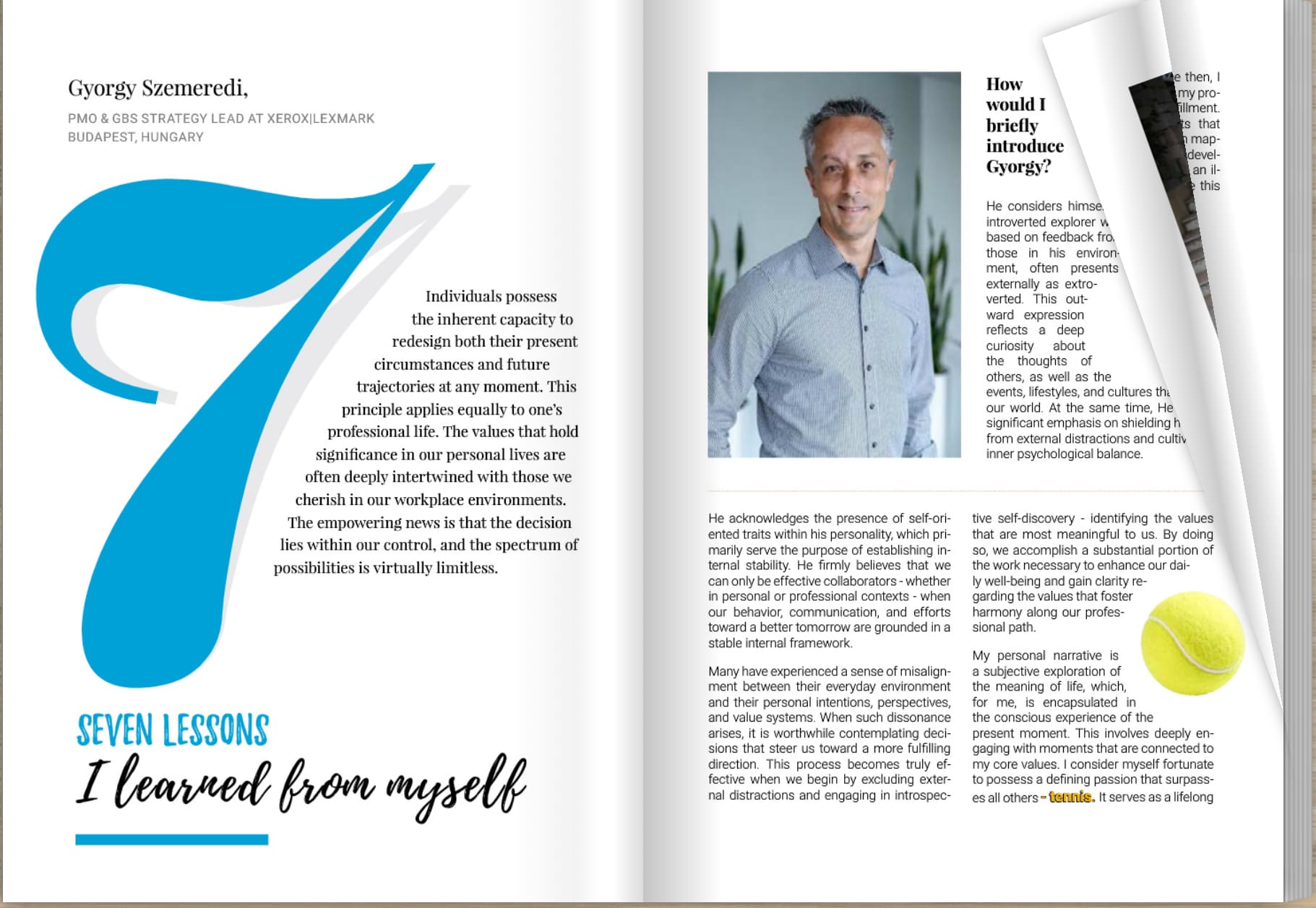
Individuals possess the inherent capacity to redesign both their present circumstances and future trajectories at any moment. This principle applies equally to one’s professional life. The values that hold significance in our personal lives are often deeply intertwined with those we cherish in our workplace environments. The empowering news is that the decision lies within our control, and the spectrum of possibilities is virtually limitless.
How would I briefly introduce Gyorgy? He considers himself an introverted explorer who, based on feedback from those in his environment, often presents externally as extroverted. This outward expression reflects a deep curiosity about the thoughts of others, as well as the events, lifestyles, and cultures that shape our world. At the same time, He places significant emphasis on shielding himself from external distractions and cultivating inner psychological balance.

He acknowledges the presence of self-oriented traits within his personality, which primarily serve the purpose of establishing internal stability. He firmly believes that we can only be effective collaborators – whether in personal or professional contexts – when our behavior, communication, and efforts toward a better tomorrow are grounded in a stable internal framework.
Many have experienced a sense of misalignment between their everyday environment and their personal intentions, perspectives, and value systems. When such dissonance arises, it is worthwhile contemplating decisions that steer us toward a more fulfilling direction. This process becomes truly effective when we begin by excluding external distractions and engaging in introspective self-discovery – identifying the values that are most meaningful to us. By doing so, we accomplish a substantial portion of the work necessary to enhance our daily well-being and gain clarity regarding the values that foster harmony along our professional path.
My personal narrative is a subjective exploration of the meaning of life, which, for me, is encapsulated in the conscious experience of the present moment. This involves deeply engaging with moments that are connected to my core values. I consider myself fortunate to possess a defining passion that surpasses all others – tennis . It serves as a lifelong source of energy and joy, whether through watching or playing, and consistently helps me organize my thoughts and recharge. A defining passion, such as tennis, serves not merely as recreation but as a vital source of energy and psychological renewal. In professional contexts, it is essential to cultivate areas within one’s work life that facilitate regular recharging of mental and emotional reserves. This practice enhances clarity, focus, and sustained performance, enabling leaders to navigate complex environments with resilience.

Over the past 25 years, I have accumulated professional experience across 11 distinct workplace environments, including six years spent in Hungary, Spain, the United Kingdom, and the United States. My career has spanned multiple industries – manufacturing, services, hospitality, IT, sports management, and education – each offering unique insights into diverse business operations. Every moment has been worthwhile. This vibrant and varied journey has significantly contributed to my professional and personal clarity, instilling confidence and self-awareness in my current role. Exposure to diverse cultures through international assignments fosters a nuanced understanding of group dynamics and interpersonal relations. By integrating these insights into daily operations, professionals can bridge cultural differences, promote inclusivity, and optimize team performance. Such experiences underscore the value of adaptability and global perspective in leadership roles.
I have come to understand that perfection is not a realistic goal, nor is it one I aspire to. The pursuit of perfection is neither realistic nor desirable. Instead, recognizing and appreciating work of good quality, while avoiding unnecessary efforts toward unattainable standards, cultivates a pragmatic approach to professional excellence. This mindset encourages continuous improvement and acknowledges the inherent value in progress over perfection. In pursuit of a deeper understanding of my values, I began visualizing my thoughts using a blank puzzle template, gradually filling it with meaningful content. Creating space for reflective solitude amidst the fast-paced demands of daily life was instrumental in this process. I am profoundly grateful for the support of my wife and family, which has been invaluable. Since then, I have gained a clearer perspective on my professional expectations and their fulfillment. Feedback from colleagues suggests that this technique has also aided others in mapping and evaluating their professional development opportunities. I have included an illustrative image below to demonstrate this approach.

Visualizing professional aspirations and achievements through tools such as a “puzzle assessment” enables individuals to set realistic expectations and appreciate milestones reached. This reflective practice supports strategic career planning and fosters self-awareness, empowering professionals to identify areas for growth and celebrate accomplishments.
These reflections have affirmed that I am in the right place – both professionally and personally. I am thankful for the enriching experiences and invaluable connections I have made throughout my career. I am especially grateful to my mentors and coaches, past and present, whose guidance and encouragement have enabled me to explore operational and project environments. To process the wealth of experiences I have accumulated, I consciously chose to take time away from the noise of the world, allowing myself to reflect and cultivate a sense of contentment. The first such pause occurred in the United Kingdom, where I spent six months outside of professional circles, working in restaurants and hotels organizing events. This marked my first intentional career break after seven years of professional engagement, providing rejuvenation and fresh energy for future endeavors.
Following this, I embarked on another seven-year phase of professional growth, characterized by steady and deliberate progress. I firmly believe that well-timed breaks are essential for effective learning and development. Based on personal experience, I advocate for consciously dedicating time to reflection after each seven-year cycle. Such periods of renewal allow individuals to release the pressure of workplace conformity, gain perspective, and formulate new plans for both personal and professional domains.
After my second seven-year cycle, I took another break – this time relocating to Tenerife to contribute to a tennis academy, leveraging my passion for tennis and proficiency in English to support youth training programs. Working on the Canary Islands was an unforgettable experience, allowing me to engage with two of my greatest non-professional passions: tennis and language education.
Effective communication is a cornerstone of success in both private and professional contexts. We employ a multitude of verbal and written techniques to convey our messages, and their effectiveness depends on our attentiveness and adaptability to the given environment. For me, this is the “Art of Communication,” one of the most enjoyable learning processes in my life.

The world is in constant flux, and while it is impossible to respond to every change, those occurring in our immediate surroundings often require us to react differently than we did before. This demands a high degree of flexibility and resilience – skills for which there is ample room for development. I believe that revising outdated behavioral patterns can significantly enhance our ability to navigate challenges, whether sought or unexpected. A positive mindset is a critical driver of everyday success. By consistently focusing on solutions and envisioning a better tomorrow, professionals can overcome challenges and inspire those around them. While not universally embraced, positive thinking remains a cornerstone of effective leadership and personal fulfillment.
Of course, people differ. Some consciously choose not to embrace positive thinking. This has long been a central question in my life, one I sought to answer until the age of 40. I even considered it a personal mission to advocate for the power of positivity. While this approach proved surprisingly effective with some people and colleagues, I also encountered resistance. Despite my belief that a positive outlook hinges on a simple mental shift, I came to understand that not everyone assigns the same value to this perspective.
During the 6 months in Tenerife, I experienced a profound realization. Frustrated by my inability to convey the benefits of positivity in some instances, I spent the last three weeks of my Canarian Island adventure tour camping and reflecting alone. This period transformed my frustration into acceptance – perhaps the most significant insight of my life. I discovered that my life becomes more peaceful and balanced when I simply accept things I cannot understand as they are. Intentional career breaks, taken at regular intervals, provide opportunities for holistic reflection and renewal. Stepping away from routine allows for a comprehensive reassessment of connected situations and the formulation of new plans. Such pauses are instrumental in maintaining long-term motivation, creativity, and strategic vision.
In my current role, I coordinate tasks, projects, and people. Daily decision-making and maintaining team efficiency are central to our operations. While control plays a vital role in fostering continuous improvement, acceptance can also be a powerful tool for leaders in managing situations effectively and empathetically. Acceptance involves discerning between situations that can be influenced and those that must be regarded as given conditions. By channeling efforts toward areas of impact and relinquishing attempts to change the unchangeable, leaders cultivate peace, balance, and operational effectiveness. This lesson is particularly relevant in managing teams and navigating organizational complexities.
I often hear that one should try everything in life. While I generally agree, I believe that the relentless pursuit of novelty can detract from the few activities that genuinely inspire and fulfill us. Many people seem to seek satisfaction not from their own desires, but by observing others. I encourage everyone to identify a few things that bring them joy and to disregard the crowd. This approach not only enhances personal satisfaction and happiness but also distinguishes us in both personal and professional settings.
Each lesson has been consciously integrated into my professional journey. From leveraging tennis as a source of energy to applying insights from international experiences, these principles have shaped approaches to team management, strategic planning, and personal development. The deliberate practice of reflection, positive thinking, and acceptance has enabled sustained growth and adaptability across varied business contexts. The synthesis of personal and professional lessons underscores the transformative potential of introspective learning in business leadership. By identifying and applying core values, professionals can foster environments of authenticity, resilience, and continuous improvement. My journey exemplifies how self-discovery and purposeful action can lead to both personal fulfillment and organizational success.
In conclusion, my life philosophy aligns with advice I have received in the past, with one key distinction: new discoveries need not be pursued incessantly. Once you discover the few things that inspire and fulfill you, integrate them into your daily life. The time spent on these activities will energize you and enrich the moments of your life.