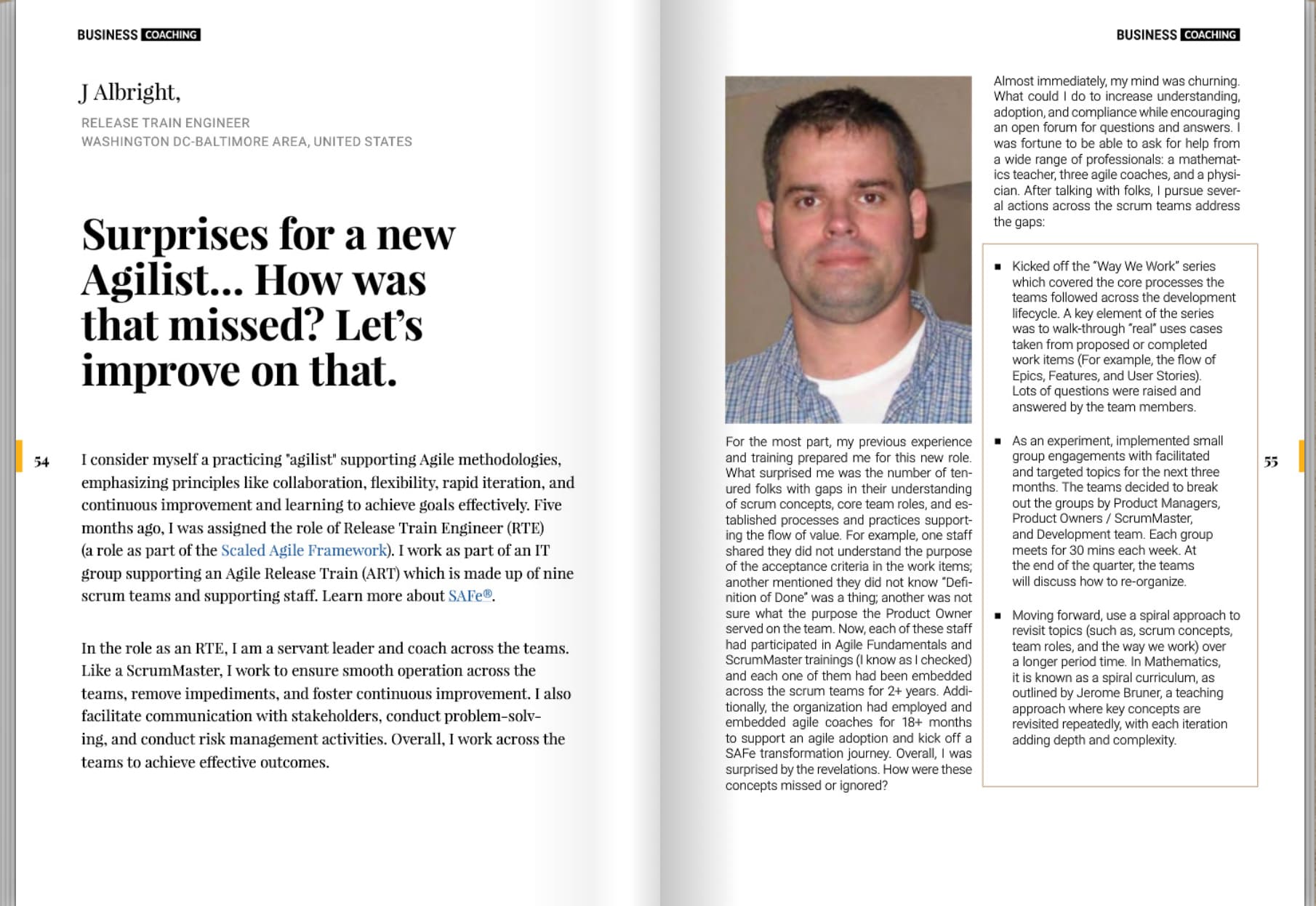
I consider myself a practicing “agilist” supporting Agile methodologies, emphasizing principles like collaboration, flexibility, rapid iteration, and continuous improvement and learning to achieve goals effectively. Five months ago, I was assigned the role of Release Train Engineer (RTE) (a role as part of the Scaled Agile Framework). I work as part of an IT group supporting an Agile Release Train (ART) which is made up of nine scrum teams and supporting staff. Learn more about SAFe®.
In the role as an RTE, I am a servant leader and coach across the teams. Like a ScrumMaster, I work to ensure smooth operation across the teams, remove impediments, and foster continuous improvement. I also facilitate communication with stakeholders, conduct problem-solving, and conduct risk management activities. Overall, I work across the teams to achieve effective outcomes.
For the most part, my previous experience and training prepared me for this new role. What surprised me was the number of tenured folks with gaps in their understanding of scrum concepts, core team roles, and established processes and practices supporting the flow of value. For example, one staff shared they did not understand the purpose of the acceptance criteria in the work items; another mentioned they did not know “Definition of Done” was a thing; another was not sure what the purpose the Product Owner served on the team. Now, each of these staff had participated in Agile Fundamentals and ScrumMaster trainings (I know as I checked) and each one of them had been embedded across the scrum teams for 2+ years. Additionally, the organization had employed and embedded agile coaches for 18+ months to support an agile adoption and kick off a SAFe transformation journey. Overall, I was surprised by the revelations. How were these concepts missed or ignored?

Almost immediately, my mind was churning. What could I do to increase understanding, adoption, and compliance while encouraging an open forum for questions and answers. I was fortune to be able to ask for help from a wide range of professionals: a mathematics teacher, three agile coaches, and a physician. After talking with folks, I pursue several actions across the scrum teams address the gaps:
- Kicked off the “Way We Work” series which covered the core processes the teams followed across the development lifecycle. A key element of the series was to walk-through “real” uses cases taken from proposed or completed work items (For example, the flow of Epics, Features, and User Stories). Lots of questions were raised and answered by the team members.
- As an experiment, implemented small group engagements with facilitated and targeted topics for the next three months. The teams decided to break out the groups by Product Managers, Product Owners / ScrumMaster, and Development team. Each group meets for 30 mins each week. At the end of the quarter, the teams will discuss how to re-organize.
- Moving forward, use a spiral approach to revisit topics (such as, scrum concepts, team roles, and the way we work) over a longer period time. In Mathematics, it is known as a spiral curriculum, as outlined by Jerome Bruner, a teaching approach where key concepts are revisited repeatedly, with each iteration adding depth and complexity.
Based on the targeted process training, small group feedback loops, and revisiting topics, in short period of time, we are seeing positive improvements:
- Participation and feedback increased during our weekly syncs. Previously, two or three people engaged in the discussion. Now, several raise their hand to contribute.
- Team members have started to challenge ideas with another perspective. A new theme has emerged: “it is ok to disagree; be curious!”
- Metrics for the flow of work have improved. For example, the number of late features dropped. Product Managers observed the teams are closing out work items without continued prompting. Previously, the teams did not view the administrative tasks, such as updating the agile tracking tool, as part of the work.
- Folks are more proactive in asking questions and suggesting topics for discussion and feedback. Now, we have a backlog of topics to engage.
So, all things considered, something that surprised me actually created an opportunity for improvement. With the actions taken by the teams, we have seen an increase in understanding and compliance with processes, expanded collaboration, increased the flow of value, and fostered an environment where asking questions is a good thing. While I did not figure out exactly “how” it happened, we found ways to overcome it.