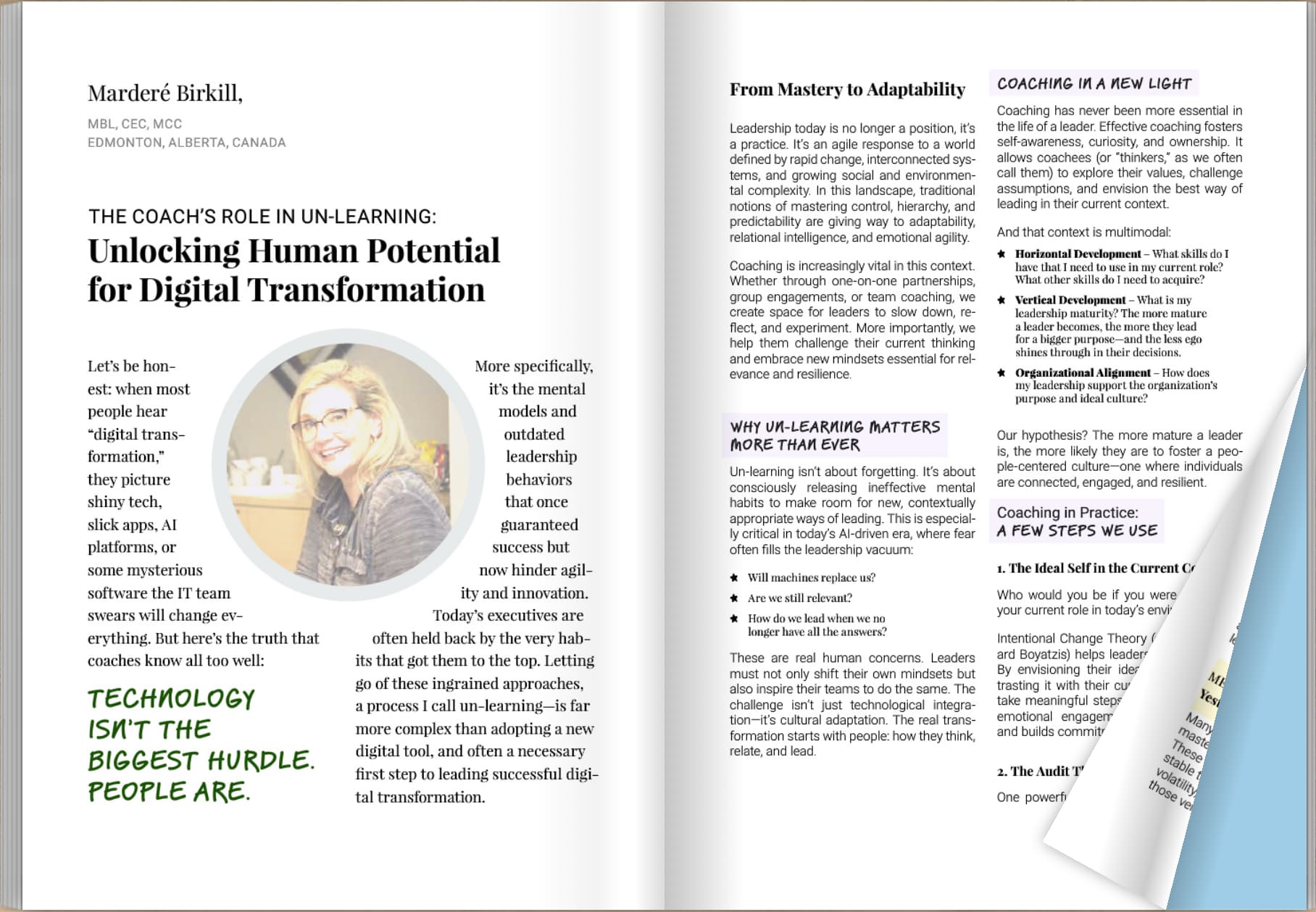
Let’s be honest: when most people hear “digital transformation,” they picture shiny tech, slick apps, AI platforms, or some mysterious software the IT team swears will change everything. But here’s the truth that coaches know all too well: technology isn’t the biggest hurdle. People are.
More specifically, it’s the mental models and outdated leadership behaviors that once guaranteed success but now hinder agility and innovation. Today’s executives are often held back by the very habits that got them to the top. Letting go of these ingrained approaches, a process I call un-learning—is far more complex than adopting a new digital tool, and often a necessary first step to leading successful digital transformation.
From Mastery to Adaptability
Leadership today is no longer a position, it’s a practice. It’s an agile response to a world defined by rapid change, interconnected systems, and growing social and environmental complexity. In this landscape, traditional notions of mastering control, hierarchy, and predictability are giving way to adaptability, relational intelligence, and emotional agility.
Coaching is increasingly vital in this context. Whether through one-on-one partnerships, group engagements, or team coaching, we create space for leaders to slow down, reflect, and experiment. More importantly, we help them challenge their current thinking and embrace new mindsets essential for relevance and resilience.
Why Un-Learning Matters More Than Ever
Un-learning isn’t about forgetting. It’s about consciously releasing ineffective mental habits to make room for new, contextually appropriate ways of leading. This is especially critical in today’s AI-driven era, where fear often fills the leadership vacuum:
- Will machines replace us?
- Are we still relevant?
- How do we lead when we no longer have all the answers?
These are real human concerns. Leaders must not only shift their own mindsets but also inspire their teams to do the same. The challenge isn’t just technological integration—it’s cultural adaptation. The real transformation starts with people: how they think, relate, and lead.
Coaching in a New Light
Coaching has never been more essential in the life of a leader. Effective coaching fosters self-awareness, curiosity, and ownership. It allows coachees (or “thinkers,” as we often call them) to explore their values, challenge assumptions, and envision the best way of leading in their current context.
And that context is multimodal:
- Horizontal Development – What skills do I have that I need to use in my current role? What other skills do I need to acquire?
- Vertical Development – What is my leadership maturity? The more mature a leader becomes, the more they lead for a bigger purpose—and the less ego shines through in their decisions.
- Organizational Alignment – How does my leadership support the organization’s purpose and ideal culture?
Our hypothesis? The more mature a leader is, the more likely they are to foster a people-centered culture—one where individuals are connected, engaged, and resilient.

Coaching in Practice: A Few Steps We Use
1. The Ideal Self in the Current Context
Who would you be if you were perfect for your current role in today’s environment?
Intentional Change Theory (coined by Richard Boyatzis) helps leaders bridge this gap. By envisioning their ideal future and contrasting it with their current state, they can take meaningful steps toward growth. This emotional engagement catalyzes change and builds commitment.
2. The Audit That Changes Everything
One powerful exercise we use is the Success-to-Obsolescence Audit. It’s a structured reflection that honors past achievements while making space for future leadership possibilities.
Here’s how it works:
- The Artifact of Success: Identify a past success and unpack the mental model behind it.
- The Environmental Shift: Assess how today’s context has changed, for example: faster communication, more complexity, greater uncertainty.
- The Obsolescence Test: Test old models against current realities. What no longer works? What’s being sacrificed?
- The People-Centered Reframe: Redefine the leader’s role, from controller to coach, from bottleneck to enabler.
This process allows leaders to grieve obsolete strategies while stepping into new, more adaptive ones.
Unlearning: The Hidden Key to Leading Digital Transformation
Let’s be real, when leaders hear “digital transformation,” the knee-jerk reaction is often to focus on the tools: new platforms, AI systems, automation. But for those of us in the coaching world, we know the truth runs deeper. Digital transformation isn’t about tech, it’s about people. More precisely, it’s about the ways people think, lead, and resist letting go of what used to work.
Mental Models: Yesterday’s Edge, Today’s Obstacle
Many senior leaders have built their careers mastering control, certainty, and efficiency. These approaches worked brilliantly in more stable times. But in a world characterized by volatility, ambiguity, and exponential change, those very habits become liabilities.
The hardest part? We’re not just asking leaders to learn, we’re asking them to unlearn.
Unlearning is the quiet revolution in leadership development. It’s the act of dismantling outdated mental models to make space for new thinking. And it’s far harder than installing a new platform. That’s where coaching comes in, not as a bandage, but as a transformative partnership.
Leadership Coaching: The Safe Space for Dangerous Questions
At its core, coaching offers a safe space for inquiry. Today’s leaders are under pressure to stay relevant, motivate anxious teams, and respond to emerging tech like AI without losing their human touch. It’s a lot. Coaching provides a structured pause, a moment to think, feel, and adapt.

In our coaching partnerships, we help leaders confront not just their goals, but the limiting beliefs and unconscious habits that stand in their way. Using models like Thoughts-Feelings-Actions (TFA), we shine light on the invisible narratives shaping behavior. Add in frameworks like Intentional Change Theory (ICT), and we equip leaders to envision new futures, compare them to present realities, and take intentional steps toward growth.
Final Thought
Digital transformation may start with technology, but it succeeds, or fails, based on human adaptability. Coaches are not just facilitators of change; we are architects of unlearning. And in a world where relevance is earned daily, that might just be the most important role of all.