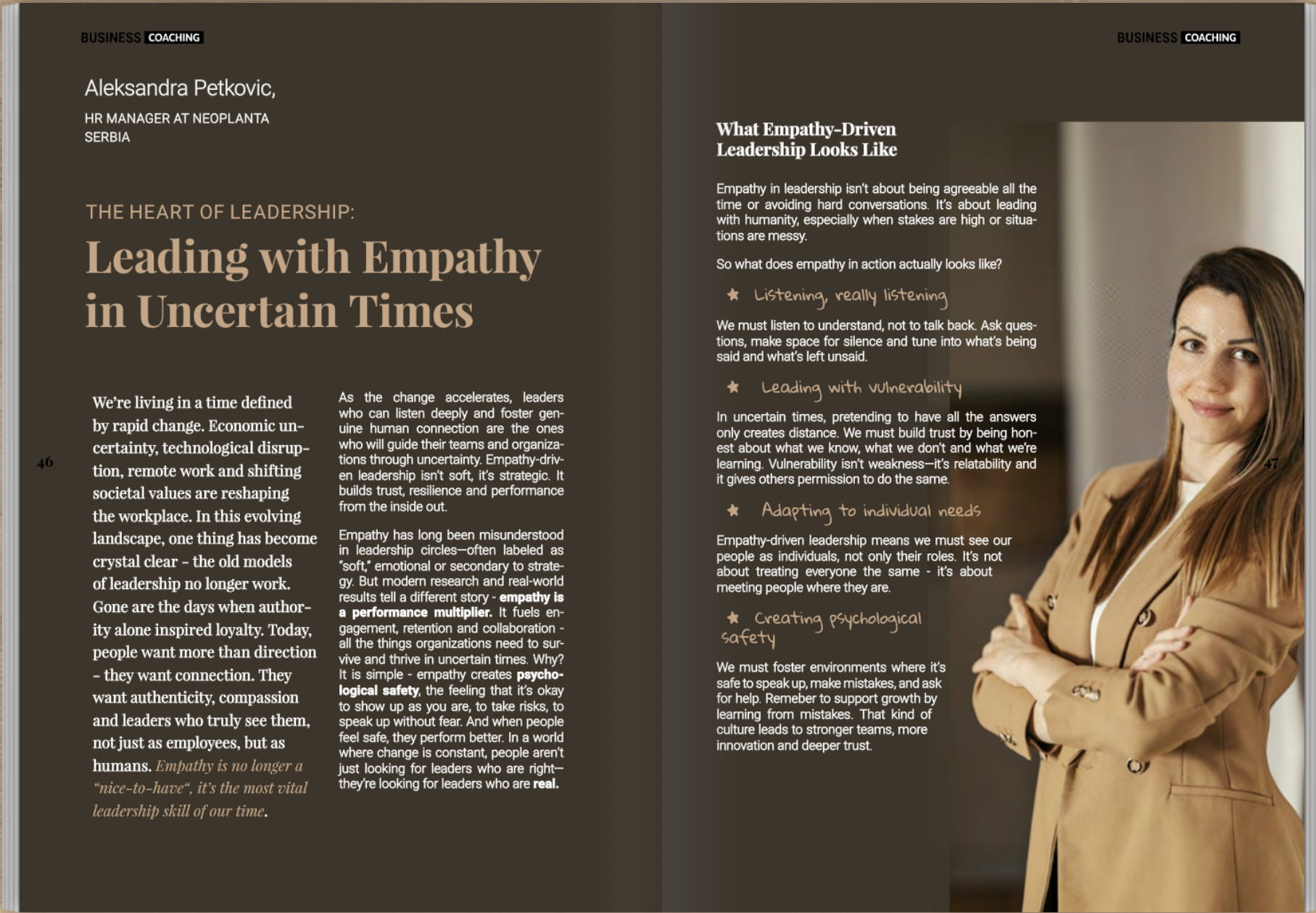
We’re living in a time defined by rapid change. Economic uncertainty, technological disruption, remote work and shifting societal values are reshaping the workplace. In this evolving landscape, one thing has become crystal clear – the old models of leadership no longer work. Gone are the days when authority alone inspired loyalty. Today, people want more than direction – they want connection. They want authenticity, compassion and leaders who truly see them, not just as employees, but as humans. Empathy is no longer a “nice-to-have“, it’s the most vital leadership skill of our time.
As the change accelerates, leaders who can listen deeply and foster genuine human connection are the ones who will guide their teams and organizations through uncertainty. Empathy-driven leadership isn’t soft, it’s strategic. It builds trust, resilience and performance from the inside out.
Empathy has long been misunderstood in leadership circles—often labeled as “soft,” emotional or secondary to strategy. But modern research and real-world results tell a different story – empathy is a performance multiplier. It fuels engagement, retention and collaboration – all the things organizations need to survive and thrive in uncertain times. Why? It is simple – empathy creates psychological safety, the feeling that it’s okay to show up as you are, to take risks, to speak up without fear. And when people feel safe, they perform better. In a world where change is constant, people aren’t just looking for leaders who are right—they’re looking for leaders who are real.
What Empathy-Driven Leadership Looks Like
Empathy in leadership isn’t about being agreeable all the time or avoiding hard conversations. It’s about leading with humanity, especially when stakes are high or situations are messy.
So what does empathy in action actually looks like?
- Listening, really listening
We must listen to understand, not to talk back. Ask questions, make space for silence and tune into what’s being said and what’s left unsaid.
- Leading with vulnerability
In uncertain times, pretending to have all the answers only creates distance. We must build trust by being honest about what we know, what we don’t and what we’re learning. Vulnerability isn’t weakness—it’s relatability and it gives others permission to do the same.
- Adapting to individual needs
Empathy-driven leadership means we must see our people as individuals, not only their roles. It’s not about treating everyone the same – it’s about meeting people where they are.
- Creating psychological safety
We must foster environments where it’s safe to speak up, make mistakes, and ask for help. Remeber to support growth by learning from mistakes. That kind of culture leads to stronger teams, more innovation and deeper trust.
Leading through uncertainty in the FMCG industry
Uncertainty is nothing new in FMCG. From global supply chain disruptions to rapidly shifting consumer preferences, it has always been part of the game. But in recent years, the pace and complexity of change have accelerated and so has the need for a new kind of leadership. In this environment, the strongest leaders are not those who promise certainty, but those who provide clarity, calm and connection.

When the path ahead feels foggy, communication becomes your most powerful tool. Your team doesn’t expect you to have all the answers, but they do need to know what’s happening, what you’re prioritizing and how decisions are being made. Frequent, honest updates create trust and alignment, even when things are changing fast.
FMCG is driven by numbers – sales, speed, efficiency. But behind every metric is a human being with their own challenges. We need to understand that people won’t perform at their best if they’re overwhelmed, anxious or disconnected. Taking time to check in, listen and support well-being isn’t just kind—it’s strategic.
Empower agility – do not micromanage. When there are clearly set priorities and empowered team, they can move fast and make smart calls on the ground. It’s not about control, it’s about confidence in your people. When people know why they do what they do, they’re more resilient and adaptive. We must lead with values, not just tactics.The truth is, uncertainty isn’t going away, but neither is the power of human connection!