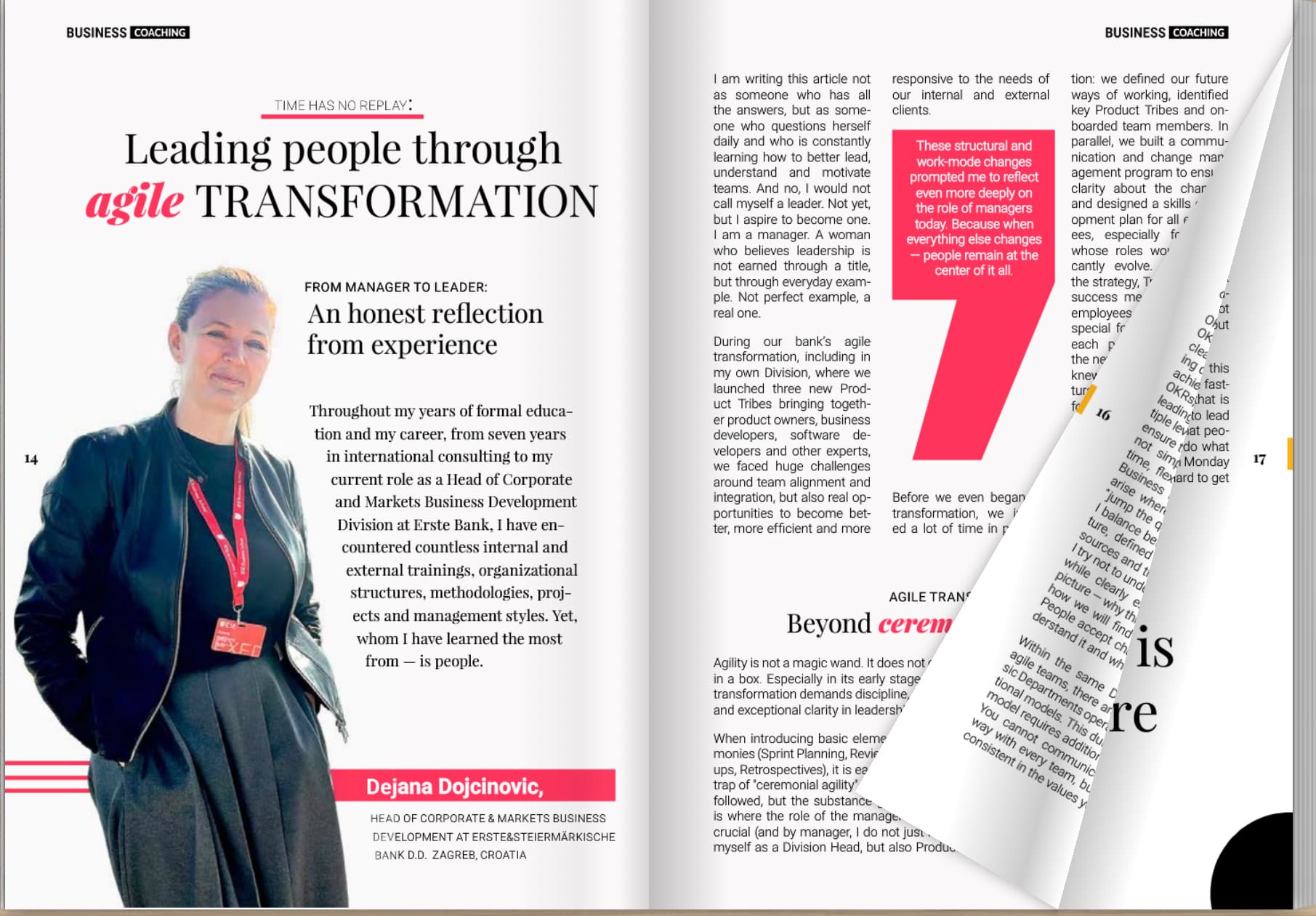
From manager to leader: An honest reflection from experience
Throughout my years of formal education and my career, from seven years in international consulting to my current role as a Head of Corporate and Markets Business Development Division at Erste Bank, I have encountered countless internal and external trainings, organizational structures, methodologies, projects and management styles. Yet, whom I have learned the most from — is people.
I am writing this article not as someone who has all the answers, but as someone who questions herself daily and who is constantly learning how to better lead, understand and motivate teams. And no, I would not call myself a leader. Not yet, but I aspire to become one. I am a manager. A woman who believes leadership is not earned through a title, but through everyday example. Not perfect example, a real one.
During our bank’s agile transformation, including in my own Division, where we launched three new Product Tribes bringing together product owners, business developers, software developers and other experts, we faced huge challenges around team alignment and integration, but also real opportunities to become better, more efficient and more responsive to the needs of our internal and external clients. These structural and work-mode changes prompted me to reflect even more deeply on the role of managers today. Because when everything else changes — people remain at the center of it all.
Before we even began the transformation, we invested a lot of time in preparation: we defined our future ways of working, identified key Product Tribes and onboarded team members. In parallel, we built a communication and change management program to ensure clarity about the changes and designed a skills development plan for all employees, especially for those whose roles would significantly evolve. We shared the strategy, Tribe goals and success measures with all employees, while placing special focus on explaining each person’s role within the new way of working. We knew that without this structural groundwork, the transformation would lack a solid foundation. Yet even with the best preparation, defining and refining everyone’s new role remains a continuous journey — people remain at the center of it all.
Agile transformation: Beyond ceremonies and sprints
Agility is not a magic wand. It does not come in a box. Especially in its early stages, agile transformation demands discipline, patience and exceptional clarity in leadership.
When introducing basic elements like ceremonies (Sprint Planning, Review, Daily Stand-ups, Retrospectives), it is easy to fall into the trap of “ceremonial agility”, where the form is followed, but the substance gets lost. That is where the role of the manager becomes crucial (and by manager, I do not just mean myself as a Division Head, but also Product Owners and Tribe Leads): not as a master of ceremonies, but as a guardian of alignment. It means constantly listening: do people feel a sense of purpose? Is the backlog a living organism? Do they know why they are doing what they are doing?
One of my biggest challenges. and it remains ongoing, is how to prevent our Tribes from becoming “new silos.” It sounds paradoxical, but even agile teams can close themselves off into micro-worlds, especially if strong internal dynamics develop. This can be a serious problem when teams are working on interconnected topics that together form a single service for the client, which is the case for us, as we collectively deliver credit and transaction processes for Corporate clients.
To prevent this, we implemented horizontal communication, coordinating between Tribe Leads within the Division, conducting joint strategic planning, and introducing OKRs (Objectives and Key Results) that are not only “vertical” but also foster inter-team connectivity.
OKRs are an art of their own. A good OKR is not just a numeric goal, it must clearly articulate why something is being done and what change we want to achieve. That is why when we define OKRs, as well as the quarterly goals leading up to them, I try to involve multiple levels of Division management, to ensure that ownership of goals is real, not simply delegated. At the same time, flexibility must remain central. Business is unpredictable, situations arise where a new priority needs to “jump the queue.” In those moments, I balance between the planned structure, defined backlogs, allocated resources and the need to pivot quickly. I try not to undermine the team’s trust, while clearly explaining the broader picture — why things are changing and how we will find a solution together. People accept change when they understand it and when they feel heard.
Within the same Division, alongside agile teams, there are still some classic Departments operating under traditional models. This dual management model requires additional adjustment. You cannot communicate the same way with every team, but you can be consistent in the values you uphold.
Challenges: What if not everyone is “All In”?
Agile structures assume high levels of autonomy and intrinsic motivation. But what happens when that is missing? When people enjoy the benefits of agility, flexibility and freedom, but do not take on the responsibility that comes with it? Some employees want leadership, clear guidance and a framework that shields them from uncertainty. Others seek autonomy, room for independent decisions and a sense of ownership.
That is where the challenge lies for any manager, to recognize these nuances in people, while maintaining a fair and effective system that delivers results. Six months into our agile transformation, I am still learning every day.
From my consulting days, I learned that organizational agility does not mean every individual will move at the same speed. As Roland Berger Strategy Consultants highlight in their work on transformational leadership, the strength of leadership lies in defining a clear purpose, but also in creating a system that acknowledges different types of motivation, from highly self-driven individuals to those who perform better with structural support.
Agility does not mean anarchy. It demands discipline, not the kind that suffocates, but the kind that guides and gives structure. As managers, we walk a fine line between empathy and decisiveness. If we tolerate disengagement for too long, we send a message that it is acceptable. If we react too harshly, we lose people. The solution is not in being overly strict, but in being clear and fair. In setting expectations — with empathy.

Leading calmly, decisively and with purpose
I do not want to romanticize my role. Leading people, especially within an agile organization, is not just about “inspiration and support.” Sometimes it demands unpopular decisions, and sometimes, a firmness that does not feel easy.
I want my teams to be the best, but not at any cost.
I still believe, and not as an empty phrase, that people need to know why they are doing something, what they are achieving, whom it serves and where their time and knowledge are being invested. Lifetime passes and there are no replays. This means that if someone, despite our efforts, does not find meaning or fulfilment in their work, it is important to recognize that, not out of frustration, but out of respect for their time. I believe trust, support and integrity are not weaknesses, they are the foundations of true strength. And that when people feel you genuinely care, they respond. Not always, not everyone, but most do.
That is why I choose this path. It may not be the fastest, but it is the one that is closest to my heart: to lead with humanity. So that people know why they do what they do, and that on Monday morning, it is not hard to get out of bed.
Because Monday is coming. And there are no replays.