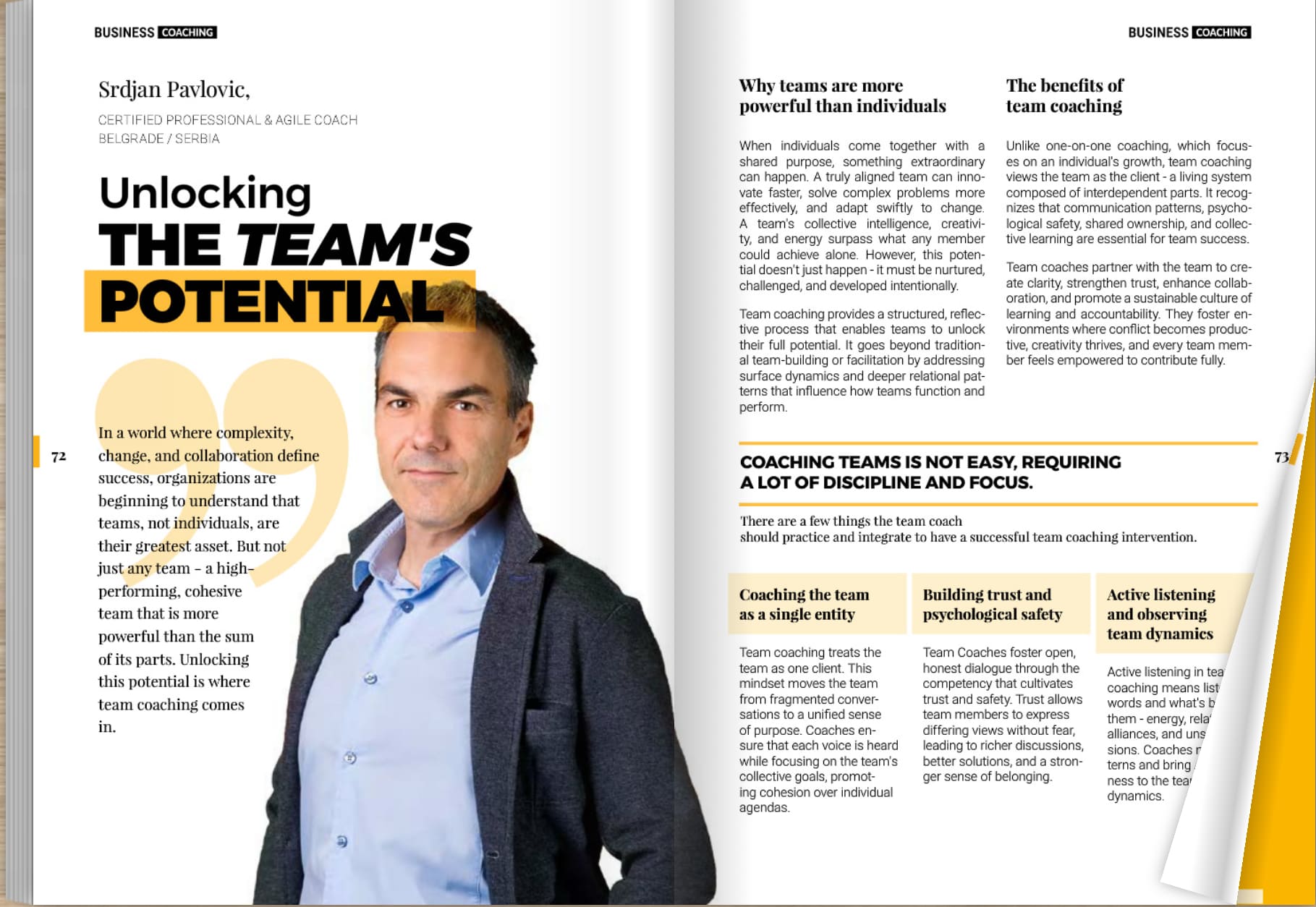
In a world where complexity, change, and collaboration define success, organizations are beginning to understand that teams, not individuals, are their greatest asset. But not just any team – a high-performing, cohesive team that is more powerful than the sum of its parts. Unlocking this potential is where team coaching comes in.
Why teams are more powerful than individuals
When individuals come together with a shared purpose, something extraordinary can happen. A truly aligned team can innovate faster, solve complex problems more effectively, and adapt swiftly to change. A team’s collective intelligence, creativity, and energy surpass what any member could achieve alone. However, this potential doesn’t just happen – it must be nurtured, challenged, and developed intentionally.
Team coaching provides a structured, reflective process that enables teams to unlock their full potential. It goes beyond traditional team-building or facilitation by addressing surface dynamics and deeper relational patterns that influence how teams function and perform.
The benefits of team coaching
Unlike one-on-one coaching, which focuses on an individual’s growth, team coaching views the team as the client – a living system composed of interdependent parts. It recognizes that communication patterns, psychological safety, shared ownership, and collective learning are essential for team success.
Team coaches partner with the team to create clarity, strengthen trust, enhance collaboration, and promote a sustainable culture of learning and accountability. They foster environments where conflict becomes productive, creativity thrives, and every team member feels empowered to contribute fully.
Coaching teams is not easy, requiring a lot of discipline and focus.
There are a few things the team coach should practice and integrate to have a successful team coaching intervention.
- Coaching the team as a single entity
Team coaching treats the team as one client. This mindset moves the team from fragmented conversations to a unified sense of purpose. Coaches ensure that each voice is heard while focusing on the team’s collective goals, promoting cohesion over individual agendas.
- Building trust and psychological safety
Team Coaches foster open, honest dialogue through the competency that cultivates trust and safety. Trust allows team members to express differing views without fear, leading to richer discussions, better solutions, and a stronger sense of belonging.
- Active listening and observing team dynamics
Active listening in team coaching means listening to words and what’s beneath them – energy, relationships, alliances, and unspoken tensions. Coaches notice patterns and bring Awareness to the team’s relational dynamics.
- Facilitating collective awareness
Coaches challenge assumptions and help teams explore beyond their habitual thinking. This allows for breakthrough insights, greater ownership of team challenges, and the development of more innovative solutions.
- Partnering for clear agreements
Establishes and maintains agreements and ensures everyone in the system understands the objectives, roles, and responsibilities. This clarity prevents confusion, misalignment, and wasted effort.
- Maintaining presence and resilience
A team coach must be fully present and grounded, even amidst group complexity and emotion. By modeling calmness and focus, the team coach helps the team develop its emotional resilience.
- Supporting growth and autonomy
Finally, the team coach encourages teams to transform learning into action. Coaches empower teams to identify their next steps, increasing autonomy and reducing dependence on external intervention.
The lasting impact of team coaching
The beauty of team coaching lies in its ripple effects. When a team becomes more self-aware, communicative, resilient, and aligned, it doesn’t just perform better – it transforms the organization around it. Collaboration improves, silos break down, and a culture of trust, innovation, and shared leadership emerges.
Organizations that invest in team coaching and certified team coaches invest in a future where their teams don’t just survive – they thrive.
As we step into a future that demands even greater collaboration and adaptability, one thing is clear: strong teams, empowered by skilled team coaches, will be the driving force behind tomorrow’s success stories.