Introduction
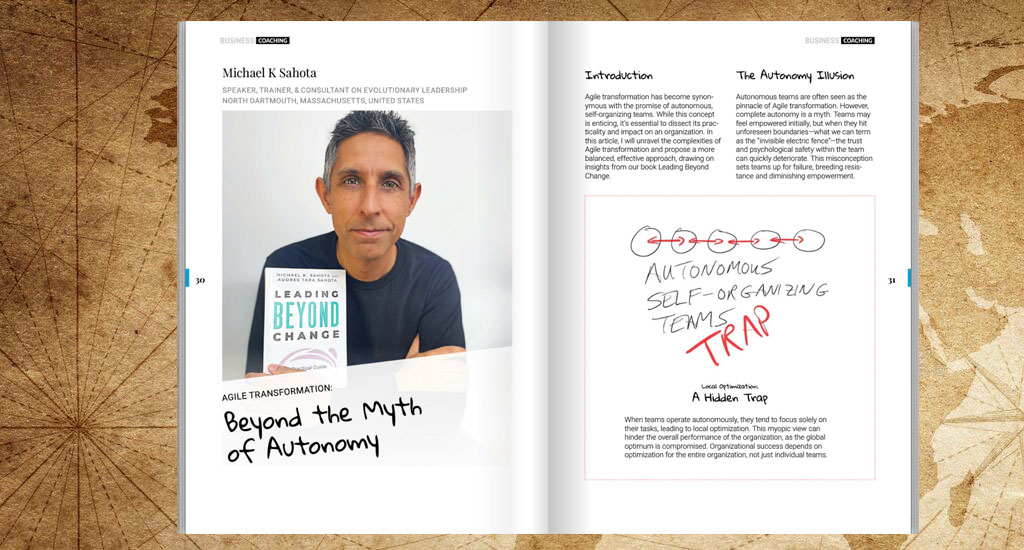
Agile transformation has become synonymous with the promise of autonomous, self-organizing teams. While this concept is enticing, it’s essential to dissect its practicality and impact on an organization. In this article, I will unravel the complexities of Agile transformation and propose a more balanced, effective approach, drawing on insights from our book Leading Beyond Change.
The Autonomy Illusion
Autonomous teams are often seen as the pinnacle of Agile transformation. However, complete autonomy is a myth. Teams may feel empowered initially, but when they hit unforeseen boundaries—what we can term as the “invisible electric fence”—the trust and psychological safety within the team can quickly deteriorate. This misconception sets teams up for failure, breeding resistance and diminishing empowerment.

Local Optimization: A Hidden Trap
When teams operate autonomously, they tend to focus solely on their tasks, leading to local optimization. This myopic view can hinder the overall performance of the organization, as the global optimum is compromised. Organizational success depends on optimization for the entire organization, not just individual teams.
Self-Organizing: A Double-Edged Sword
Self-organizing teams can yield incredible results when comprised of highly responsible and mature individuals. However, this scenario is rare. For the majority, a sudden shift to self-organization can be overwhelming and counterproductive. It’s crucial to approach self-organization as a long-term goal, gradually increasing autonomy and responsibility as people are developed.
Rethinking Agile Transformation
So, how did autonomous, self-organizing teams become the hallmark of Agile? The popularity of Scrum, a widely adopted Agile framework, plays a significant role. However, it’s important to highlight that Scrum encourages teams to be self-managing within their confines, not fully autonomous.

To foster genuine Agile transformation, we should aim for interrelated, responsible teams, aligning with the SELF Framework‘s maps and tools to create high-performance organizations. These teams optimize for the organization as a whole, understanding their role within the larger ecosystem. This shift from autonomy to interrelatedness, and from self-organization to responsibility, is key to achieving sustainable Agile transformation.
Conclusion
Agile transformation is a journey, not a destination. It requires a shift from the pursuit of autonomy to cultivating interrelated, responsible teams. By aligning our teams with the broader organizational goals and fostering a culture of mutual support and collaboration, we can unlock the true potential of Agile transformation, leading us beyond the myth of autonomy.