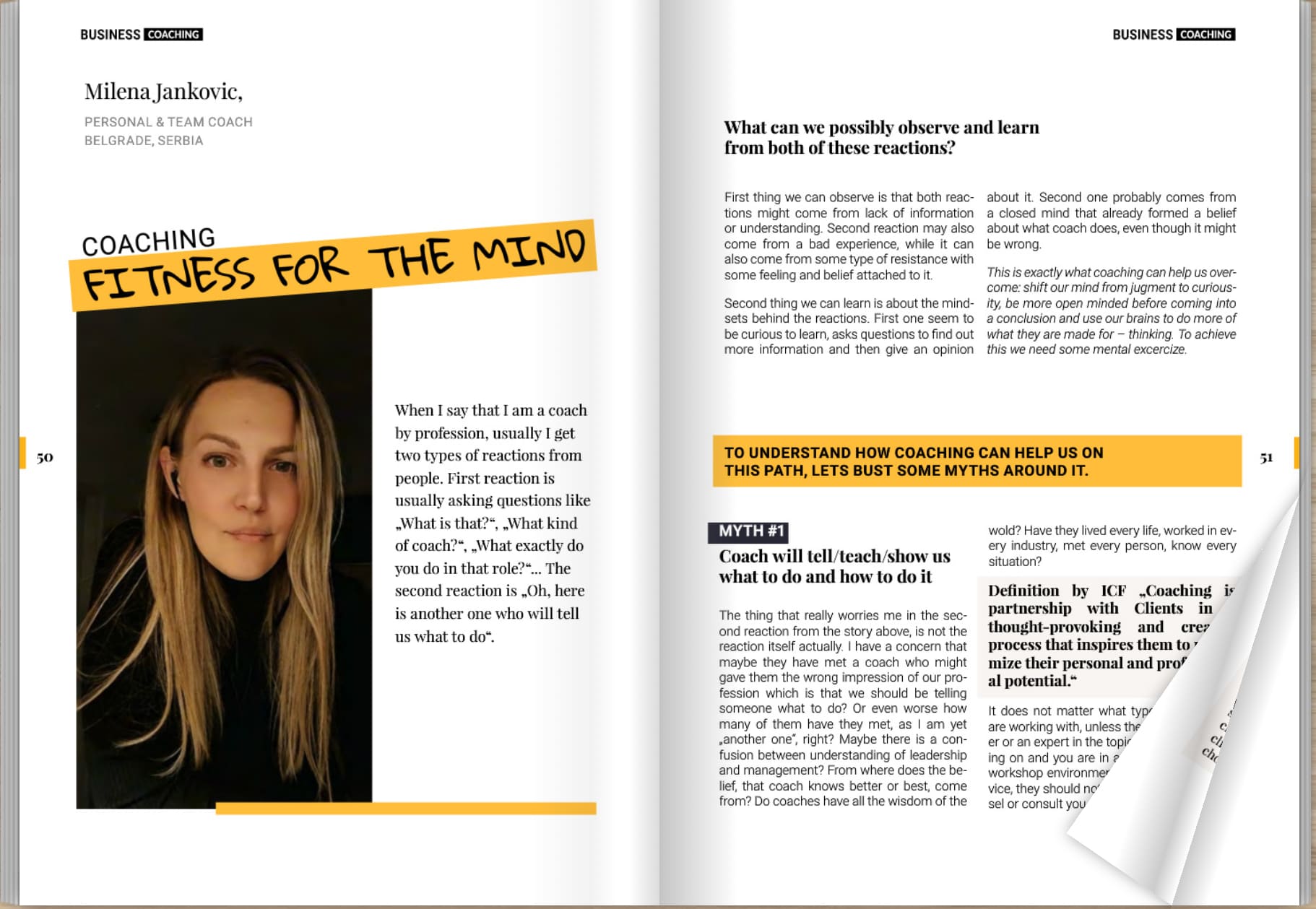
When I say that I am a coach by profession, usually I get two types of reactions from people. First reaction is usually asking questions like „What is that?“, „What kind of coach?“, „What exactly do you do in that role?“… The second reaction is „Oh, here is another one who will tell us what to do“.
What can we possibly observe and learn from both of these reactions?
First thing we can observe is that both reactions might come from lack of information or understanding. Second reaction may also come from a bad experience, while it can also come from some type of resistance with some feeling and belief attached to it.
Second thing we can learn is about the mindsets behind the reactions. First one seem to be curious to learn, asks questions to find out more information and then give an opinion about it. Second one probably comes from a closed mind that already formed a belief about what coach does, even though it might be wrong.
This is exactly what coaching can help us overcome: shift our mind from jugment to curiousity, be more open minded before coming into a conclusion and use our brains to do more of what they are made for – thinking. To achieve this we need some mental excercize.
To understand how coaching can help us on this path, lets bust some myths around it.
Myth #1 Coach will tell/teach/show us what to do and how to do it
The thing that really worries me in the second reaction from the story above, is not the reaction itself actually. I have a concern that maybe they have met a coach who might gave them the wrong impression of our profession which is that we should be telling someone what to do? Or even worse how many of them have they met, as I am yet „another one“, right? Maybe there is a confusion between understanding of leadership and management? From where does the belief, that coach knows better or best, come from? Do coaches have all the wisdom of the wold? Have they lived every life, worked in every industry, met every person, know every situation?
Definition by ICF„Coaching is partnership with Clients in a thought-provoking and creative process that inspires them to maximize their personal and professional potential.“
It does not matter what type of coach you are working with, unless they are also a trainer or an expert in the topic that you are working on and you are in a training, teaching or workshop environment, or you asked for advice, they should not tell, teach, advise, counsel or consult you what to do, fullstop and no doubt about it. Coach should never direct, lead or influence Clients in making decisions. As a coachee, you are the owner of your own identity, value system, attitudes, behaviours and reactions. You are the only one who is held responsible and accountable for your own thoughts, decisions, actions etc. You need to do the hard work, which is the thinking. Nobody can tell you what should you do best even if they may have been in the exact same situation, but they have never lived your life or been in your mind under the exact same cirmumstances. You have all the knowledge you need to make a decision for yourself. So, coaching can teach you a lot of things, but only if you want to be taught. You do receive new learnings from the process, but not by the coach. One of the best motivational coaching acronym to work by is WAIT – why am I talking? So Client does the talking, Coach does the observing, listening and asking questions..
ICF CORE COMPETENCEs
- Foundation 1. Demonstrates Ethical Practice Definition: Understands and consistently applies coaching ethics and standards of coaching 6. Maintains the distinctions between coaching, consulting, psychotherapy and other support professions 7. Refers clients to other support professionals, as appropriate
- Foundation 2. Embodies a Coaching Mindset Definition: Develops and maintains a mindset that is open, curious, flexible and client-centered 1. Acknowledges that clients are responsible for their own choices
Myth #2 Coaches do nothing and silence is awkward
You must be asking yourself „wait, if coach is not telling, teaching or showing me anything what am I paying him for when I am doing all the work?“

Lets shortly reflect on the second reaction from the intro story. For various reasons when in a situation where we lack information or understanding or we come from a feeling we can easily jump right into an assumption or a judgement. As this is an instant reaction without thinking, a habit, we fail to remember that we have more options to choose from. We fail to observe what is happening and to become aware of our instant reactions.
This is exactly why we want to obtain a growth mindset and that can be practiced with coaching. Between a statement or a question and a reaction or a response, there is a space. Coaching teaches us how to use that space. How to stop, think, reflect and then respond or react. In the coaching session, coach support us by guiding us through that process of questions and silence for us. They hold the space for us to reflect. That is why silence is golden and not awkward.
Someone can think „So what I can do it on my own“. True and people use journaling for that mostly. But even the most reflective people sometimes need to hear the words out loud. Other times they need just to understand that they do not know everything and there is a possible different perspective to it still. The coach is here supporting with silence, but also challenging with powerful questions, making us think in a different way than it is logical or usual for us.
ICF CORE COMPETENCEs
B. Co-Creating the Relationship
5. Maintains Presence Definition: Is fully conscious and present with the client, employing a style that is open, flexible, grounded and confident 6. Creates or allows space for silence, pause or reflection
Mental excercize to start with and stay fit
Do you sometimes do seasonal cleaning of the closet/attic or some other storage? What do you do there usually? Remove what you do not need, maybe change the space and order for some things, or you just repack and clean the mess, right? After that you realise how much more space, room and capacity you actually have for some other things you like, and it is far more cleaner than before, no? Ok so why do we not find it equaly important to do this excercize with our brain, thoughts and emotions?
Our brain stores a lot of things, but some of the information can be outdated and does not serve the point anymore. The storage may be full, somewhere overloaded and messy, meaning it is in desperate need of some cleaning and dusting, repacking and restacking of the used space. And most importantly throwing out things that are unsused or unimportant for everyday functioning and future plans. So try to clean up your thinking space first and be amazed how much more capacity for the new information and decision making you will have.
How can we help ourselves with the cleaning of the brain space? By doing the reflections on coaching and by ourselves with journaling. That is where coaches comes in support. To help your mind stay fit to the purpose. And they will not tell you what to do, but you need to use that silence for the hard work. Mental excercize is equally important as the one for the body. It is a whole system that you need to serve your purpose, so stay fit!